
Let’s say you’re looking at a new idea…
Management just left (or more likely fired)
Revenue, margins, and earnings are falling badly
The share price is down 30-40% over the past year
You can’t even reliably value the business since earnings went negative
Before taking a quick pass, it might be worth seeing if there’s a viable turnaround story developing…

What’s a turnaround?
In One Up On Wall Street, Peter Lynch said about turnarounds: “These aren’t cyclicals that rebound; these are potential fatalities.”
Bankruptcy is the extreme case, but I’d describe them more as:
Turnaround — a business whose operating or financial performance has materially worsened, but where specific actions within management’s control could get the company back to sustainable profitability and cash flow
While there’s no universal definition for a turnaround, here are some things I look for to qualify these setups:
Revenue, margins, cash flow and/or earnings are usually declining (or turning from profitable to unprofitable)
The balance sheet is worsening and leverage is ticking higher (usually a combination of lower earnings and/or lack of cash flow)
An acquisition, roll-up attempt, rapid expansion, market/product pivot, etc. is blowing up
Management team or board members are turning over rapidly
There is an identifiable/controllable path from today’s bad economics back to acceptable performance
The last point might be the only one that matters.
It’s easy to find companies where the fundamentals suck, but if you’re expecting a turn, then you want to see management closing 100 stores, shedding $50m in overhead, and paying down $200m in debt. The thesis can’t be: “demand for Yellow Pages should bounce back next year.”
So a turnaround = actually fixable (i.e. within management’s control) versus a macro/cyclical/secular issue.
Some rules for turnaround investing…
It can pay to wait — As Peter Lynch described in OUOWS, sometimes it’s better to wait for the “turn” to materialize than try to catch it too early. Yes, you might be giving up some upside (perhaps significant upside) but you’re reducing the chance of a total blowup.
The non-fundamental stuff matters a lot — Is management buying shares on the open market? Does the operational plan make sense? Are there activists or other shareholders involved? Is management taking the situation seriously enough and willing to make hard and fast decisions?
Watch for leases (and other fixed costs) — High fixed cost business models are much harder to fix quickly. With retailers, watch for the lease schedule. When a company is locked into leases for multiple years and the business is losing money, then you probably have an unfixable problem on your hands. GameStop is one of the best examples I’ve ever seen of a favorable lease situation. They had 40 to 50% of their leases up for renewal each year over a 5 to 8 year stretch which allowed them to walk away from unprofitable stores fast.
Does the plan make sense — Make sure the company has a sensible turnaround plan (or any plan at all!). Hoping for a turn on a single new product launch or rebounding demand isn’t something you want to hang your hat on. Look for self-help operational tactics like store/plant closures, headcount reductions, walking away from unprofitable business, SKU rationalization, etc. (more on this later).
Make sure the business/situation is fixable — If you’re dealing with a structural or secular issue, or a (very) deep pile of debt, then you might be waiting for a turn that never comes. The Yellow Pages does not qualify as a turnaround.
Runway matters — Next to a fixable situation, flexibility and time to execute are paramount. It’s really tough to fix a horrendous balance sheet. As I’m writing this, Leslie’s (pool supplies retailer) is filing for bankruptcy with ~$750m debt and an estimated $30m EBITDA. There’s almost no room to maneuver in that situation.
Where to find turnarounds…
Think of running a stock screen for the inverse of “good” financial performance.
Here’s a basic screen that should turn up some distressed companies:
Start with your desired universe (I used the Russell 3000 all-cap index)
3 years of positive net income (your choice on adjusted vs. non-adjusted)
2 quarters of net losses
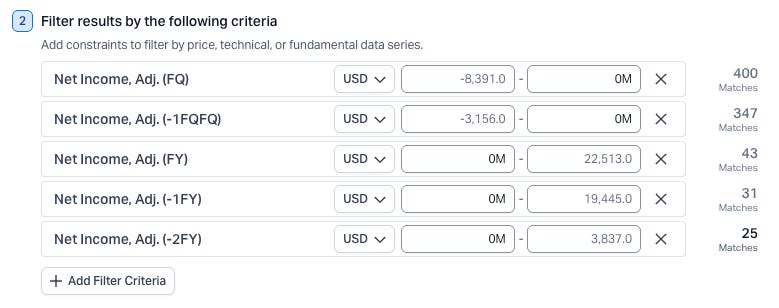
Running this screen today (late September 2026) produced 25 decent turnaround candidates like Whirlpool, Alaska Air, Vital Farms, etc. whose shares are collectively down 30-70% over the past year. (It also turned up a turnaround idea I currently own!)
Alternatively, you could mix in:
Gross margins, operating margins, or net margins falling by 200-500bps compared to recent 3-year averages
A major valuation re-rating compared to 3-5 year history (i.e. a stock moving from 20x earnings to 10x earnings or less)
Revenue moving from consistently growing to consistently shrinking
More often, I’m building my top of funnel from the beaten down category like 52 week lows or share prices that are declining 10 to 30% on a single event
Qualitative news flow can be helpful here too: headcount reductions of 10% or more, headlines about plant or store closures, etc.
Other signs a company might be on the cusp of a turn could be when an activist gets involved or if management starts buying shares in the open market. Those are probably your best tell tale signs that results could be turning the corner.
Case studies
The root of almost all turnaround execution is simplification or “getting back to the core.” Here are some tactical items with examples to watch for:
(1) Shedding unprofitable customers
From 2014-2016, Quest Resource Holdings (QRHC) was consistently doing $14m gross profit on $170-180m annual revenue (8% gross margins).
Growth was stalling and earnings compressing. Quest brought in a new CEO early 2016 who found that several customer contracts were losing money for the company. His first move was to walk away from a quarter of annual revenue in 2017. Then another quarter in 2018, and another 5% in 2019. So peak-to-trough revenue was down almost 50% from 2016-2019.
But look what happened to gross margins & profit:
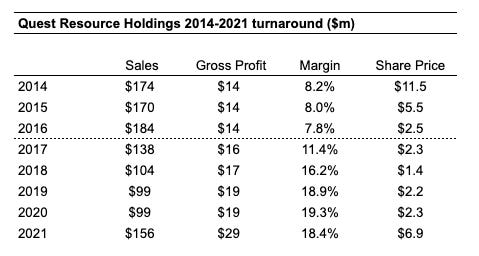
Margins steadily grew and the company repositioned itself to profitably absorb an acquisition in 2021. Shares went from $1.40 at the end of 2018 to nearly $7 by 2021 (a 5-bagger).
(2) Closing unprofitable locations
This one is critical for struggling retailers.
Look at the table below showing lease expirations for GameStop (GME) and Circuit City stores during their respective turnaround periods:
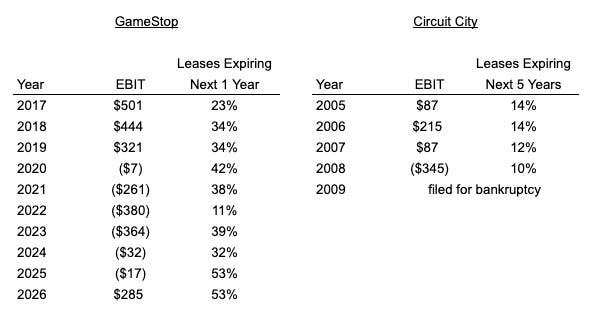
GameStop went from 7,500 locations in FY2017 to 2,200 by FY2026 (a 70% reduction) because they had tons of stores up for renewal every year. Circuit City had mounting losses, but zero store flexibility with only 10% of their locations up for renewal over the next 5-year period!
There are trade-offs in having short-term leases (it’s usually more expensive from a rent standpoint) but the flexibility is invaluable during a turnaround. Be sure to check the Properties section of the 10-K.
Build-A-Bear (BBW) was another great example moving from a $50m loss in 2012 to $27m net income in 2015 with virtually zero change in revenue. Shares jumped from $4 to $20 (a 5-bagger).
(3) Simplification
Watch for companies selling underperforming brands, reducing their SKU count / product portfolio, or getting out of business lines entirely. These tactics are designed to refocus companies on what they do best (or where they make the most money).
Former media exec Ynon Kreiz stepped into the CEO role at toymaker Mattel in 2018 at a time when the company was losing money, had barely positive EBITDA, and leverage was pushing 25x.
His plan involved $650m of cost savings (including reducing their non-manufacturing headcount by 33%), but it also involved reducing SKU count by 30% and exiting 5 owned & operated plants. The goal was to focus on “power brands” like Barbie, Hot Wheels, and Fisher-Price.
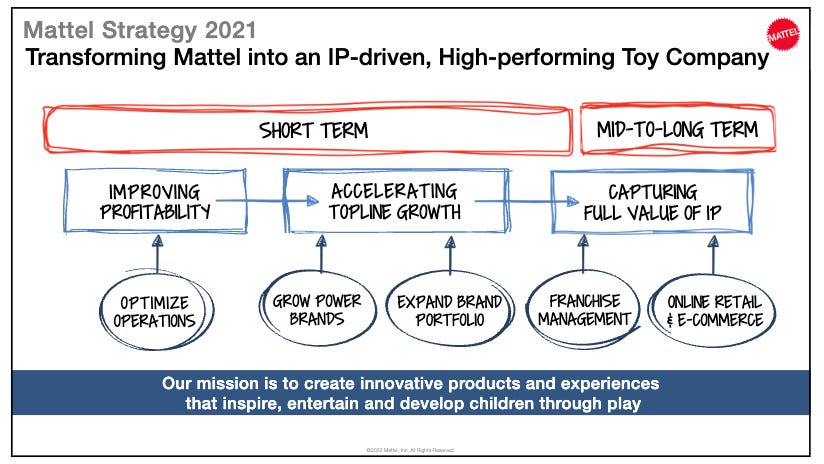
Here were the results a few years later:
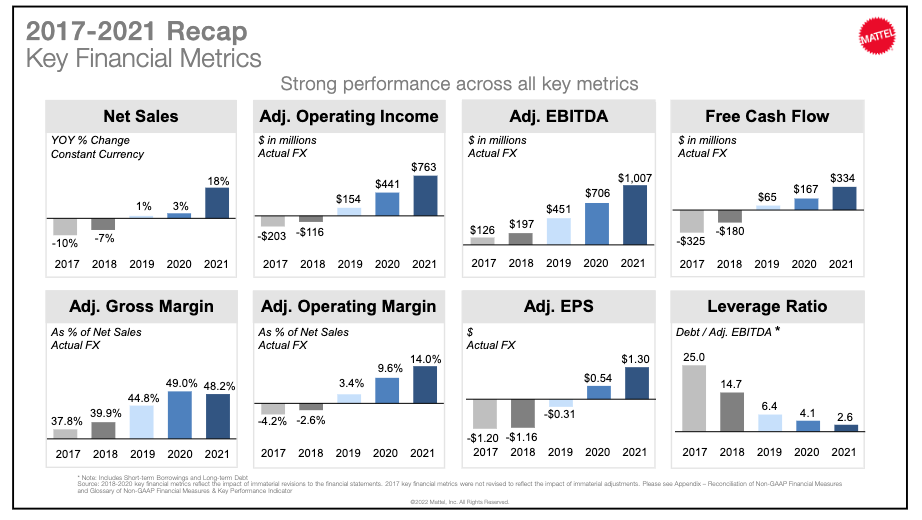
This is objectively stellar financial performance for a turnaround.
COVID happened in the midst of this turn and likely affected share price performance. The stock went from ~$14 at the time Ynon started in 2018 to around $26 in mid-2022 (+85%).
Plenty of others have gone through a successful “simplification” effort — GE under Larry Culp ended with a 3-way spin-off and P&G which reduced brands from 100 to 65 including a sale of Duracell to Berkshire and some beauty brands sold to Coty (P&G operating margins went from ~18% to ~24% during the 2014-2018 period).
(4) Cutting overhead and headcount
3G Capital, with their “zero based budgeting” approach, are probably the poster child for intensive overhead management. At Kraft Heinz they cut overhead from $2.9bn in 2016 to $2.1bn in 2017 and Burger King went from $500m to $238m in 2010.
Before the iPhone took the world by storm, BlackBerry (BB) was cranking out cell phones at a massive profit (you already know what happened once Apple released the iPhone).
So in 2013, the company announced a massive 40% headcount reduction, I don’t think I’ve ever seen one as large as this, and other cost cutting measures.
A few years later, they reduced the workforce by more than 80%, but operating income still wasn’t sustainably positive.
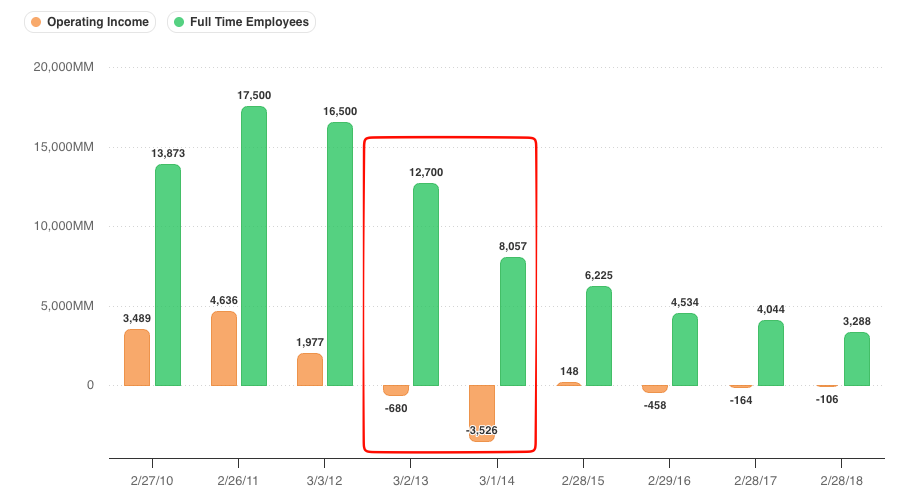
There weren’t enough stable or growing revenue streams to get them back to sustainability. Shares have been flat for 10+ years now.
You’ll run across plenty of press releases highlighting 10-20% headcount reductions or restructuring plans cutting $XXXm annually.
Weight these against the current overhead (or SG&A) costs of the business, and against the current market cap. A $500m restructuring plan on a $2.5bn market cap is meaningful savings!
(5) Cutting the dividend
You know you have a management team willing to make hard choices when they eliminate sacred cows.
Dividends become a huge cash flow constraint in a turnaround situation. What little cash flow you have available to reinvest or dig yourself out of a hole is now getting soaked up by the dividend payment.
I’m going to ignore macro or industry-driven dividend cuts like Bank of America’s cut to 1 cent in 2009 or the automakers cutting in 2006-2008 leading up to the GFC.
Following COVID, the mattress industry was in shambles and Leggett & Platt manufactured components for mattress production. Earnings fell from over $2.50 per share to $1, and the dividend payment was consuming every penny by 2023.
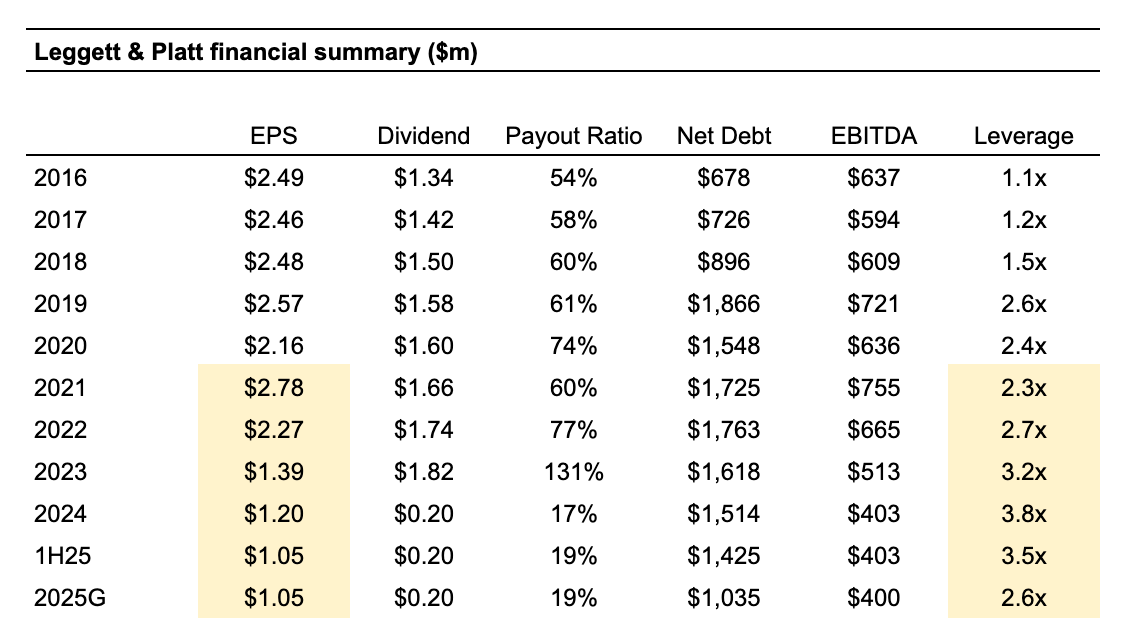
Leverage was pushing 4x and there was no room to repay debt with all of earnings going to a big dividend payout.
So in April 2024, they cut the dividend almost 90% and found a path to start delevering.
This turnaround plan was arguably cut short as the company was acquired in mid-2026 by mattress retailer Somnigroup, just as results were stabilizing.
For a dividend cut to work, you need other specific fixes in play… significant deleveraging, stabilizing business, divesting assets, etc. Again, the best turnarounds are within management’s control, eliminating a dividend is just another lever to pull.
(6) Selling assets
Sometimes there’s enough cash flow from divestitures (big or small) to fuel the entire turnaround plan. These could come from real estate, equipment, or entire business units.
Supervalu is a great example here.
In 2012, Supervalu was trading around $15, staring at 4 years of declining revenue and earnings, and mounting debts. Supervalu ran a wholesale food distributor serving grocery stores and they owned about a dozen grocery store brands across 2,400 locations.
In 2013, under their new “turnaround CEO,” Supervalu announced a $3.3bn sale of several grocery chain brands which cut their debt in half. The remaining businesses had stable revenue and earnings improved almost overnight.
The divestiture announcement was the catalyst to get involved here (and that’s where my predecessor firm bought shares), and at a split-adjusted $21 you would have had a 3-bagger by the time shares peaked around $70 in 2015.
(7) Operating leverage
This is more something-to-watch than a tactical turnaround lever.
A combination of high fixed costs and declining revenue creates increased pressure on profitability (and the inverse is true when revenue is growing).
Here’s a look at revenue and SG&A by year for United Parks & Resorts (PRKS) which operates SeaWorld and Busch Gardens:
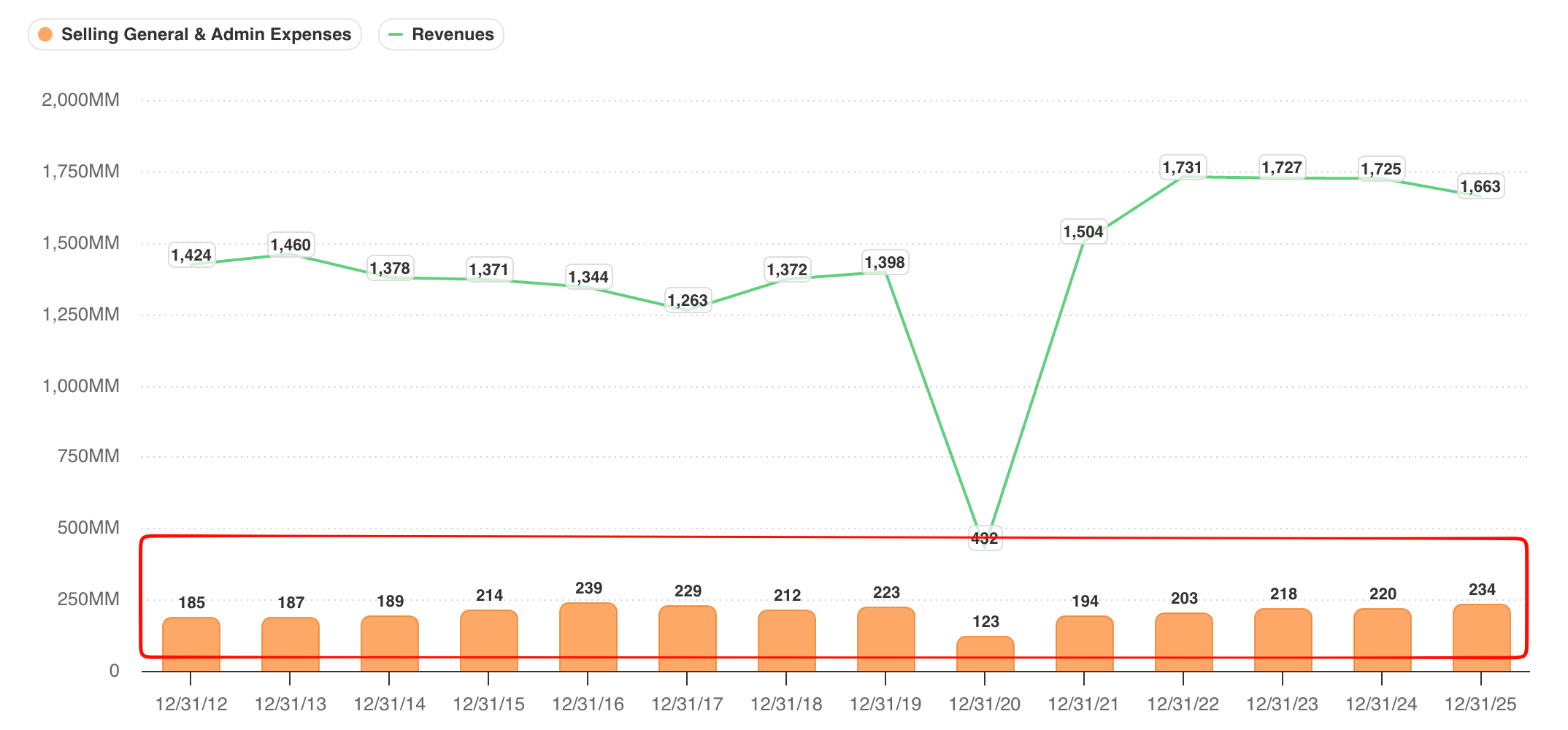
There’s almost zero variability in overhead every year which means revenue swings will have an outsized impact on profitability.
As for turnarounds, it’s much harder to walk away from fixed costs quickly. So asset sales or revenue stabilization become much more important.
Turnarounds I’m watching…
Portillo’s (PTLO, $4) — Shares are down 90% over the last 5 years as they rapidly expanded store count. These are high fixed cost locations compared to traditional fast-casual restaurants. Revenue is growing as new locations open, but weak same store sales are driving earnings lower. A new CEO joined early 2026, but the turnaround plan is early. His plan is to slow new openings and improve marketing/awareness in recently opened geographies. Shares are trading at 0.65x EV/sales for a business that was producing 15-18% EBITDA margins in 2019-2020.
Baxter (BAX, $24) — Baxter is a healthcare conglomerate ranging from hospital supplies to infusion pumps. An external CEO (management change) was hired in July 2026 following a few years of large divestitures to repay debt and a big dividend cut. His first priority is tackling the debt (goal = 3x leverage by yearend 2026), then simplifying operations (wouldn’t be surprised to see more divestiture announcements). Baxter even hired a CFO explicitly for his turnaround experience. This turnaround is still early innings and shares are trading at 11x earnings / 9x EBITDA.
Six Flags (FUN, $11) — After merging with Cedar Fair in 2024, sales have been weak (this is another high fixed cost theme park operator), and leverage is high (~4x). It’s now turning into quite the special situation as they’ve sold some underperforming properties to refocus and an activist (JANA Partners) with a 4% stake is pushing for a sale of the company. The stock is trading around 8x EBITDA but FCF is minimal.
Monro (MNRO, $14) — I wrote about this one in August 2026. The short story: company fired prior CEO for poor performance, hired a restructuring consultant to fix the business (eventually became permanent CEO), closing underperforming locations, selling real estate, Carl Icahn owns ~17% of shares, and the board recently announced a formal strategic review.
Nike (NKE, $36) — This will become a business school case study someday. Shares are down from $150+ in 2021 to $36 in September 2026. The dividend yield is pushing 5% and total dividend payments now outpace FCF (perhaps a dividend cut is in store?). A new CEO is refocusing the company on its sports heritage and fortunately the balance sheet is excellent. Worth watching if only because it’s so high profile.
Thinkific (THNC.TO, $2) — A few days ago, Thinkific announced what looks like a major restructuring announcement including a 96-person headcount reduction (roughly one third of their workforce). Half the market cap sits in net cash and the company expects this restructuring effort to bring FCF margins to 25% which would imply a very cheap stock price.
I’m only scratching the surface on turnarounds here…
Generally speaking, focus on finding fixable situations. Runway (liquidity) might be the most important variable in getting a sustainably “fixed” state. And you’ll need a management team willing to move fast and change things up.
Happy hunting!
Colin
Disclosure: I own shares of MNRO and may buy or sell any securities mentioned in this post at any time. DYODD.
P.S. leave a comment and share a turnaround idea I should look at