
Small caps are (were?) up a bunch this year but I’m still finding good value both in the portfolio and on the watchlist… here are 3 current holdings I like at today’s prices.
Today’s ideas:
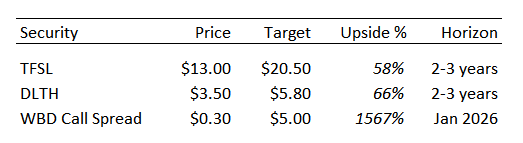
First-step thrift conversion trading at 8.75x P/E and 0.36x P/B
Call option on a cash flowing deleveraging story (trading at 3.6x FCF)
Microcap retailer with self-help earnings upside (trading at 3.2x EBITDA)
This post is for premium subscribers (sign up below)… we’ll be back next week with a free edition of Quick Value. I’m planning to do a few “where are they now” posts for ideas that look attractive or have meaningful updates from my original post. So let me know if anything catches your eye from the archives.
Market Performance

Quick Value
This week I’m highlighting 3 stocks in my portfolio that are each trading at good entry points (DYODD of course). Consider it a combination of “3 stocks to buy now” plus a thesis update for each company.
1) TFS Financial (TFSL) — sleepy 8.7% yielder
I’ve often referred to this as my “punt on third down” idea. Here’s what I like about it:
Nice dividend yield at 8.7%
Extremely cheap — 8.75x P/E and 0.36x P/B
Earnings upside from floating rate loan portfolio
Overcapitalized balance sheet with potential for capital returns
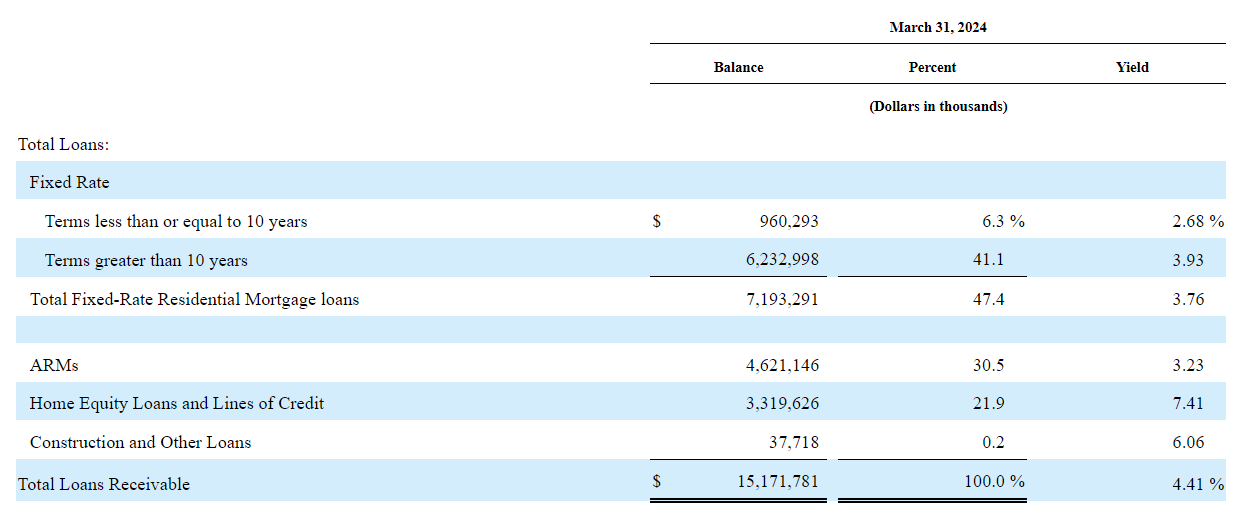
TFSL is a first-step mutual conversion (still MHC owned) and a plain vanilla residential mortgage lender in Ohio, Florida, and California. Loans are split almost evenly between fixed and floating rates so there’s earnings upside with higher interest rates (>87% of ARMs reset by 2027, more on that later).
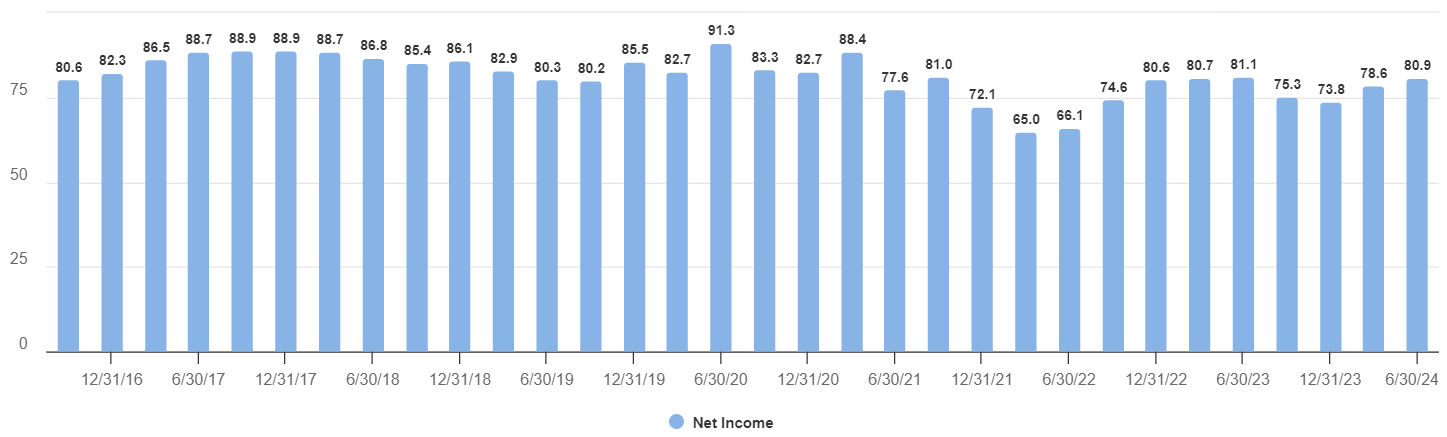
I’d say the excitement level for this stock is the equivalent to watching paint dry… they generate ~$80m per year in net income (8.75x P/E) and pay out ~$60m in dividends (8.7% yield). The rest is stockpiling in equity/retained earnings which grew ~2% annually since 2016. With $1.9bn equity, they have more capital than needed… buybacks would be massively accretive but there haven’t been meaningful repurchases since 2018-2019 (maybe I should write a letter to let them know?).
Onto the earnings upside… to highlight the earnings potential from floating rate loans: a 1% increase in $4.6bn adjustable rate loans = $46m additional net interest income, and a 2% increase = $92m additional net interest income. Even after taxes, that would add a ton to their $80m net income! We’re now on the cusp of Fed rate cuts but that shouldn’t significantly affect the ARM loans with a weighted rate of ~3.3%.
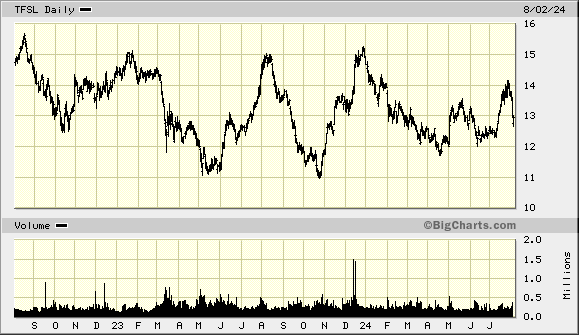
TTM net income has been hovering around $80m for a long time which is likely a big reason for the languishing stock price (that, and the confusion around the MHC structure).
There are 53.6m shares outstanding and a $13 share price = ~$700m market cap. (Note: this is a partial conversion so you’ll need to exclude 227.1m MHC shares when calculating market cap.) Book value is $1.9bn or $35.70/share, leaving the stock trading at 0.36x P/B the cheapest of any well-capitalized bank stock.
Although this has been a long-time underperformer, I think it’s a reliable 10%+ return from here with upside if: 1) they deploy excess cash on the balance sheet over time (via buybacks, etc.); and 2) earnings grow from rate adjustments on floating loans.
My target for this one is >$20/share. ROEs are hovering around 4-5% today ($80m / $1.9bn = 4.2%) but I think they’ll get net income up to $110m within the next 2-3 years so call it 5.7% ROE or 0.57x P/B which gets to $20.50/share. That’s a nice >30% IRR with the dividend included. Plus, you’ll get >25% of your capital returned within 3 years.
2) Duluth Trading (DLTH) — multi-bagger upside over 2-3 years
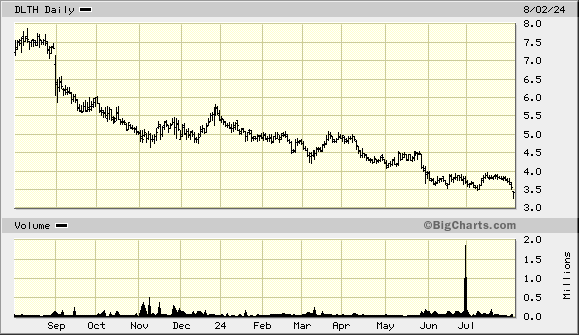
This former Quick Value post is only a month old. Here’s what I like about this one and why I bought shares:
Clean balance sheet / low leverage
Elevated capex/COGS masks true earnings power
Significant upside from self-help as opposed to macro
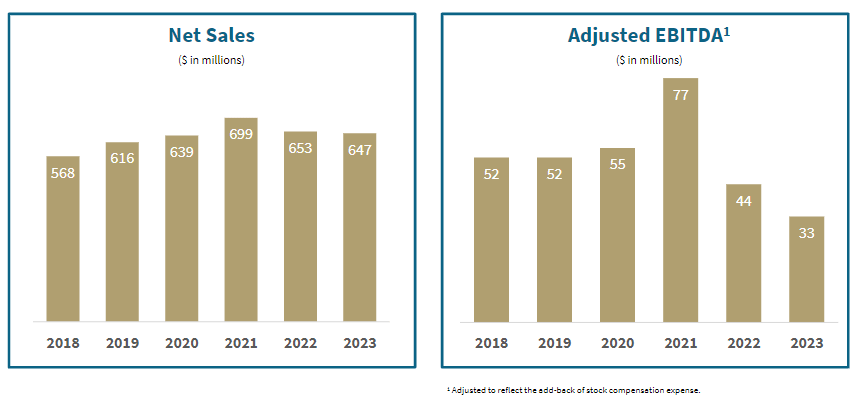
Duluth is an apparel retailer selling through a chain of 65 retail stores (1/3 of sales) and direct-to-consumer via their website (2/3 of sales). It was a high growth company from their 2015 IPO up until COVID. Since then, they’ve stalled out and EBITDA is ~25% below pre-COVID levels. Good news is they have a plan to fix it!
So what makes this interesting?
They’ve invested a ton of money in both capex and opex recently. Gross margins are ~500bps below historic levels and should recover over the next few years as investments pay off. Same for capex. They’ve been spending 5-8% capex/sales while most retailers are in the 2-3% range. 2024 is still elevated (3.9% guide) but 2025 should begin to level off. This means DLTH could be on the cusp of a multi-year run in EBITDA and FCF growth. Management has been reiterating this for several earnings calls in a row.
With 35.1m shares outstanding and a ~$3.40 price = $120m market cap. Net debt is virtually zero ($11m LOC balance and $6m cash on hand going into holiday selling season). EBITDA guide is $39m for FY24 (vs. $33m in FY23) so DLTH is currently trading at 3.2x EBITDA (excluding leases from EV calculation).
I’d argue that 3.2x valuation is giving them zero credit for future performance. To be fair, it isn’t that simple… revenue is down ~6% so far this year and expected to fall 2.5% for the full year when adjusting for a 53rd week.
Let’s say gross margins increase by 200bps over the next 2 years while holding revenue and opex constant = $13m additional EBITDA or $52m. At 4x, that would equate to a $5.80 share price (+70%). Now let’s assume they bring capex down to 3% of sales ($19m), interest remains at ~$4m, and cash taxes are another $4m. That works out to $25m FCF or $0.71/share, good for a 21% FCF yield. Now assume they get 500bps of gross margin and capex falls to 2% of sales with no revenue growth = $71m EBITDA / $1.15 FCF per share. At 5x EBITDA = $10 stock price.
Clearly, the big question here is whether they can return to growth… but honestly, it might not matter with some of these other things going on…
3) Warner Bros (WBD) — call option
This one is a bit unique, as I don’t often use options…
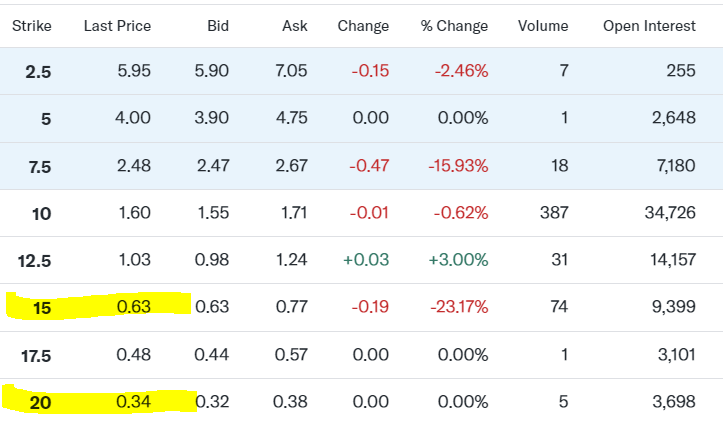
I’m buying the January 2026 $15 call and selling the $20 call (vertical call spread). All in, this should cost ~$0.30 for total upside of $5 if shares hit $20 or more by January 2026 (that’s 16:1 upside if it works).
Why?
I’ve been loosely following the WBD story since the merger between Warner and Discovery. Debt is high and investors are worried about growth and FCF stability. It’s going to take a few years to get this cleaned up.
Instead of committing a normal-sized position on a stock I know could take time to play out, I’d rather commit a very small amount of my portfolio (0.5-0.75%) to a position with a significant payoff down the road.
Here are the reasons that led me to this one:
FCF is significant and the math pencils out at 2.5 years to reach their leverage target of 3x or better
Debt profile is highly favorable (average maturity, blended rate, discount to fair value) which gives me plenty of cushion to be wrong
Here’s what CFO Gunnar Wiedenfels had to say about the debt situation on the 1Q24 call (emphasis added):
I continue to view our debt stack as an important and valuable resource. Our weighted average maturity is roughly 15 years with very manageable average annual maturities for the foreseeable future with maturities in any given year, significantly less than what our annual free cash flows have been even normalized for the strikes. Our debt is virtually all fixed with an average cost of 4.6%, in line with the yield on comparable U.S. long-dated treasury.
Based on the difference of current market value to book value reflecting the current rate environment versus when issued, we have a $6 billion asset in our debt stack. And you should expect that we will begin to be more opportunistic in monetizing this asset as evidenced by the debt tender that we announced this morning. We intend to repurchase outstanding debt using up to $1.75 billion of cash.
Trailing EBITDA is $9.7bn EBITDA with analyst estimates calling for $10bn+ in 2025, but let’s call it $9bn to bake in some declines in the core network business. At $9bn EBITDA, they’d need to get debt down to $27bn in order to hit 3x leverage (vs. $39.7bn net debt as of Q1).
How long would it take to repay $12.5bn net debt? Starting with my $9bn EBITDA estimate less $2.1bn interest and $1.2bn capex = $5.7bn FCF… That would take ~2.5 years to get leverage below 3x (pretty close to my January 2026 options expiry).
If shares kept the current 8x EBITDA multiple or traded at 10x FCF (inline with CMCSA and FOXA), then they’d be worth $19-23/share which lines up with my target strike price too.
You might be thinking this is pretty loose math, but I find it conservative. My EBITDA estimate is well below consensus and I haven’t factored in any debt discounts (which their CFO called out as a $6bn discount to market value!). So hypothetically, WBD could repurchase $12.5bn of debt for only ~$11bn. I feel like I have some execution padding on both earnings and debt here…
Thanks for reading! Planning to do a few more position updates throughout the month so stay tuned.
Disclosure: I own the stocks and securities mentioned in this post. DYODD.
Hi - is TFSL not trading at 2xBV while earnings 4-5% ROE? Maybe my math is wrong. $1.9B in BV 80/20 split and then same split for $3.6B in market cap. ROE being $80MM in NI divided by $1.9B in BV. $1.9B in BV should be divided among public and private ownership, no? Thanks