
Today’s idea:
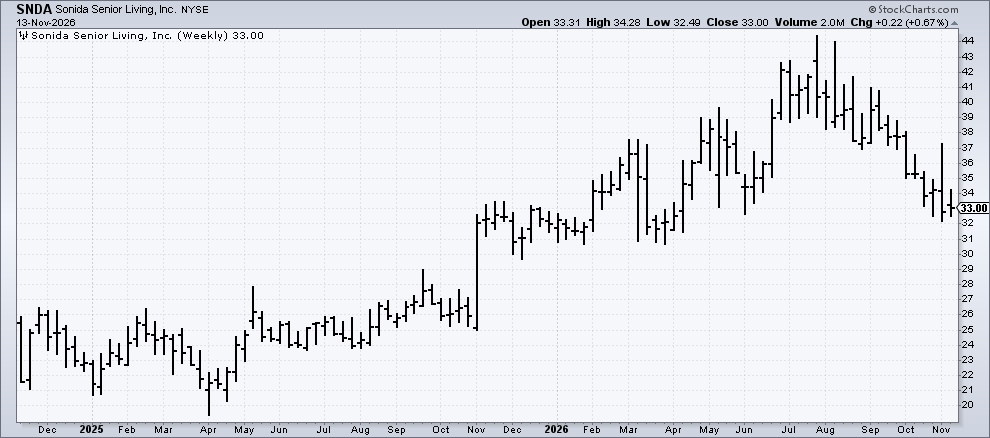
Shares down ~25% from July peak
Recently completed a “transformative” merger in March 2026
Super attractive industry backdrop: accelerating demand + tight capacity
These write-ups are meant to be a “jumping off point” for the idea generation process (i.e. a surface level review). Each write-up includes: (1) company background; (2) why the idea is interesting; and (3) my fair value estimate.
Recent write-ups:
11/09/26 — Upcoming RMT transaction at Dana Inc ($)
10/29/26 — A look at the VDL portfolio ($)
10/26/26 — New CEO with insider buying at Truist
10/19/26 — New recommendations in the portfolio ($)
10/12/26 — Beaten down CPG stock at Flowers Foods
Quick Value
Sonida Senior Living (SNDA)
Ticker: SNDA
Price: $34
Shares: 50m
Market cap: $1.7bn
Valuation: 7.5-7.9% cap-rate ($241m trailing NOI / $254m annualized)
Theme: Inflection
I first read about Sonida in a February 2026 newsletter from my friend Nat Stewart. The stock started to “work” faster than I could get up to speed on it (plus I’m a complete noob when it comes to evaluating real estate investments).
Shares got as high as $43 in July before coming back to $33-34 where it is today. A ~25% correction felt like an opportunity to revisit the name.
So here are my notes…
TL;DR:
Sonida Senior Living (SNDA) is a $1.7bn senior housing owner-operator with roughly 153 properties and 15,000 units.
Industry fundamentals are attractive: accelerating demand from an aging population plus tight capacity / slowing supply.
A transformative merger in March 2026 doubled the business, improved the balance sheet, and added much needed scale.
Shares trade at an a 7.5% to 7.9% cap-rate. If NOI grows ~6% annually through 2029, I see 40%+ upside (conservatively).
Background
Sonida Senior Living (SNDA) is an owner-operator of senior housing communities.
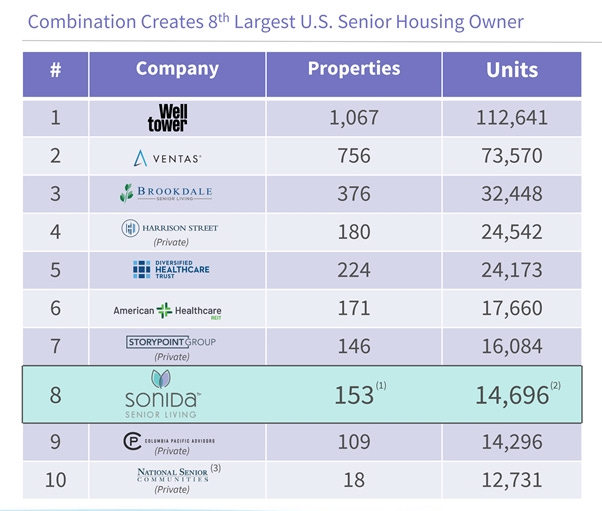
As of September 30, 2026, Sonida owns 153 properties with 14,900 units making them the 7th largest senior housing operator.
Unlike Diversified Healthcare Trust (DHC), it’s not a REIT; and unlike Brookdale Senior Living (BKD), they own the underlying real estate and operate most of their facilities (Brookdale owns property too, but they lease much of their capacity as well).
Think of Sonida as both OpCo and PropCo combined.
It’s a simple business model: as the senior population ages to 75+ some move into full-time communities, those residents pay a monthly rate, Sonida hires staff and operates most of their facilities keeping whatever is left over as profit.
Senior care industry
There are two ways to care for the aging adult population: (1) in-home with a healthcare professional visiting; or (2) as a full-time resident in a senior housing community (which range based on level of care needed).
NIC pegs senior housing as a ~$340bn market (2026 report) with ~2,400 local and regional operators (90% of which operated 5 or fewer communities).
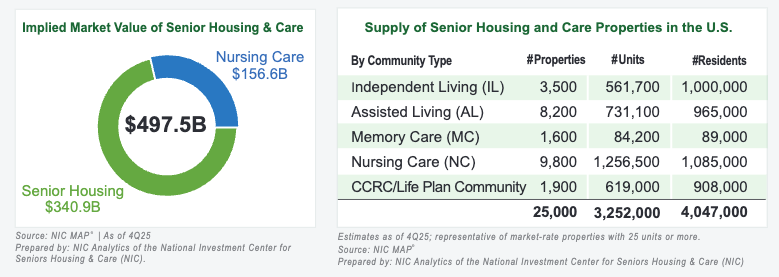
Sonida operates independent living (IL), assisted living (AL), and memory care (MC) properties.
A few things to note:
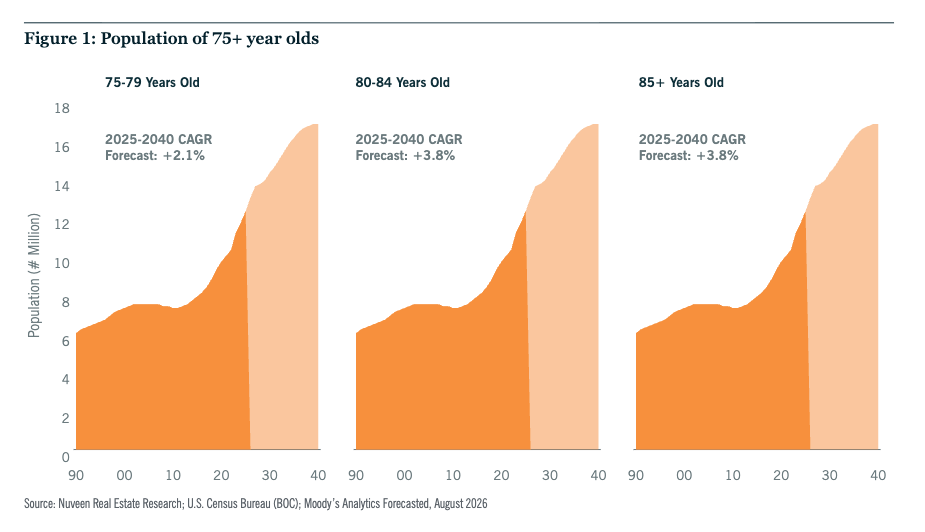
(1) Demand is growing at an accelerating pace as the US population ages. Ventas projects the 80+ population will grow by 28% through 2030.
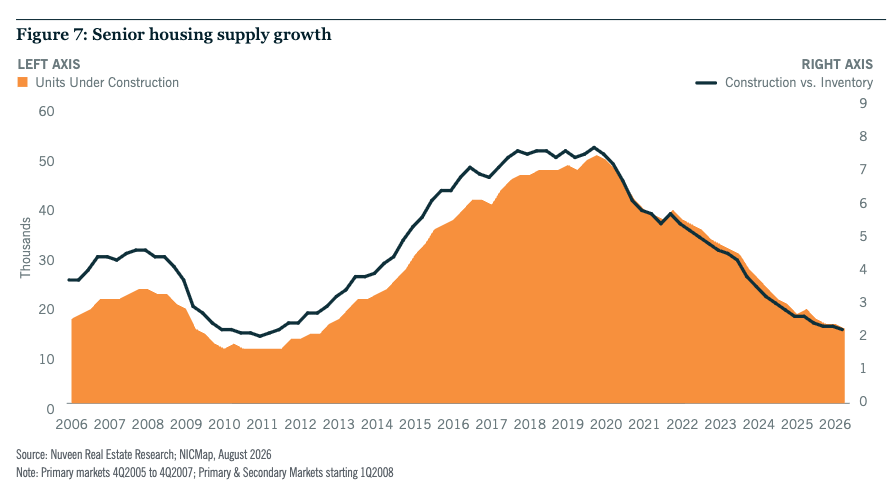
(2) After a period of rapid supply growth from ~2012 to 2020, capacity is looking tight with new construction slowing.
(3) The entire senior housing market suffered from falling occupancy levels during COVID. Since then, the market has recovered to ~90% occupancy (in part from the lack of new housing supply).
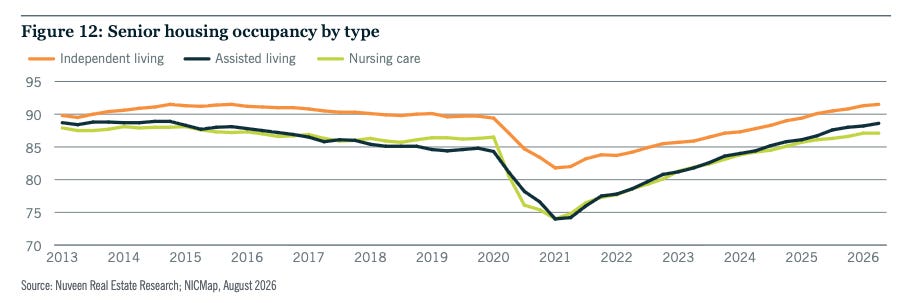
Bottom line: Because industry capacity growth is low, this is a business with decent pricing power (and therefore ability to offset cost inflation) and built-in demand growth for many years.
Why it’s interesting…
Thesis in a single sentence — Industry capacity is tight (a la Ed Chancellor’s Capital Returns) while demand is growing/accelerating. Sonida is at an inflection point following a merger and looks cheap with industry tailwinds to boot.
In March 2026, Sonida merged with privately held CNL Healthcare Properties (CHP) in a cash & stock deal. That transaction doubled the size of the business, added much-needed scale, and delevered the balance sheet.
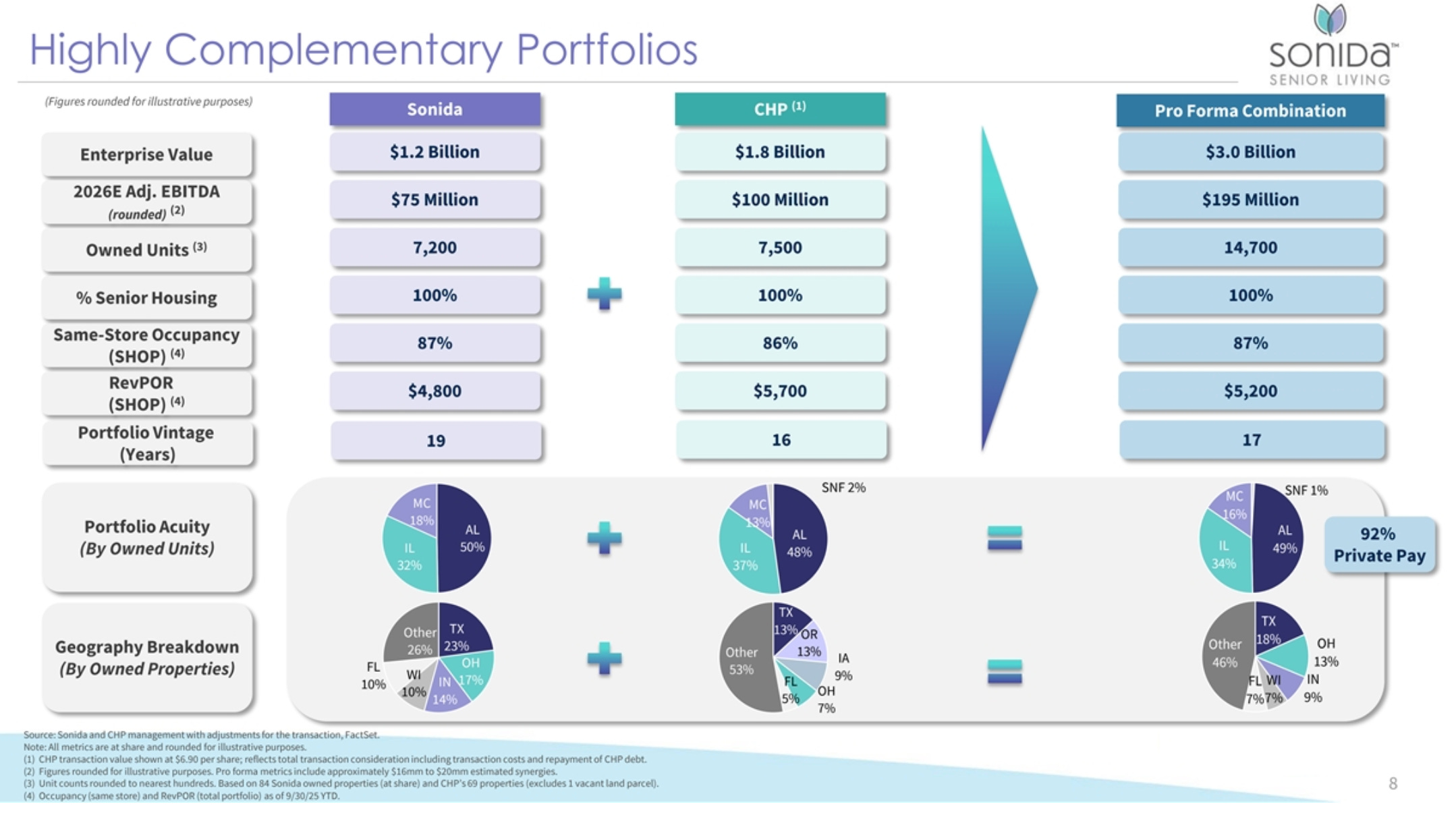
Now you have a top 10 industry player with a unique “vertically integrated” business model, a merger that should continue fueling results into 2027, and industry tailwinds carrying the torch after that.
Fundamentals
Prior to 2021, Sonida was known as Capital Senior Living (CSU) and operated a portfolio of owned and leased communities (much like BKD).
During the COVID pandemic: occupancy fell, they exited the leased portfolio, sold some properties, and raised capital through equity offerings. It was a highly distressed situation.
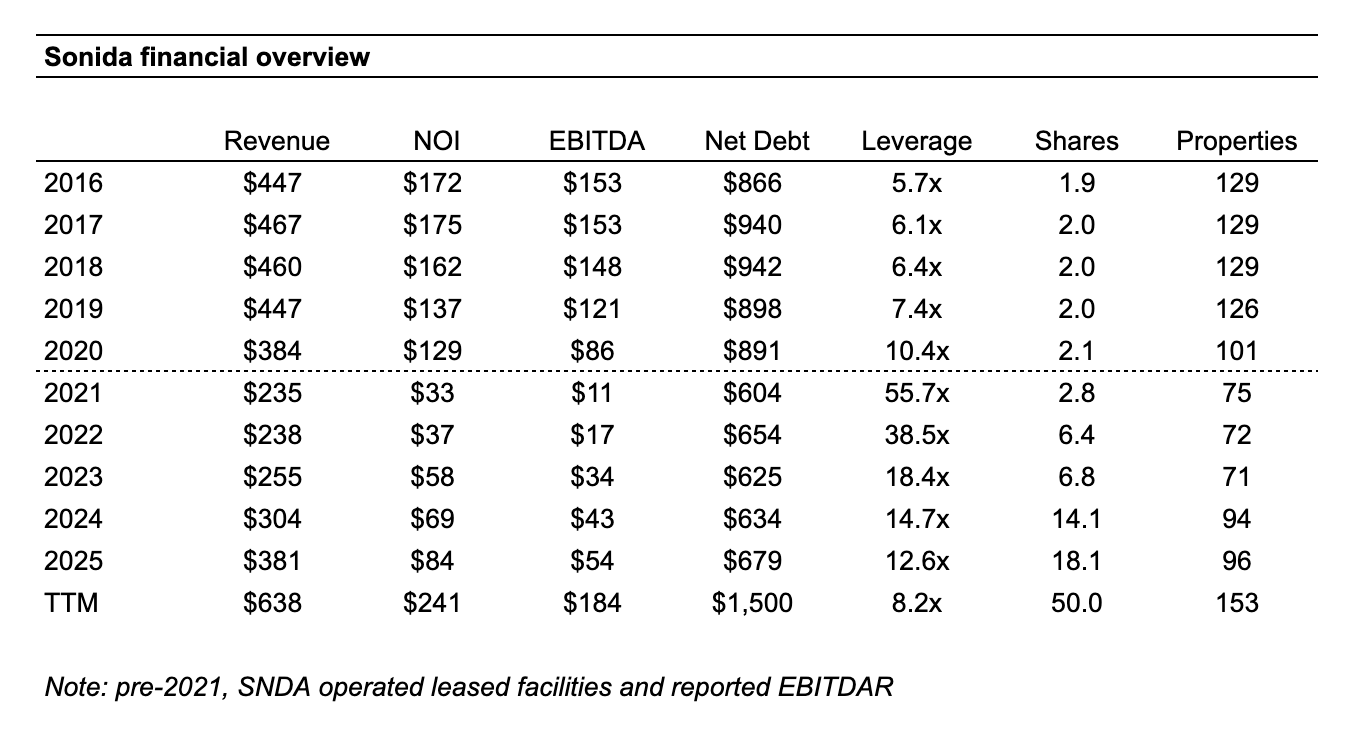
Since then, occupancy is recovering and they acquired additional properties in 2024 and 2025 culminating in the CHP merger in early 2026.
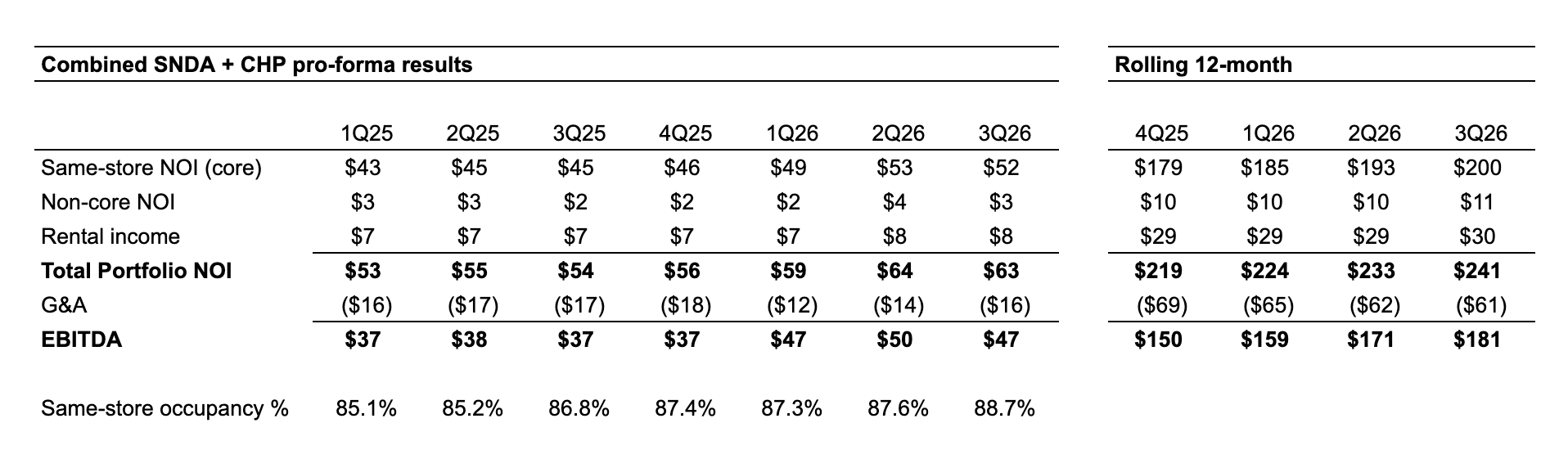
The early read on post-merger results are encouraging with NOI growing 16% YoY in Q2 and Q3 to a trailing $241m level and $254m annualized level (7.5-7.9% cap-rate).
Outlook & Valuation
Management is still on offense here.
In May 2026, they launched a $250m ATM program; of which, they’ve already issued ~1.75m shares for $68m. With those proceeds and some expected asset sales, they’ve closed on $150m acquisitions which add 620 units ($241k per unit), and have another $98m acquisitions under contract.
There are roughly 50m shares outstanding after the recent ATM issuances. At $34 per share = $1.7bn market cap. Net debt is $1.5bn (potentially higher after Q4 acquisitions close) for a $3.2bn enterprise value.
On trailing NOI of $241m = 7.5% cap-rate
On trailing EBITDA of $181m = 17.7x (8.3x leverage)
Both of those figures are running higher on an annualized basis.
Upside — I’m assuming 6% NOI growth annually from a current $254m run-rate to $300m by 2029. That’s a ~18% total increase which works if they can hit ~90.6% occupancy (in-line with the current industry average). This assumes FCF plus asset sales cover capital deployed and share count jumps to 52m. At today’s 7.5% cap-rate, I get $48 per share or 41% upside.
Downside — Pro-forma NOI was ~$220m in 2025 at ~87% occupancy. At an 8% cap-rate, that works out to $25 per share or 26% downside.
That’s roughly 1.5x upside/downside (and my upside forecast runs to 2029).
As usual, I’m probably being overly conservative in an upside cap-rate at 7.5%. Even private market deals are going at ~$240k+ per unit while SNDA trades at ~$213k per unit. So here’s a table of various NOI levels and cap-rates on 2029 results:
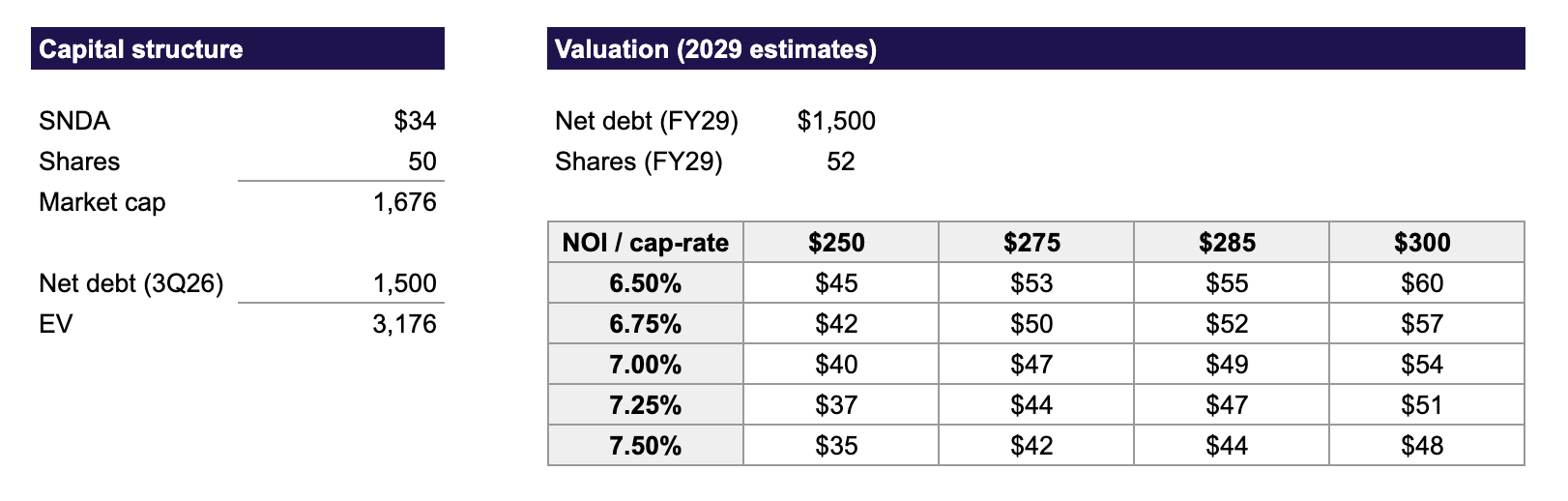
Many of these work out to 20%+ IRRs.
Interestingly, management has incentive comp tied to share price targets at $40, $53, and $67 with a measurement period running from February 2027 through February 2030. In most cases, these also work out to 20%+ IRRs.
Hmm…
Summing it up…
As much as I love catalyst-driven investing, it’s nice to own a few names that you can “set and forget” over a multi-year period.
This feels like an idea in that bucket. While there’s plenty of interest rate sensitivity baked into real estate valuations, this one has supply & demand tailwinds which give you good visibility into the next few years of performance.
If NOI continues growing while management keeps leverage and dilution in check, there’s a reasonable path to 20%+ returns over the next 3-5 years.
Disclosure: no position, but this one is high on my list.
Disclaimer: This is not investment advice. These are my opinions based on public information, and I may buy or sell shares at any time without notice. Do your own work.
Resources: