
Today’s idea:
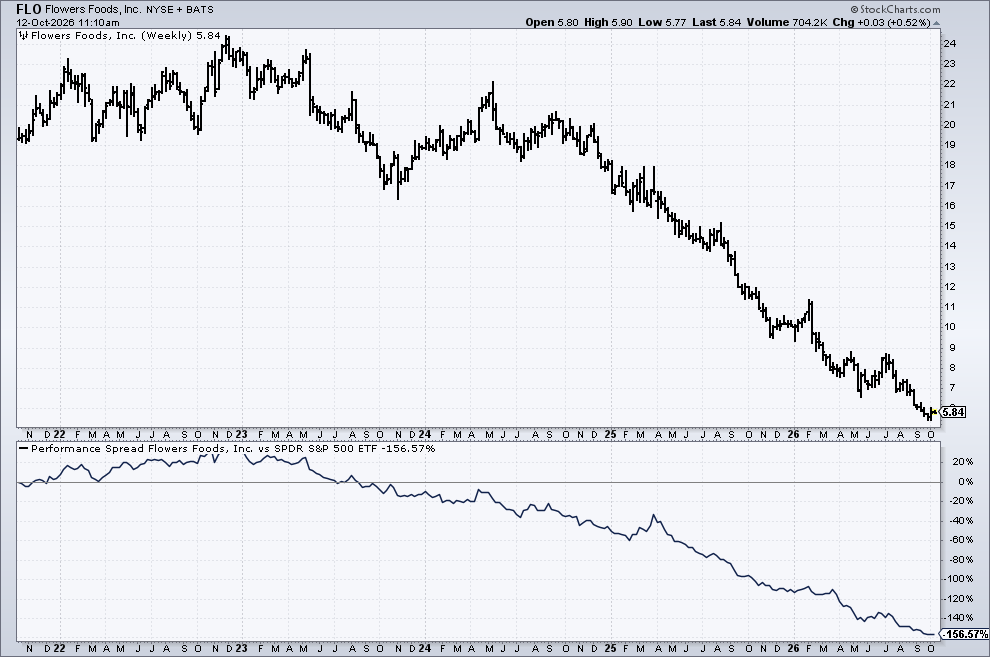
Shares down 80% from 2022 highs
Recently cut dividend by 50% leaving room for deleveraging
FLO trades at 7.5x earning and 6.4x EBITDA with 3.6x leverage
For new subscribers — these write-ups are meant to be a “jumping off point” for the idea generation process (i.e. a surface level review). Each write-up includes: (1) company background; (2) why the idea is interesting; and (3) fair value estimate.
Check out past write-ups here and my home base page here.
Recent write-ups include:
10/10/26 — Net cash + massive cost saving story at Thinkific ($)
10/01/26 — Field guide for investing in turnarounds
09/28/26 — Gentherm RMT transaction ($)
09/21/26 — A look at the Corteva / Vylor spin-off
09/15/26 — Guide to investing in M&A situations ($)
Quick Value
Flowers Foods (FLO)
Ticker: FLO
Price: $6
Shares: 214m
Market cap: $1.28bn
Valuation: 7.5x earnings
Theme: beaten down
I’m continuing on my path of reviewing beaten down staples:
And since I’m a glutton for punishment when it comes to idea generation, I figured: “why not look at the most beaten down name in the group this year?”
TL;DR:
Flowers Foods (FLO) is the 2nd largest packaged bakery producer in the US with leading brands like Nature’s Own, Wonder, and Dave’s Killer Bread.
Shares are heavily beaten down (down 80% from 2022 highs) from declining volumes, a pricey acquisition, increasing leverage, and a dividend cut.
At $6, the stock trades for roughly 7.5x earnings and 6.4x EBITDA. A potential asset sale could help with debt repayment.
Background
Flowers Foods (FLO) is the “second-largest producer and marketer of packaged bakery foods in the United States” with well-known brands like: Nature’s Own (#1 loaf brand), Dave’s Killer Bread (~74% share of organic bread), Canyon Bakehouse (~38% share of gluten-free), Wonder, Tastykake, and Simple Mills.
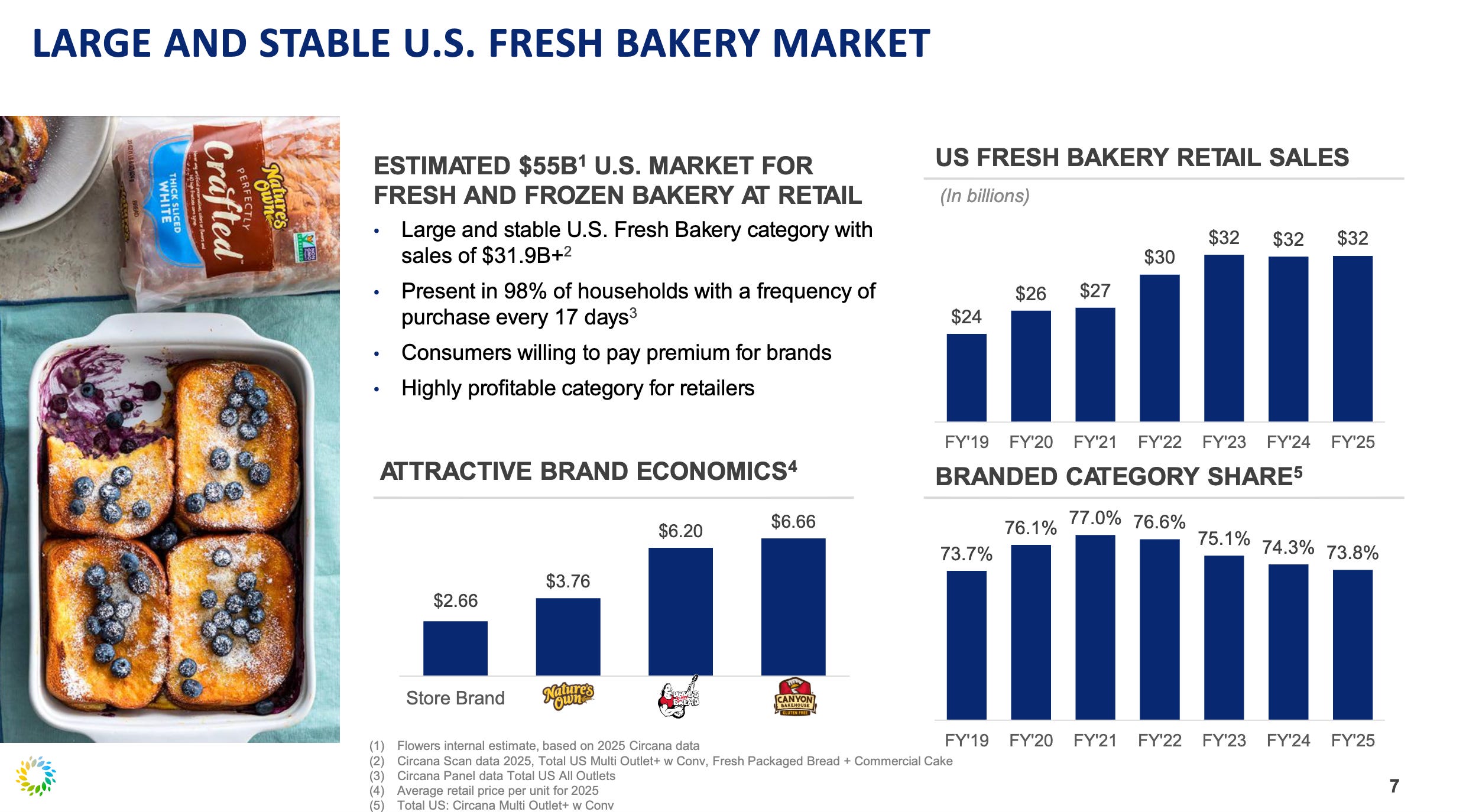
Fresh baked goods is a mature $32bn category with flat retail sales over the past 3 years. Branded products have 73.8% market share as of FY25, but this has been trending down since a FY21 peak at 77%.
It looks like another staples category facing volume declines due to changing consumer preferences and GLP-1 headwinds; as a result, they’ve been reliant on pricing to maintain sales levels.
The runaway price hikes opened the door to private label competition. Branded share peaked at 77% in FY21 and fell to 73.8% in FY25. Makes sense when a store brand loaf costs $2.66 versus $3.76 for Nature’s Own and $6.20 for DKB, so stretched consumers are trading down.
Flowers corporate history:
2011-2013 — Spent $900m to acquire Tastykake, Lepage Bakeries, and assets from the Hostess bankruptcy (including the Wonder brand). Sales went from $2.6bn to $3.7bn as they gained scale.
2014-2018 — Acquired Dave’s Killer Bread for $275m, Alpine Valley Bread for $120m, and Canyon Bakehouse (gluten free) for $200m. Sales flattish from $3.75bn to $3.95bn.
2019-2020 — Ryals McMullian becomes CEO in 2019. Hosted first investor day in 2020 establishing long-term targets of 1–2% sales, 4–6% EBITDA, 7–9% EPS growth.
2021-2024 — Acquired Papa Pita for $275m in 2023. Sales grew from $4.4bn in 2020 to $5.1bn in 2024 (mostly price increases).
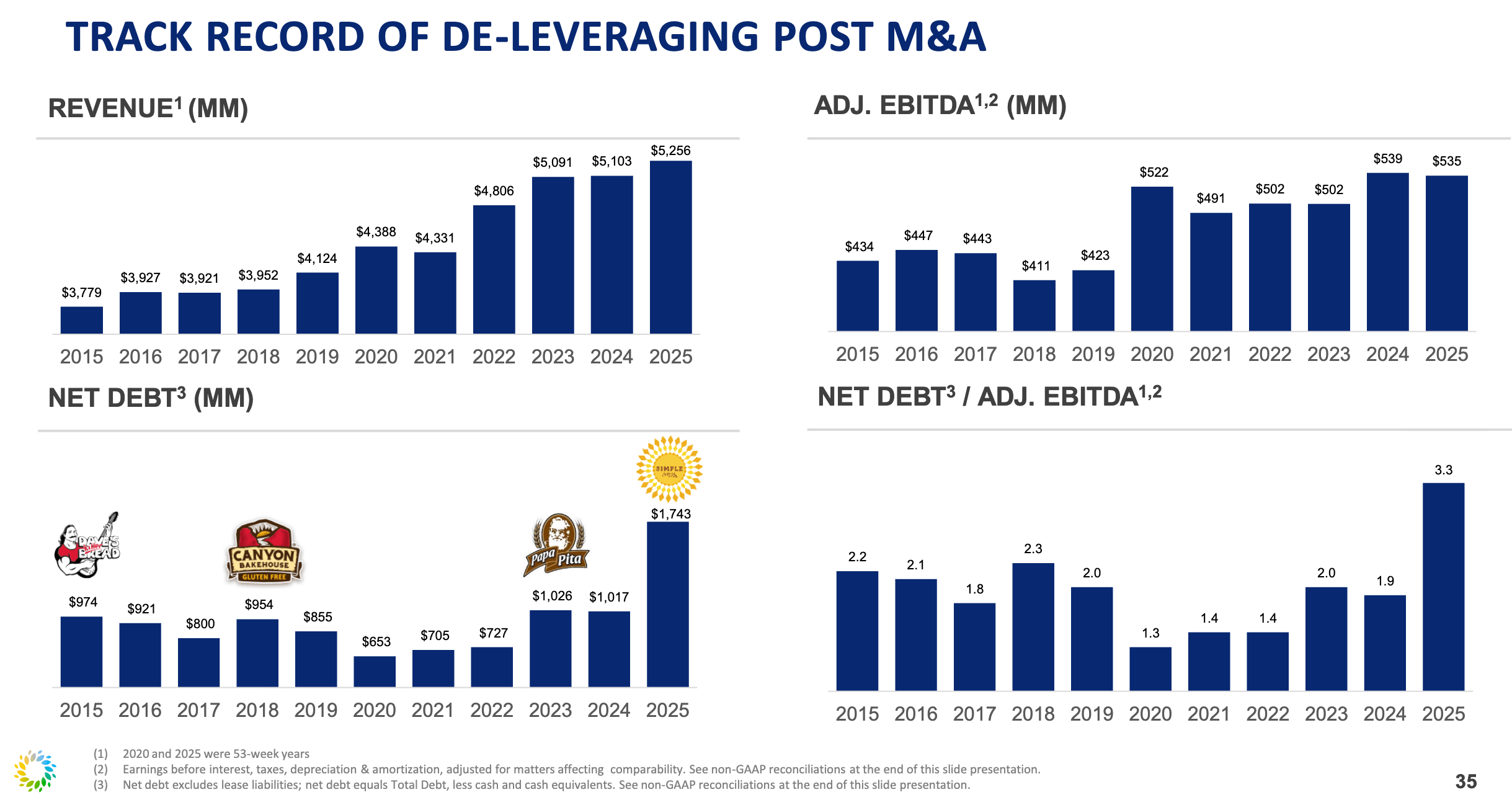
2025 — Acquired Simple Mills for $795m (3.3x revenue multiple), leverage jumps to 3.3x, several guidance cuts throughout the year. Shares fell from a peak of ~$30 in 2022 to $20.
2026 — Announced “operational review” in Feb resulting in cost saving program and 50% dividend cut. Missed Q2 results and cut guidance in Aug. Shares down 45% YTD from $11 to $6.
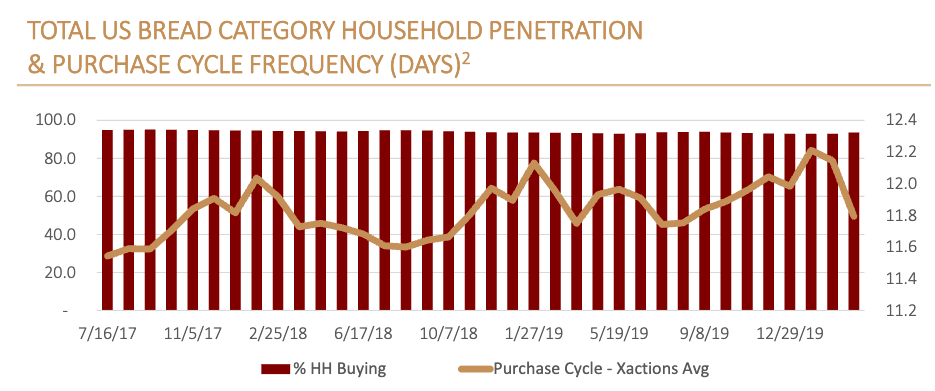
This seems like an OK business and probably better positioned than other CPG categories. It’s a profitable product line for retailers and 98% of households are buying bread. The direct-store-delivery (DSD) network of independent distributors has some scale advantages too. But it’s not a volume-growth category.
Why it’s interesting…
Flowers falls into the “beaten down” category with a share price down 54% over the past year and 78% over the past 5 years.
From the earlier timeline, a few events make this stock hard to own for most investors: (1) the 2025 acquisition of Simple Mills pushed leverage to 3.3x; (2) the 50% dividend cut in May 2026; and (3) the downward trend of fundamentals.
Toss in questionable industry dynamics (GLP-1, price inflation, private label competition, etc.), and you get a downright hated stock.
So those are the reasons to pass.
Before looking at the bright spots, let’s start with a view of the fundamentals:
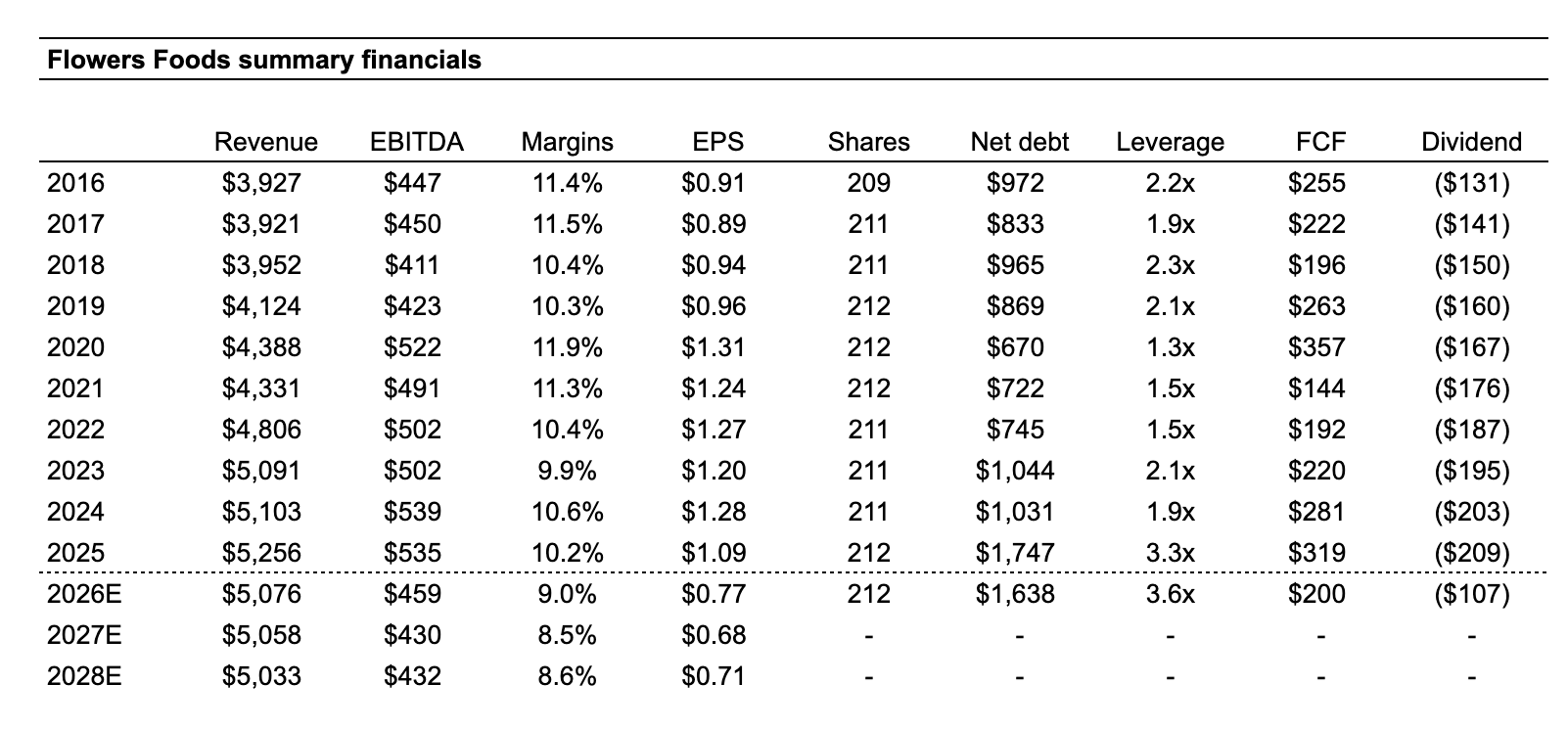
Takeaways:
This company was built on the back of substantial M&A over a decade-plus (I count ~$2.6bn total M&A spend since 2011 vs. a $2.9bn enterprise value today)
Aside from acquisitions, nearly all cash flow went to increasing dividends (some capital was spent on buybacks over the years, but there hasn’t been a reduction in share count)
Revenue growth came in spurts (M&A) while EBITDA, EPS, and margins have stalled since ~2020
So what’s to like here?
There are 3 main reasons to get excited:
Shares are really cheap, even on a recently lowered outlook
The dividend cut is already in place
The company is shopping their Tastykake brand which would help with leverage
(1) FLO is one of the cheapest CPG stocks despite having less exposure to salty and sweet snacks. At $6, I’m getting a stock trading at 7.5x earnings, 6.3x EBITDA, and 6.4x FCF based on reduced 2026 guidance.
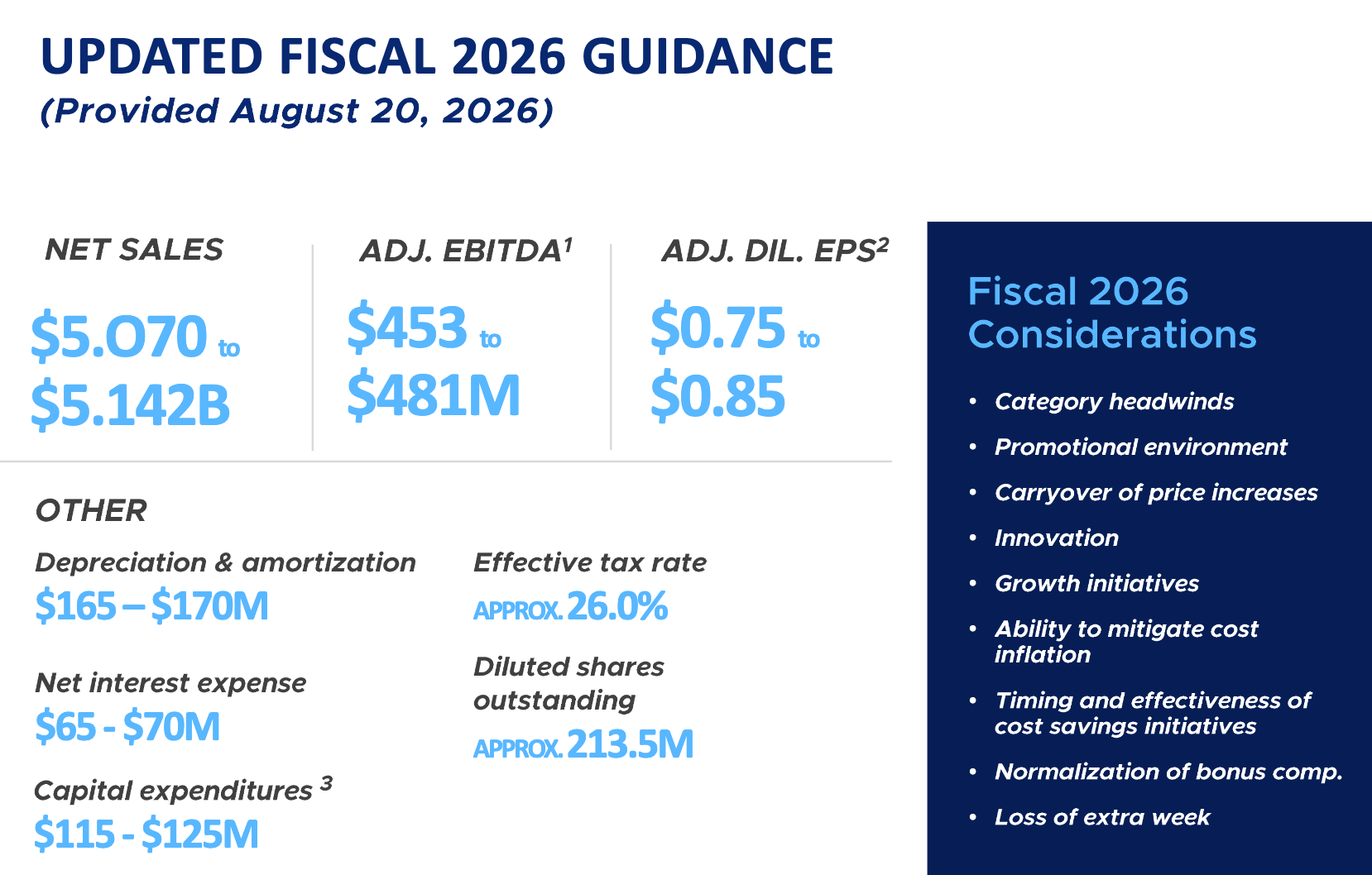
At the mid-point, 2026 guidance assumes 3% sales decline, 13% EBITDA decline, and a 27% EPS decline compared to 2025.
(2) In May 2026, the dividend was lowered by 50%. In theory, this should take some downside out of the equation; but in this case, I think there’s potential for another dividend cut down the road.
At $0.80 per share, EPS is basically down 40% from two years ago ($1.28), so a 50% dividend cut essentially moves them back to a previous payout ratio.
A $0.125 per share quarterly dividend works out to $107m per year ($0.50/share), which is right around 50% of annual FCF and a 60% payout ratio on EPS. Even after the cut, the market seems skeptical with shares trading at an 8.6% yield.
The new payout ratio leaves only a nominal amount of money to delever, call it $100m per year. Without any help from increased earnings, it would take Flowers about 5 years to get to 2.5x leverage (from 3.6x today).
Which brings me to potential divestitures…
(3) In August 2026, the company was rumored to be shopping their Tastykake brand and had hired an investment bank to run a process. Reuters estimated a potential $350m valuation for that business on $400m annual revenue.
This is where I feel most CPG companies could benefit… Redefine “core” brands and sell off non-core assets to both increase focus and reduce debt.
Flowers already has a leading bread business, organic business, and gluten-free business. Selling their cakes and sweets assets makes a ton of sense, especially considering the GLP-1 exposure in that category.
Outlook and valuation…
As much as I’d love to take 2026 guidance at face value, the Q2 earnings call was littered with headwind commentary around input costs, commodity prices, and the company’s inability to take further pricing.
Without increasing demand, it looks like 2027 is going to be a tough year and sell-side estimates reflect that (6% EBITDA decline and 11% EPS decline).
And here’s how volume is currently trending…
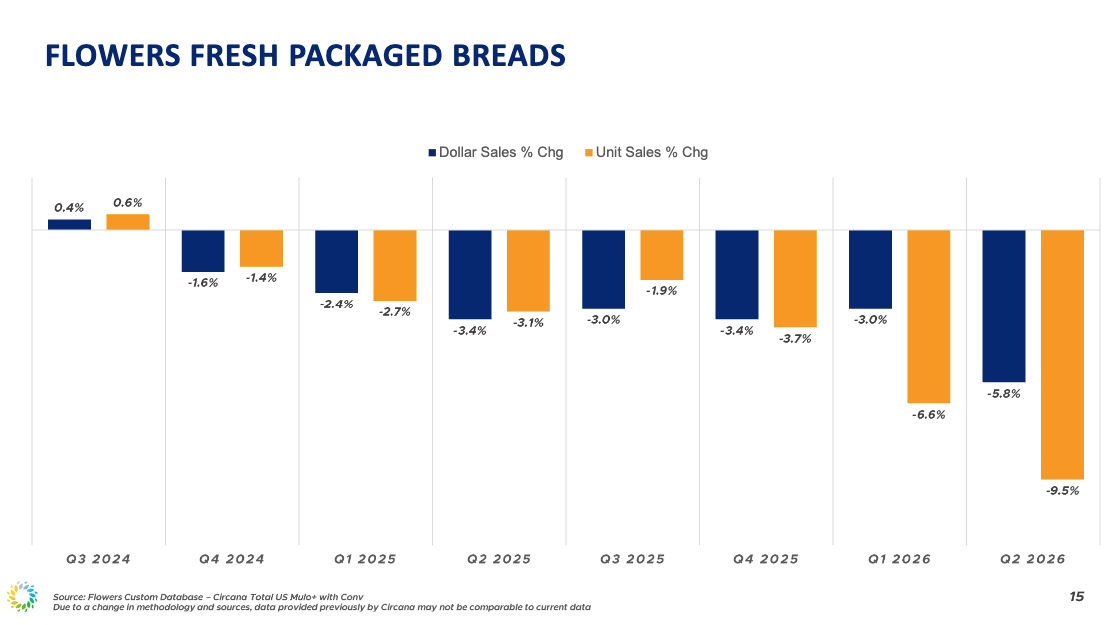
It’s not great.
So here’s how I’m thinking valuation:
There are 214m shares outstanding at $6 = $1.28bn market cap. Net debt is $1.64bn as of Q2 for a $2.92bn enterprise value.
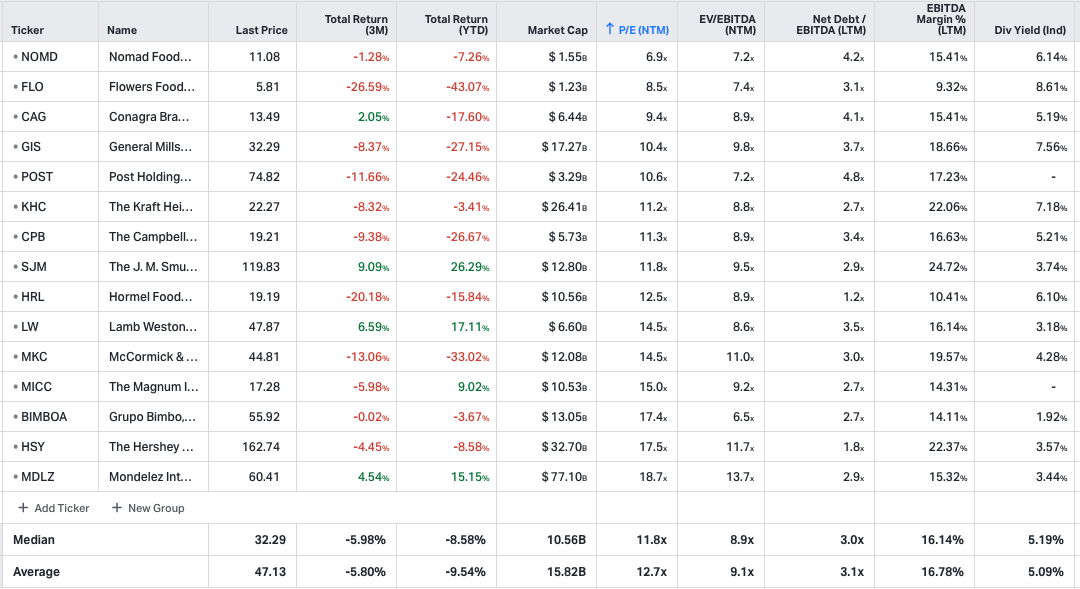
Peers are fighting all sorts of varying battles with debt, high dividend payouts, and category declines. Most stocks are trading between 9-12x earnings and 7-9x EBITDA:
Upside:
Let’s assume they sell Tastykake at $350m gross or $300m net. That business has an estimated $400m revenue. At similar margins to consolidated Flowers, it would be $40m EBITDA for a 8.75x sale price.
Then add 6 quarters of excess FCF after the dividend, call it $150m. These work out to $450m of debt repayment by the end of 2027 bringing debt down to $1.19bn.
At 7.5x EBITDA of $400m ($460m less $40m Tastykake less $20m 2027 headwinds) = $3bn EV. Less $1.19bn net debt = $1.81bn market value. On 214m shares outstanding, that works out to $8.50 per share or 42% upside.
Downside — EBITDA falls to $430m in 2027 (6% decline) and the multiple compresses to 5.5x = $2.37bn EV. Less ~$1.55bn net debt = $815m equity value or $3.80 per share (-37% downside).
It’s a balanced 1.1x upside/downside ratio and you’re likely noticing a lot of assumptions going into the upside case. I’m ignoring the $0.50 annual dividend which adds some “protection” at an 8.6% yield.
Summing it up…
FLO looks like a classic “falling knife” beaten down stock.
It’s incredibly cheap (again, even after the guidance cut) and throws off a ton of cash flow. But they’re facing serious headwinds going into 2027 and even with the lower dividend, there’s not a ton of room to delever.
Bread isn’t a volume-growth category that’s suddenly going to bail out revenue growth either.
What I’m doing with this one — I’m adding this to an already-lengthy list of CPG stocks I’m tracking. I could get more excited if: (1) they announce a sale of Tastykake with plans to reduce debt; (2) they announce a further dividend cut; or (3) volume declines ease up or 2027 guidance holds flat to 2026. If none of those show up by the Q4 earnings release (around February 2027), I’d pass.
Disclosure: no position in FLO.
Resources: