
Today’s post:
Shares are down 27% over the past year coming off previous cycle peak
Dominant industry player with fortress balance sheet (net cash 20% of market cap)
Shares are trading near the low-end of historic valuation range (P/B) while approaching cycle bottom
For new subscribers — these write-ups are meant to be a “jumping off point” for the idea generation process (i.e. a surface level review). Each write-up includes: (1) company background; (2) why the idea is interesting; and (3) fair value estimate.
Check out past write-ups here and my home base page here.
Recent write-ups include:
08/18/26 — Stars aligning for a sale at Monro ($)
08/11/26 — Roll-up story at Shift4 Payments
08/04/26 — Inflection at beaten down MarketWise ($)
07/27/26 — Looking at the Resideo + ADI Global spin-off
07/20/26 — Jockey-led holding company at HCI Group ($)
Quick Value
Cal-Maine Foods Inc (CALM)
Ticker: CALM
Price: $84
Shares: 47m
Market cap: $4bn
Valuation: 1.6x P/B
Theme: mean reversion
A friend suggested I look at Cal-Maine (CALM) as a cheap cyclical making an effort to diversify into less cyclical earnings streams.
Here are my notes…
TL;DR:
Cal-Maine (CALM) is the largest egg producer in the U.S. with significant scale and vertical integration advantages.
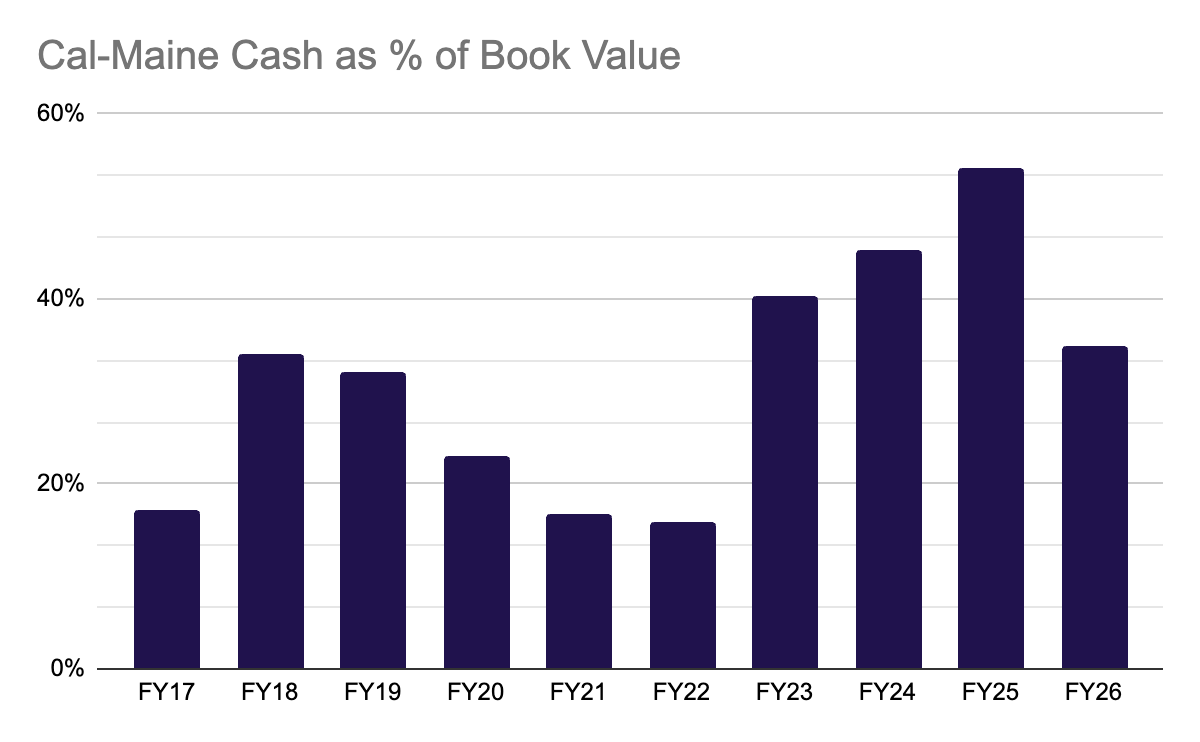
Fortress balance sheet has net cash & investments at 35% of book value and 20% of market cap (a consistent trend over time).
Simple mean reversion idea — the stock consistently trades around 2.1x book value (20-year median) vs. 1.6x today = ~40% upside to median.
Background
Cal-Maine (CALM) is the largest egg producer in the U.S. with 50 million egg-laying hens and 1.2 billion dozen eggs sold in their fiscal 2026 year (ending 5/30).
CALM is a massive, vertically-integrated egg producer with ~2x producing hens compared to the #2 player(s). They own $1.3bn+ in breeding facilities, hatcheries, production facilities, processing & packaging, feed mills, prepared food facilities, and 34,000+ acres of owned land.
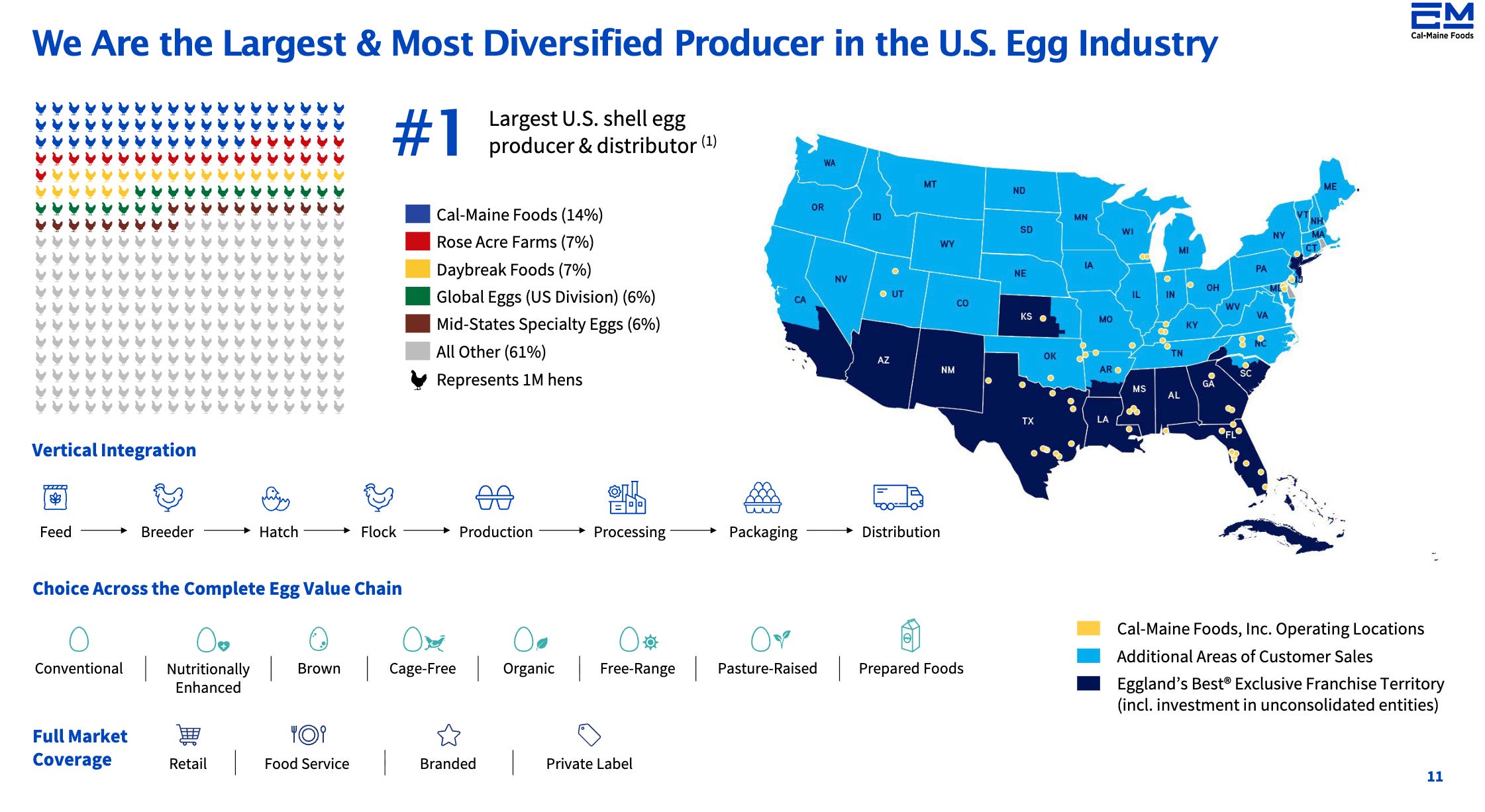
[Side note — this reminds me of Somnigroup SGI) and their industry dominance in the bedding industry.]
Quick overview of the egg industry
Eggs are an excellent source of low-cost protein and have very stable demand.
In the U.S., shell eggs are a ~$16bn industry as of 2025 with the ten largest producers owning 57% of production capacity (CALM 2025 10-K).
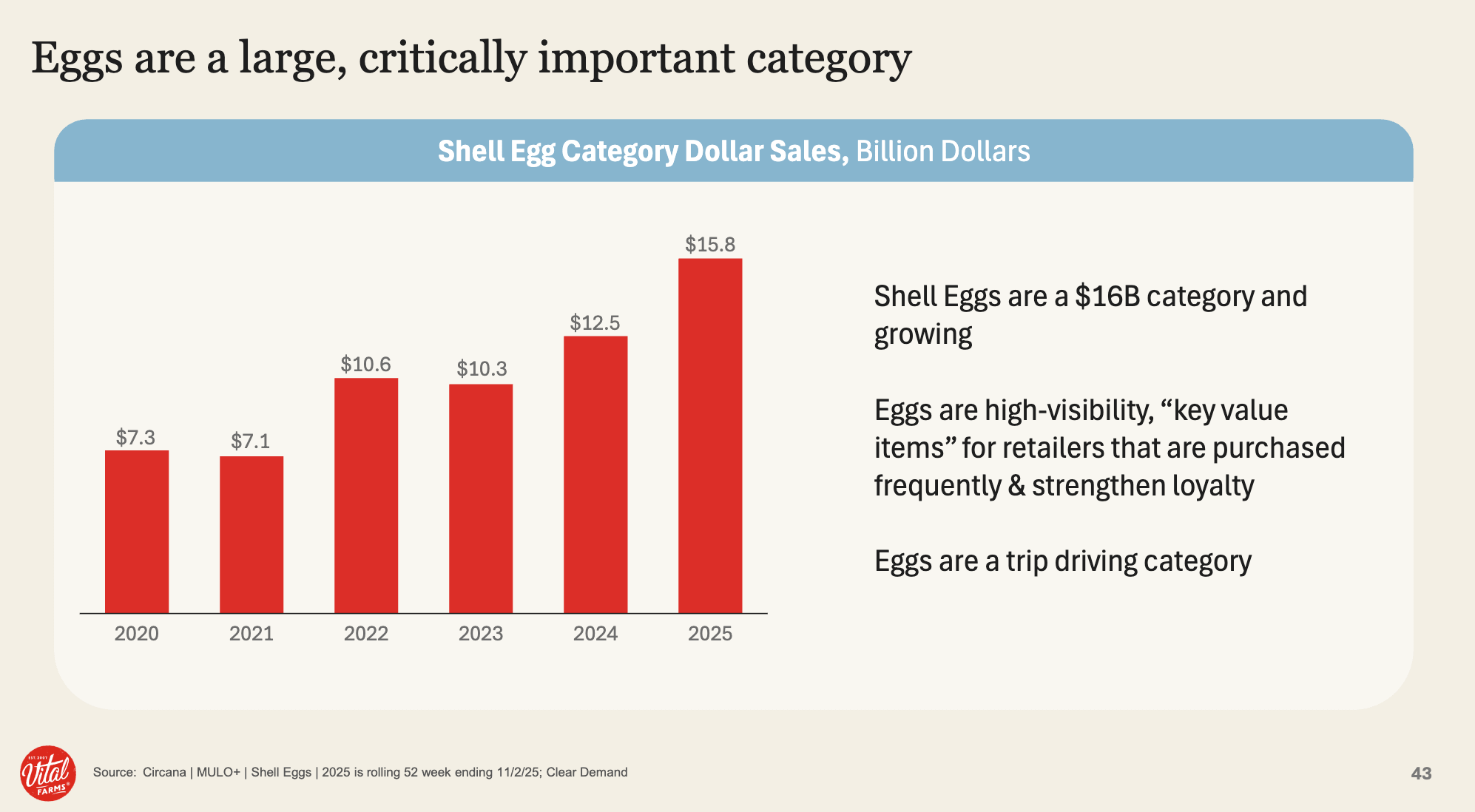
This industry is highly cyclical with large price swings tied mostly to supply-side swings (i.e. avian flu / HPAI outbreaks and producer responses to high/low egg prices).
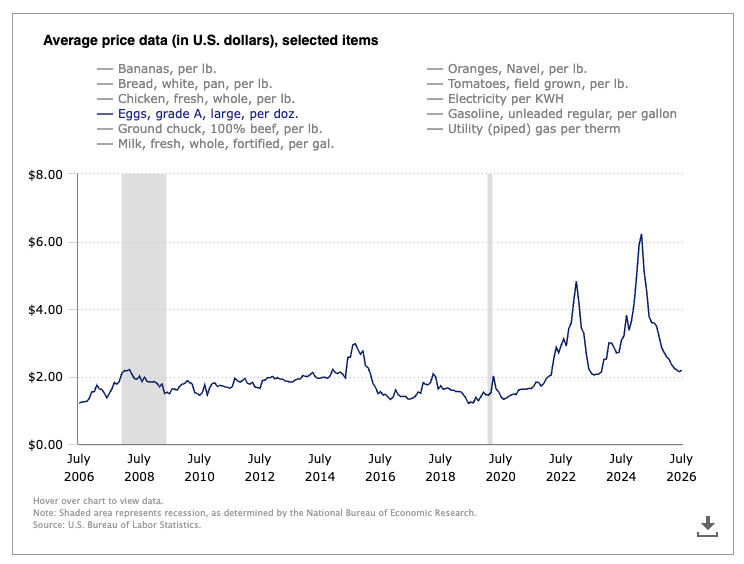
Producers can throttle supply quickly by “hanging onto” older hens longer or breeding more egg-laying hens which reach production-maturity in just a few months.
When supply is tight, prices spike and returns (i.e. earnings) are phenomenal; and vice versa when supply is plentiful. Egg production has a very short cycle time on the supply side (quick production ramp-up and low inventory positions).
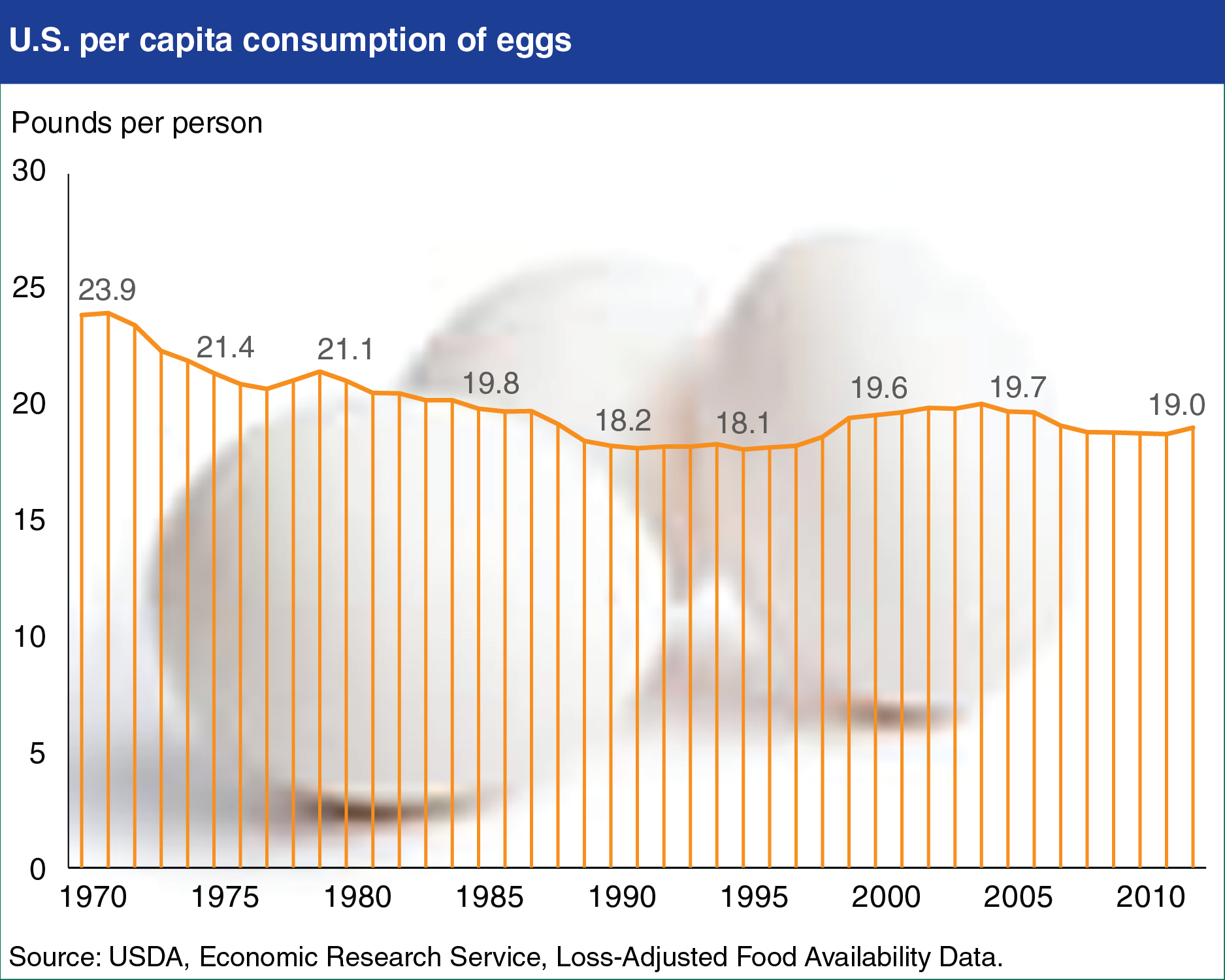
Fortunately, demand is stable with consumption (volume) flat-to-increasing over many decades:
It’s also a capital-intensive business:
Producers need baby chicks to grow or replenish their egg-laying flock which they breed on farms and hatch in computer-controlled hatcheries. Once at maturity, they are placed into their laying flock.
After eggs are produced, they need to be processed and packaged at onsite facilities before they’re sold.
This sounds like a lot of capex, and it is: CALM runs at 5-7% of sales in a typical year.
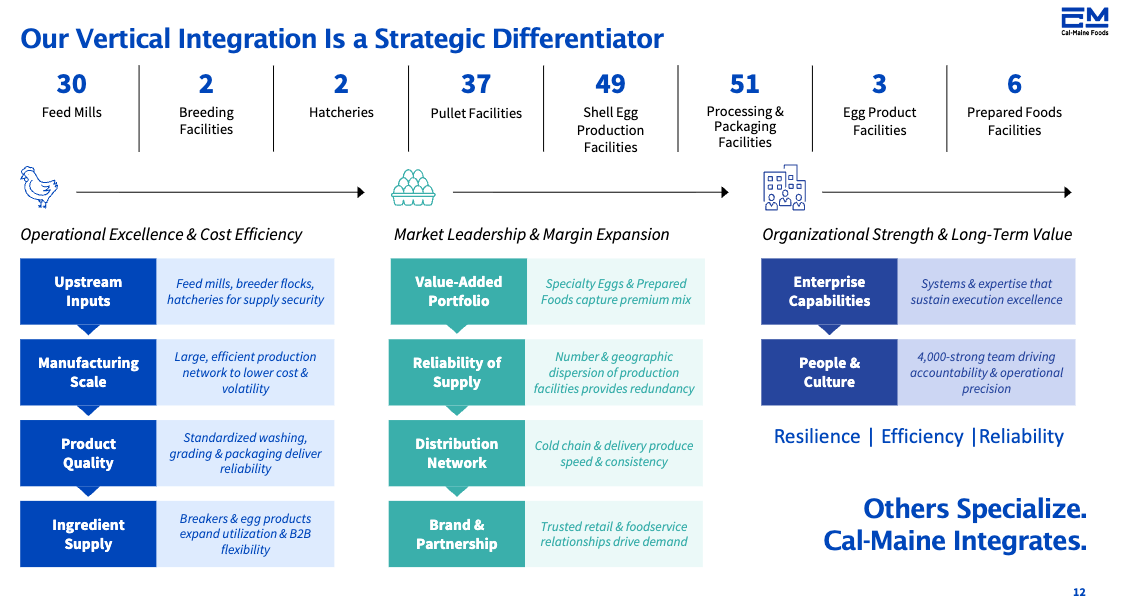
Eggs are sold as either conventional shell eggs (i.e. laid by hens in wire cages) or specialty eggs which carry higher prices (i.e. free-range, cage-free, organic, pasture-raised, etc.). You can read about the differences here.
Note: specialty eggs may have higher margins that are less dependent on market-based pricing formulas, but they are still somewhat cyclical.
In FY26, Cal-Maine sold 46% conventional shell eggs, 37% specialty eggs, 8.4% prepared foods, and 8.5% “other” items (co-pack shell eggs, hard-cooked eggs, etc.).
Why it’s interesting…
Cal-Maine looks like a plain vanilla “mean reversion” bet with a few other attributes that make it attractive. It’s a simple pitch.
Here’s what I like about this one…
1) Dominant player in cyclical industry
Huge scale & vertical integration advantages make CALM the (likely) low cost producer in this industry which is critical when market-pricing swings as wildly as eggs do.
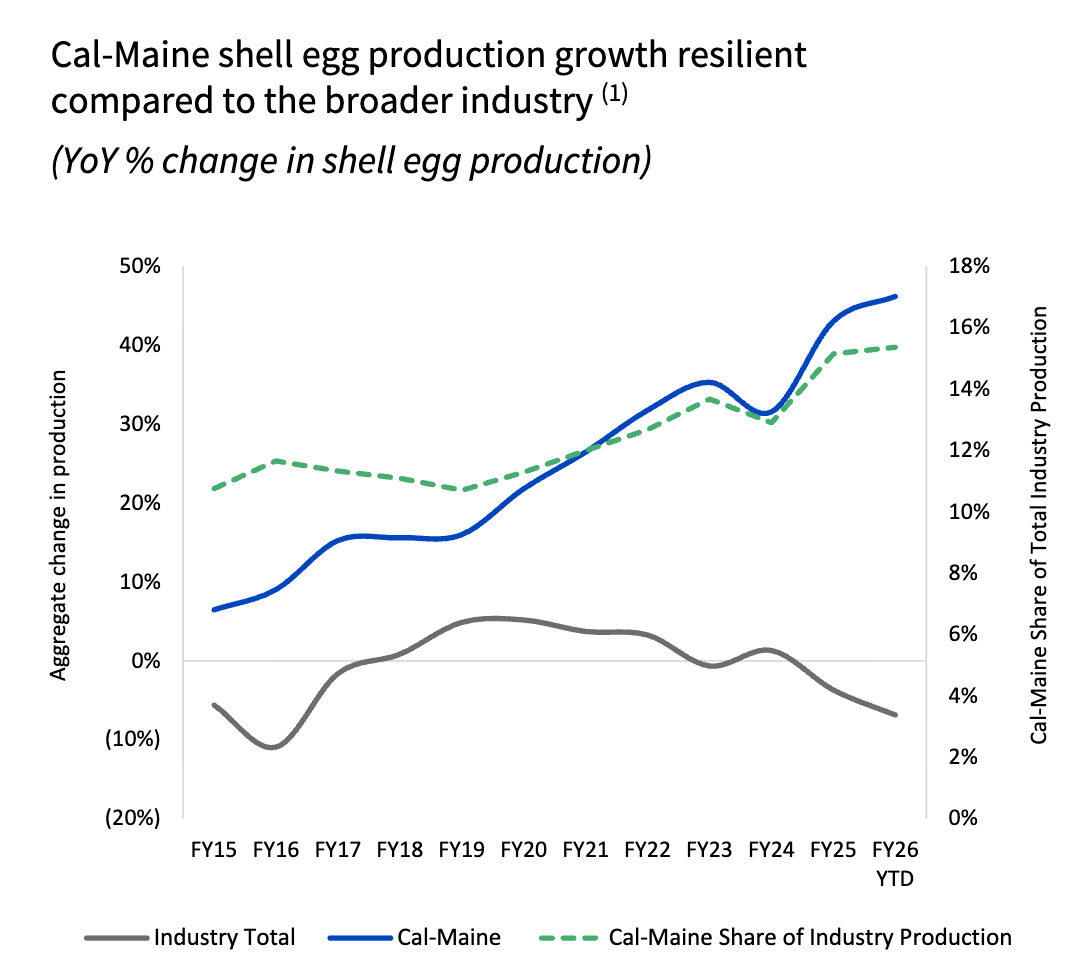
Over 10+ years, CALM continues to grow overall production (both organically and through acquisitions) while increasing their share of industry volumes.
2) Balance sheet is rock solid
The best cyclical stocks have a combination of scale/cost advantages (check) and industry-leading balance sheets (check).
As of FY26, net cash & investments totaled $924m or ~$20 per share
That represents 35% of book value and 23% of the current market cap (i.e. a substantial amount)
Historically, net cash consistently represents 20-40% of book value (i.e. a conservatively managed balance sheet is part of the operational plan)
3) Consistent book value growth & valuation
I may buy shares solely on the basis of this long-term P/B chart:
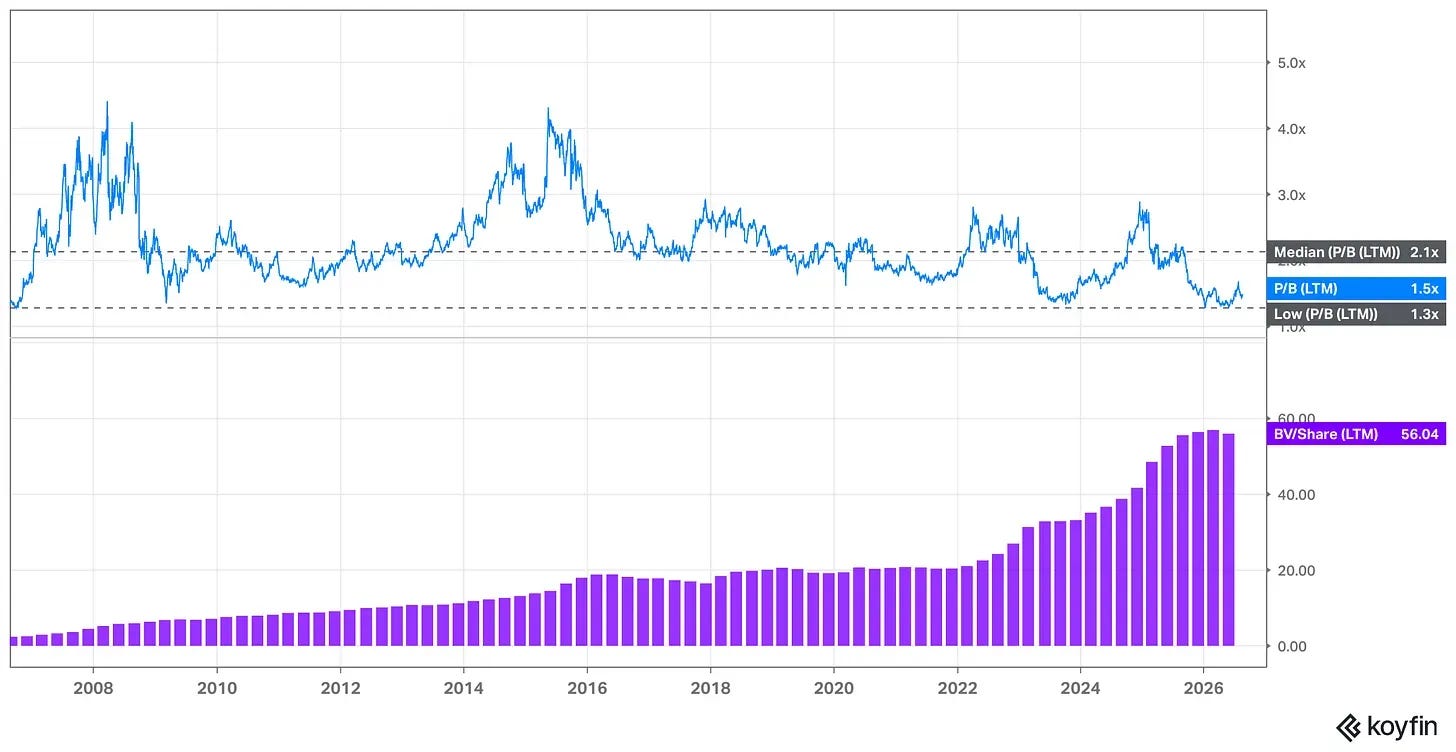
Despite cyclicality, CALM is consistently growing book value per share (from $2 in Sep 2006 to $56 in May 2026 = ~18% CAGR).
Price-to-book is likely the most appropriate valuation metric given the capital intensity and persistently defensive cash position. P/B ranges from 1.5-3x with a median of 2.1x over the past 20 years (this timeframe incorporates at least a handful of industry cycles).
Is a 2.1x P/B multiple justified?
I sure think so…
Here’s a chart of ROEs: (1) on a rolling 5-year basis; and (2) as a lifetime average starting from 1997 (i.e. nearly 30 years of history):
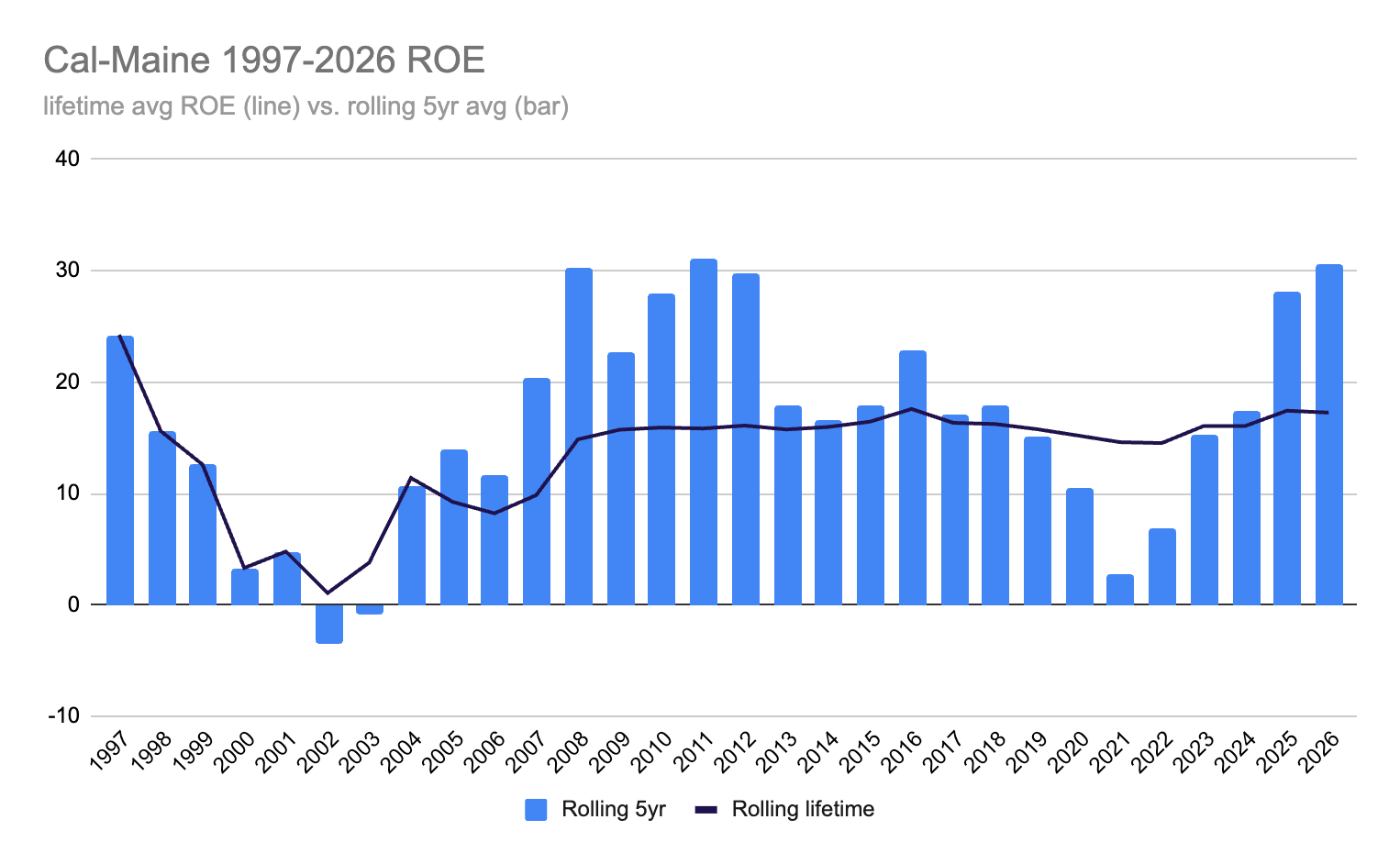
The lifetime average is an attempt to strip out the cyclicality entirely while the rolling 5-year average smoothes it a bit.
Takeaway: It paints a clear picture of consistently high-teens ROEs with periods of 20-30%+ near cycle peaks.
As a quick recap: book value is growing and cash consistently represents a large portion of book value.
4) Capital allocation & cash flow
During boom years, the company socks away cash for a rainy day (i.e. bolstering their already stellar balance sheet).
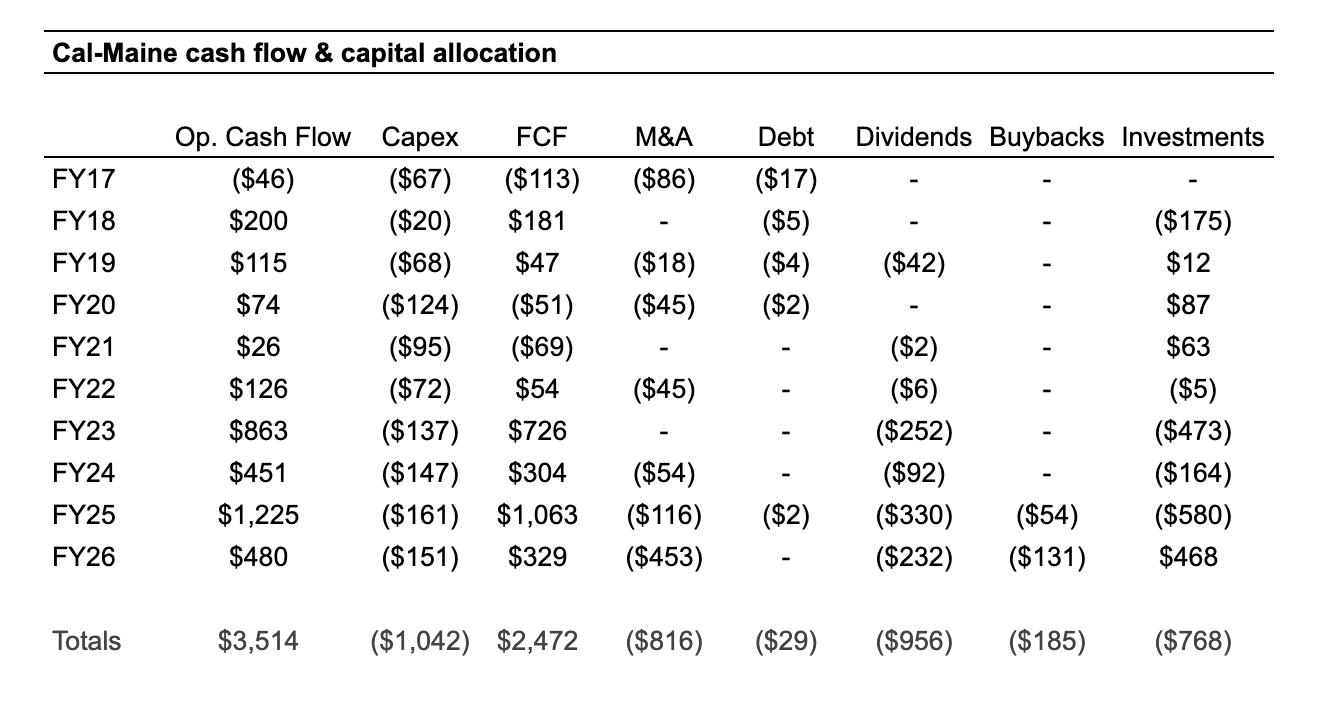
As excess cash piled up post-COVID, they’ve added to their capital allocation priorities:
Buybacks — in early 2025, they collapsed a supervoting dual share structure and launched a $500m buyback authorization and started executing at prices in the mid $70’s.
Dividends — a variable payout policy sends one-third of quarterly net income to shareholders as a dividend with a caveat that dividends are only paid after the company is profitable on a cumulative basis from the date of the last quarterly payout (this is a brilliant approach for a cyclical business).
M&A — management is prioritizing diversifying into “less cyclical” earnings streams (prepared foods became a segment in FY26 and now has $240m+ annual revenue)… in FY26, they spent $260m to acquire branded food products company Echo Lake Foods.
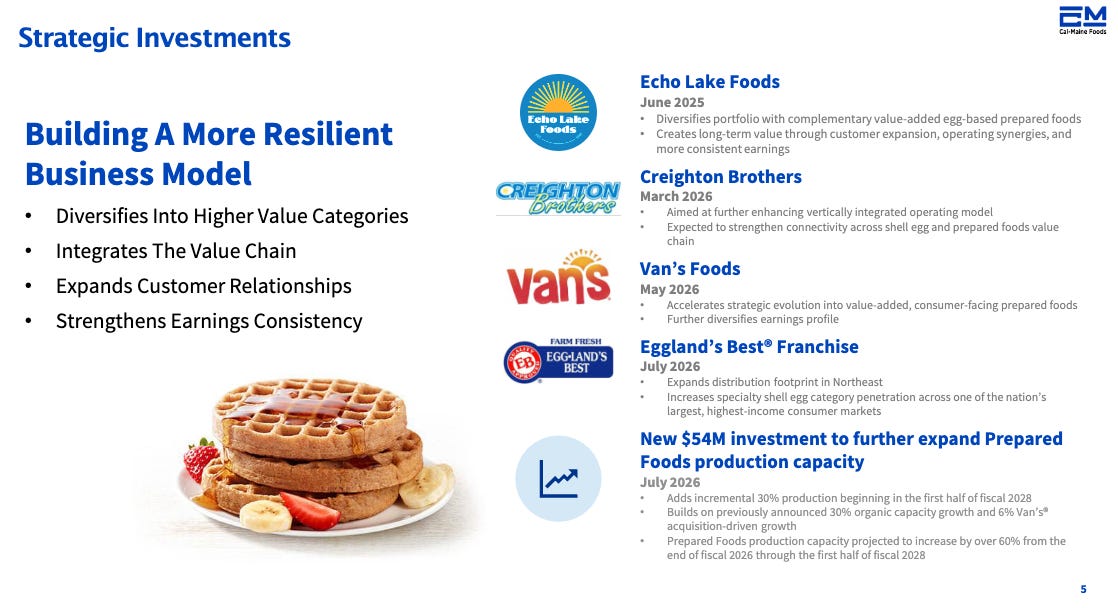
When asked about the M&A environment on Q4 FY26, management said:
We don't know how other people sit bottom line, but we do know that we have more growth opportunities than ever before when you think about M&A from Conventional Eggs to Specialty Eggs, Prepared Foods, the ingredients, liquid eggs that go into Prepared Foods and brands, particularly around Prepared Foods, all this gives us a lot more opportunity. But I just want to reemphasize that our thinking stays egg-centric. We're thinking about bolt-on and tuck-in type M&A when we look at it.
5) Cycle timing
This Q4 FY26 CEO commentary sums up the business and current operating environment well:
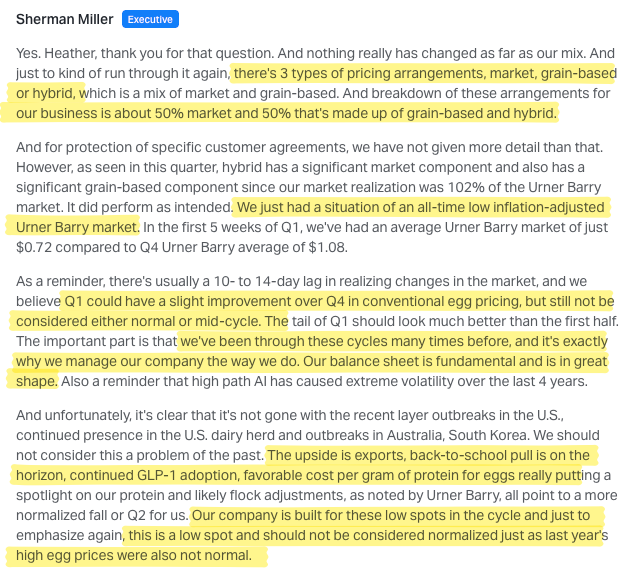
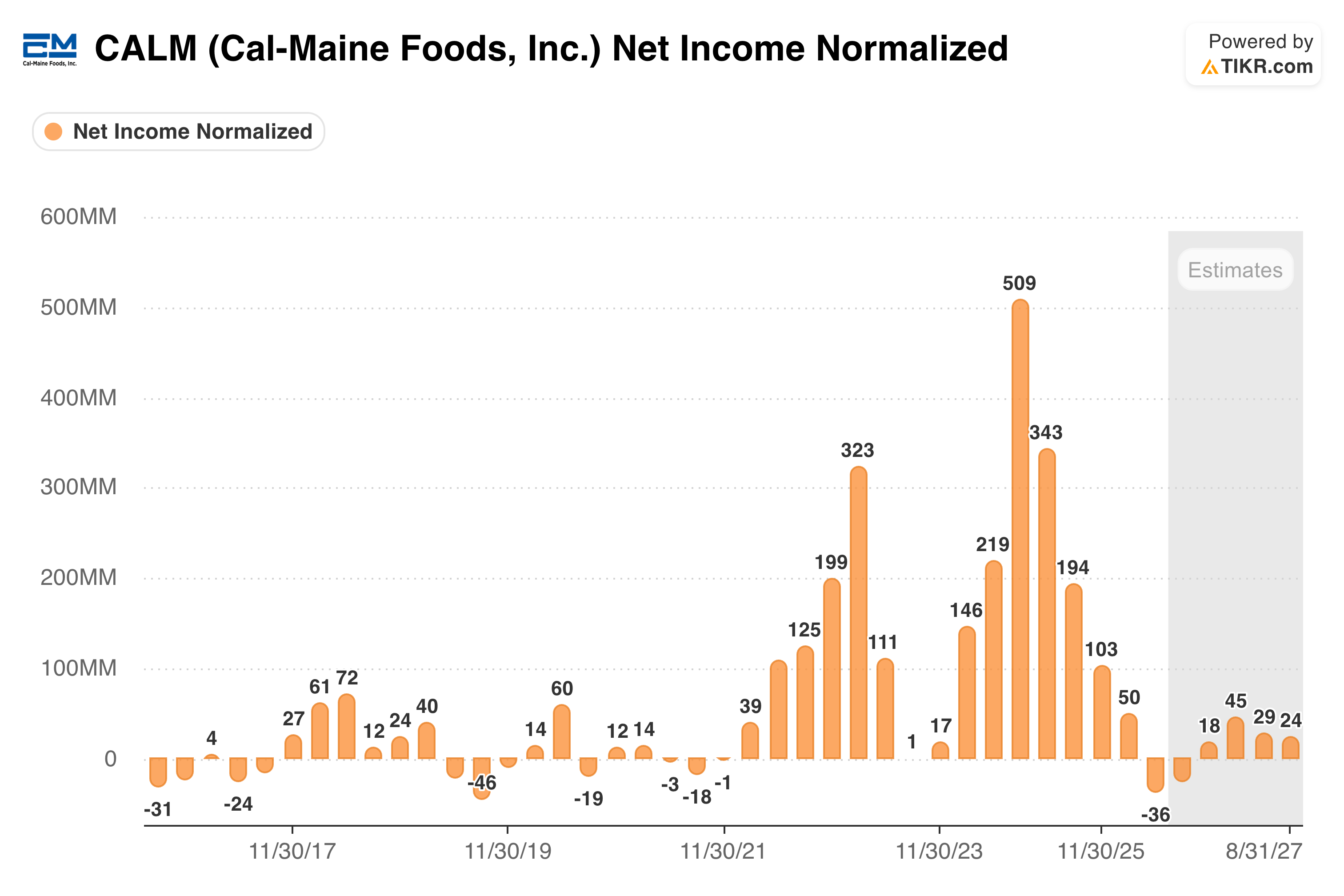
The key takeaway is that the company is managed with this sort of cyclicality in mind which allows them to “play offense” while others are hunkering down. Q4 FY26 net income was negative for the first time since 2021 as prices collapsed.
Management noted prices started Q1 FY27 ($0.83) even lower than Q4 ($1.07) before recovering at the tail end of the quarter and into Q2 ($1.39).
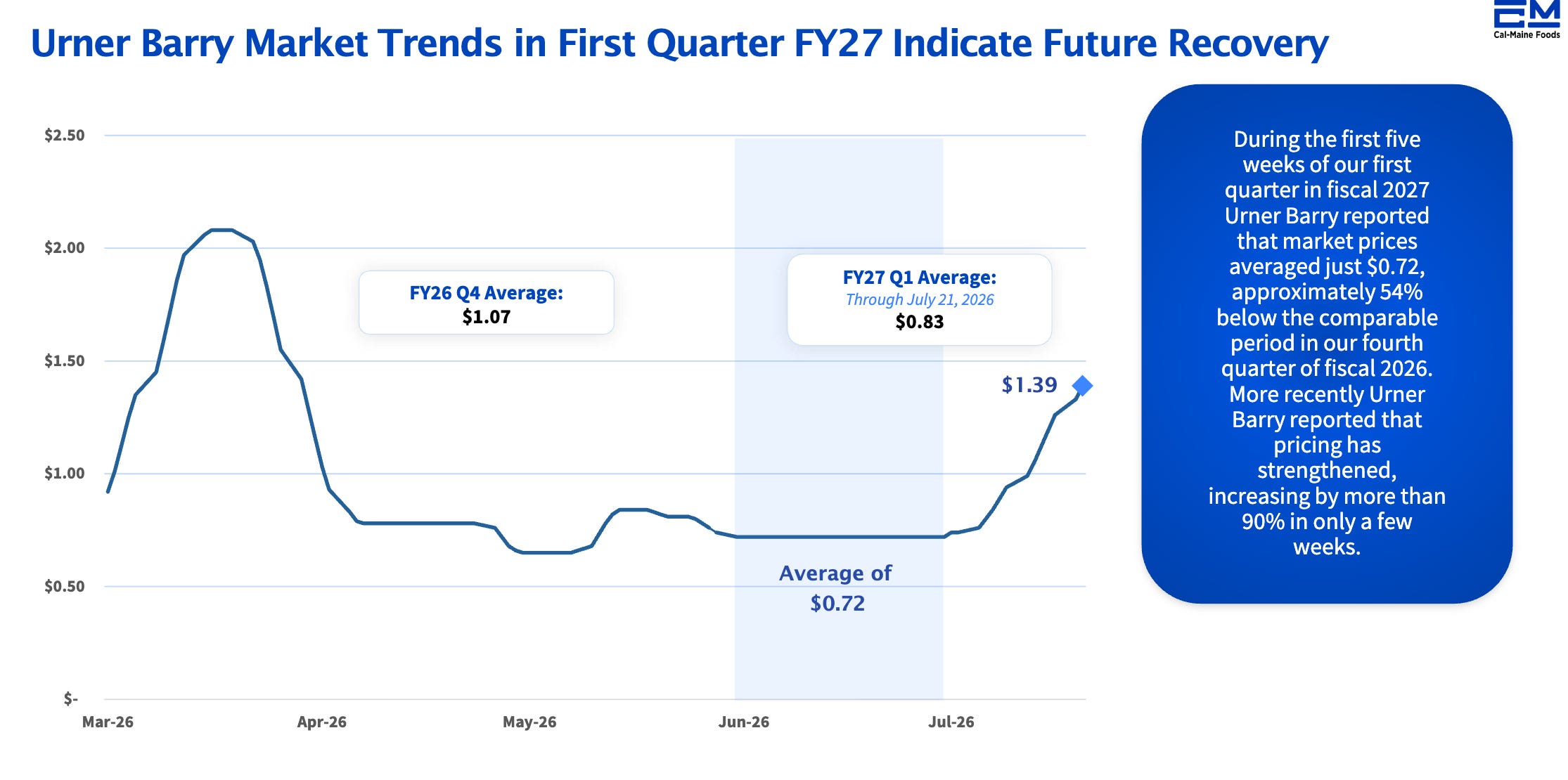
This likely implies another quarter of losses in Q1 before a potential recovery going into Q2.
So what could shares be worth?
There are ~47m shares outstanding x $84 = $3.95bn market cap. Net cash and investments are $924m for a ~$3bn enterprise value.
While the company doesn’t have a stated financial goal of growing book value per share, I’ll use that as my basis for valuing this business since it requires significant capital investment and carries lots of cash.
Upside — Using current book value of $56 per share at 2.1x P/B = $118 per share or 40% upside.
Downside — At 1.3x P/B (CALM’s 20-year historic low multiple) = $73 per share or 13% downside.
This works out to a 3x upside/downside ratio which is fairly asymmetric.
It also gives zero credit for recent investments/acquisitions or future book value growth and capital allocation.
Clearly, it could trade lower than 1.3x book value and this doesn’t account for potential declines in book value in Q1 FY27.
Summing it up…
CALM looks one of the cleaner mean reversion ideas I’ve come across in a while. It’s a dominant cyclical trading near the low end of its historical valuation range with a fortress balance sheet and (potentially) nearing a cycle low.
There’s always a risk the cycle bottom is farther away than anticipated, but it looks like an industry where supply/pricing normalizes relatively quickly.
I don’t own shares yet, but I’ll likely take a starter position in the low-to-mid $80’s with an investment horizon of 4-6 quarters as pricing recovers and the valuation gap closes.
Disclosure: no position in CALM, but I may purchase shares this week.
Resources:
Thanks, like the idea generally. It is important to note that they had 6 lean years where they averaged 80 cents/yr EPS, followed by the last 4 years where they averaged $13/shr EPS.
I think of FV as a 12x multiple to through the cycle EPS of ~ $7.20, plus cash, maybe $107...the question is how long the down cycle is, and if we have a couple years or more of this being a dog
$VITL Vs $CALM
I pick $VITL