
Today’s idea:
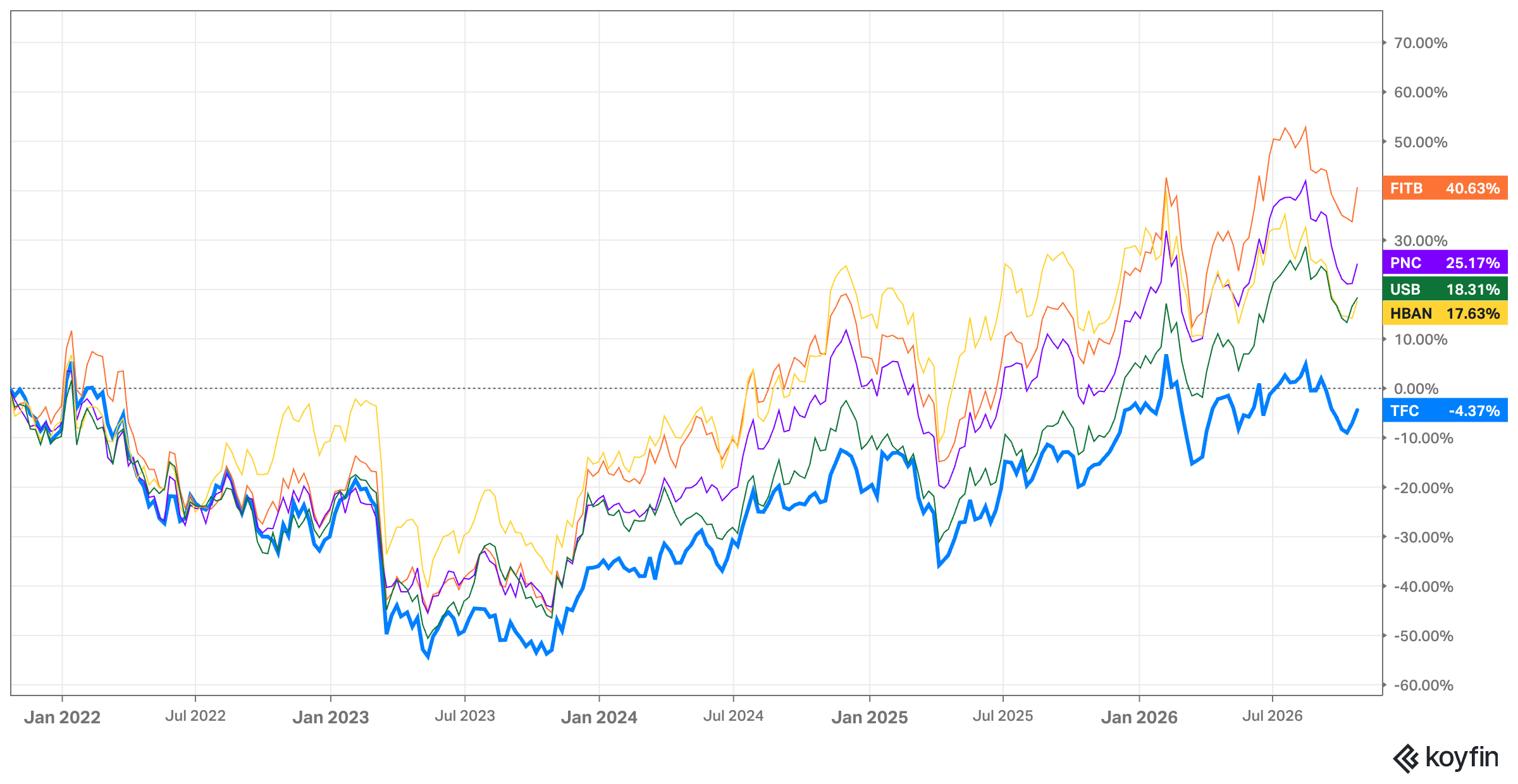
Shares of TFC have underperformed peers for 5+ years
New CEO took over in September 2026 and already pivoting
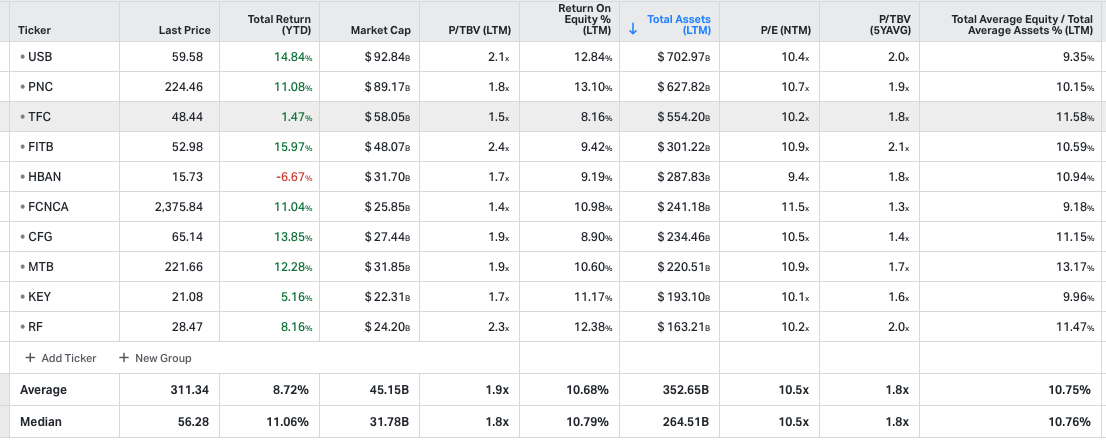
Stock is cheap at 10.5x earnings and 1.5x TBV (peers trade at ~2x)
For new subscribers — these write-ups are meant to be a “jumping off point” for the idea generation process (i.e. a surface level review). Each write-up includes: (1) company background; (2) why the idea is interesting; and (3) fair value estimate.
Check out past write-ups here and my home base page here.
Recent write-ups include:
10/19/26 — New recommendations in the portfolio ($)
10/12/26 — Beaten down CPG stock at Flowers Foods
10/10/26 — Net cash + massive cost saving story at Thinkific ($)
10/01/26 — Field guide for investing in turnarounds
09/28/26 — Gentherm RMT transaction ($)
Quick Value
Truist Financial (TFC)
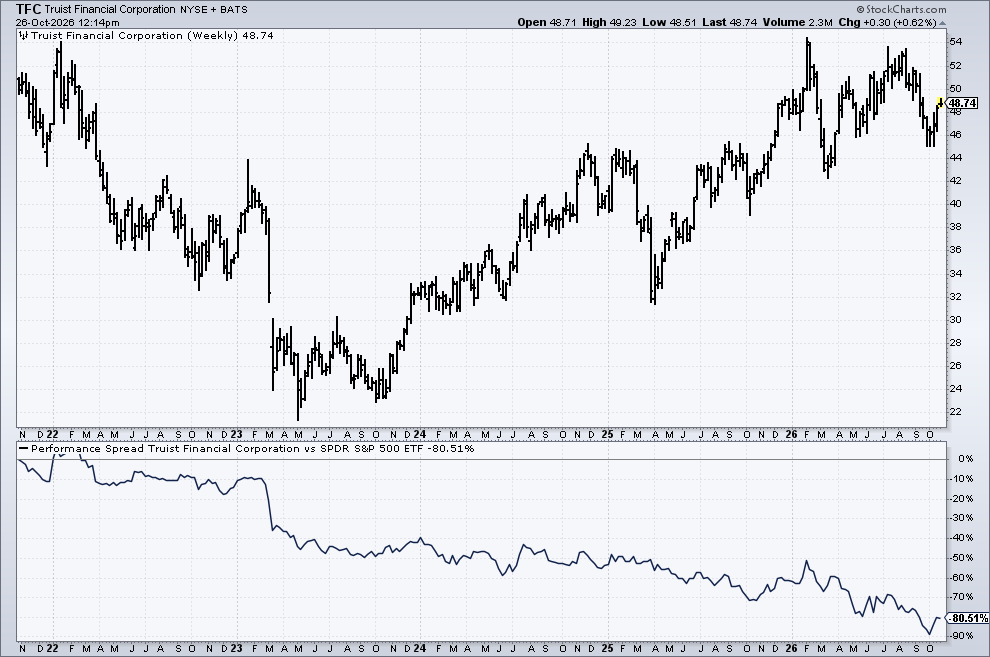
Ticker: TFC
Price: $49
Shares: 1.2bn
Market cap: $59bn
Valuation: 10.5x earnings / 1.5x TBV
Theme: management change
I get a daily feed of special situation ideas and on consecutive days I caught news about a new CEO (management change) and a sizable open market purchase (insider buying).
While I don’t normally look at a lot of large cap ideas, this one was intriguing. Here are my notes…
TL;DR:
Truist Financial (TFC) has badly underperformed the market & peers since its 2019 merger; as a result it trades a 20%+ discount
A new “outsider” CEO took over in September (management change) and is already making changes (simplifying the business, selling non-core assets, and repositioning the balance sheet)
Management is targeting peer ROTCE levels (16-18%); if they can hit those targets, there’s a reasonable path for a 35–40% re-rating over the next 2-3 years
Background
Truist is the 10th largest bank with roughly $550bn in total assets serving mostly southern states (large presence in Florida, Georgia, Virginia, and the Carolinas) with a 1,900+ branch network.
It’s a mostly C&I loan book (51% of their $326bn loan book) with a large consumer portfolio too (36% of loans). Deposits are $413bn at Q3 2026 with 25% from non-interest bearing sources.
Non-interest revenue sources are ~32% of revenue ($5.9bn in FY25) consisting of wealth management ($1.4bn), treasury management ($1.3bn), and investment banking ($1.1bn).
Some history:
2019 — BB&T and SunTrust complete $28bn all-stock “merger of equals” and rebranded as Truist Financial. Shares finished the year around $56.
2020-2023 — Merger integration period with $2bn+ restructuring charges and a $6bn goodwill impairment in 2023. Rates started climbing during this period and TBV eroded. Shares went from $56 to $37.
2024-2025 — Sold their largest source of fee revenue (insurance division) for ~$12bn to shore up the balance sheet. Earnings and TBV recovering. Shares went from $37 to $49.
2026 — Earnings recovery continues, modest buybacks, divestitures, and a new CEO taking over as of Sep 2026. Shares flat on the year vs. peers up 10-15% YTD.
Why it’s interesting…
Truist is an industry laggard both in share price performance and fundamentals, meaning there’s some upside to peer valuations assuming they can close the gap.
Here’s how TFC stacks up against peers over the last 5 years:
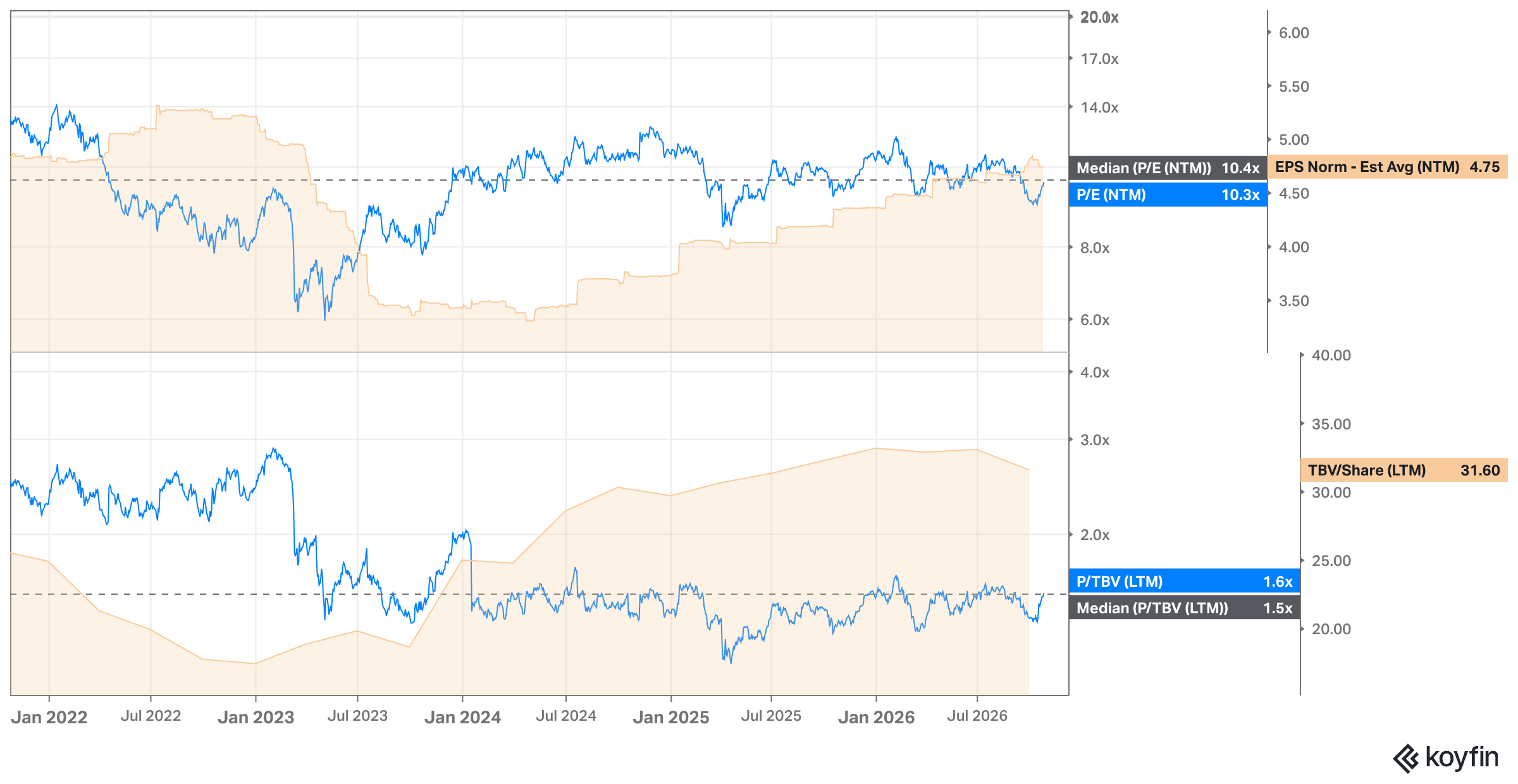
On a fundamental basis, TFC trades at a 20%+ discount to peers on a TBV basis (1.5x P/TBV vs. peers at 1.9x).
Much of this underperformance was a result of poor execution (and decision-making?) since the 2019 merger — restructuring costs, impairment charges, poorly positioned securities portfolio at low rates ($8bn losses in held-to-maturity securities), divested large non-interest revenue stream, etc.
So how are they going to close the performance gap?
The company brought in an outsider to figure that out.
Former CEO Bill Rogers (a holdover from the 2019 BB&T/SunTrust merger) retired in September 2026. He was replaced by longtime PNC exec and previous Fiserv CEO, Mike Lyons.
This is a really early management change situation (literally first inning here).
A few things intrigued me about this new CEO…
(1) Incentive package — Lyons was given a huge incentive package worth $60m+ (part of which was a replacement for lost comp in his CEO role at Fiserv). On top of that, he took his $1m “sign-on” bonus and bought $1m worth of TFC shares in the open market at $48.
This was literally the first insider purchase in years…
Governance rules require the CEO to hold 6x his base salary in TFC stock (which can include unvested RSUs, but not PSUs). Lyons is already at $18.4m or 14x his base salary. Seems like good alignment.
(2) Strategic review — After roughly two months on the job, they’ve already divested an auto loan portfolio (RAC) for $5.2bn, repositioned $8.6bn of low-yield securities, and announced a $7.7bn divestiture of their unsecured lending platform, LightStream, to Carlyle.
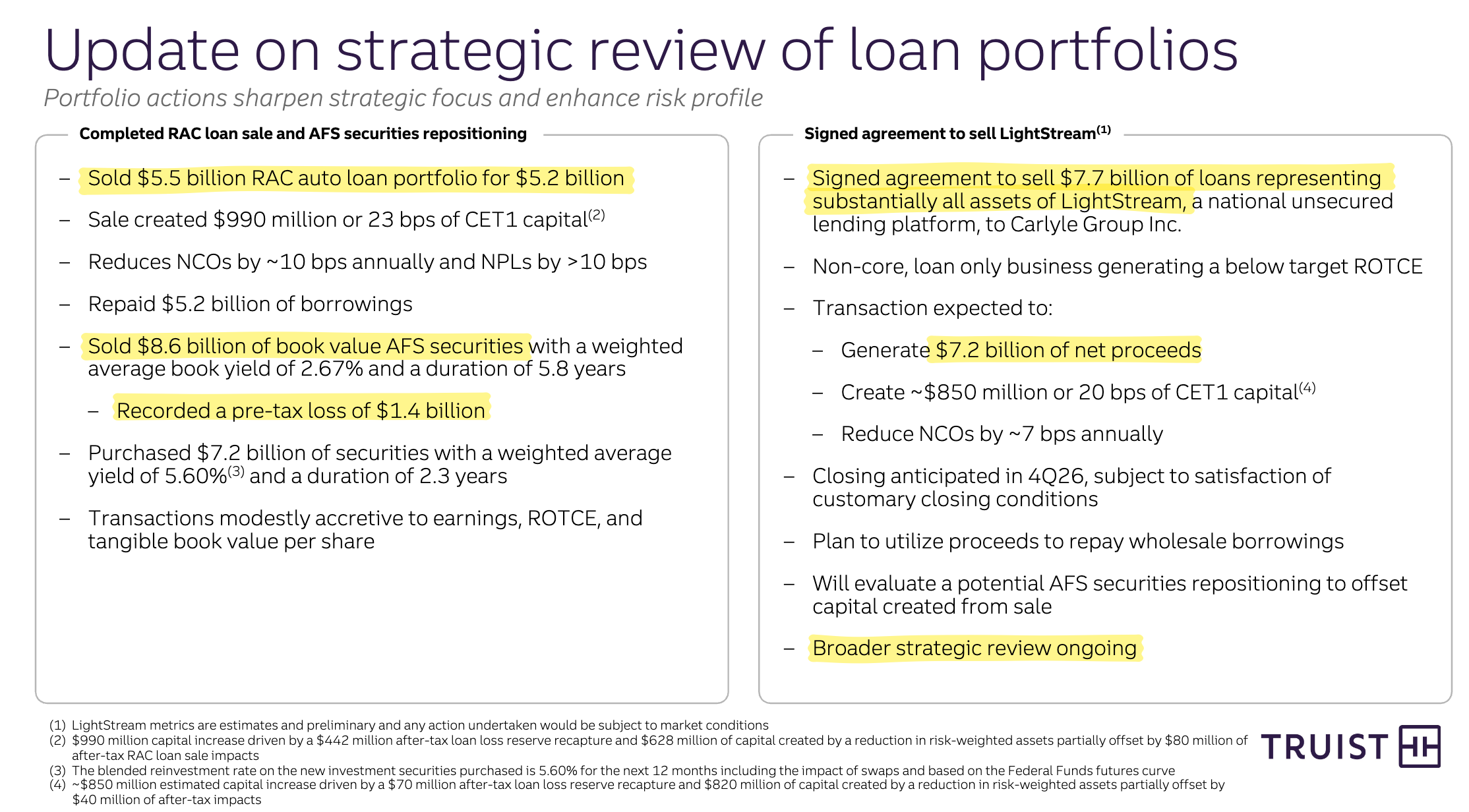
In total, these asset sales bring in $12.4bn proceeds and free up modest amounts of capital. Maybe it’s a signal that they’re gearing up for more radical changes at the bank?
Hmm…
So what’s the plan from here?
In early 2027, management plans to provide “more details on our outlook for the year and our path to becoming a top-performing bank as the investments we're making take shape over time.” So it sounds like we’ll get investor-day-like updates alongside full year results.
A few tidbits were dropped on the 3Q26 earnings call which hint toward the plan:
Historically, Truist “operated too many nationally focused stand-alone single product businesses” which “diverted attention and resources from growing our core deposit franchise.” (non-core asset sales)
Focus on fee revenue — commented on building/growing treasury management, wealth, and other service lines.
“We need to get back to basics, simplify how we work, remove unnecessary complexity and eliminate low priority activities” (improve loan growth)
“The biggest opportunity I've seen is just be clear on the strategy and then align our capital and resources against it” (improved focus)
On the call, Lyons reiterated a 15% ROTCE target in 2027 and 16-18% over the “long-term.” (US Bank and PNC each run at 18%+ ROTCE).
What could shares be worth?
There are ~1.2bn shares outstanding x $49 = $59bn market cap. Here’s a summary look at fundamentals:
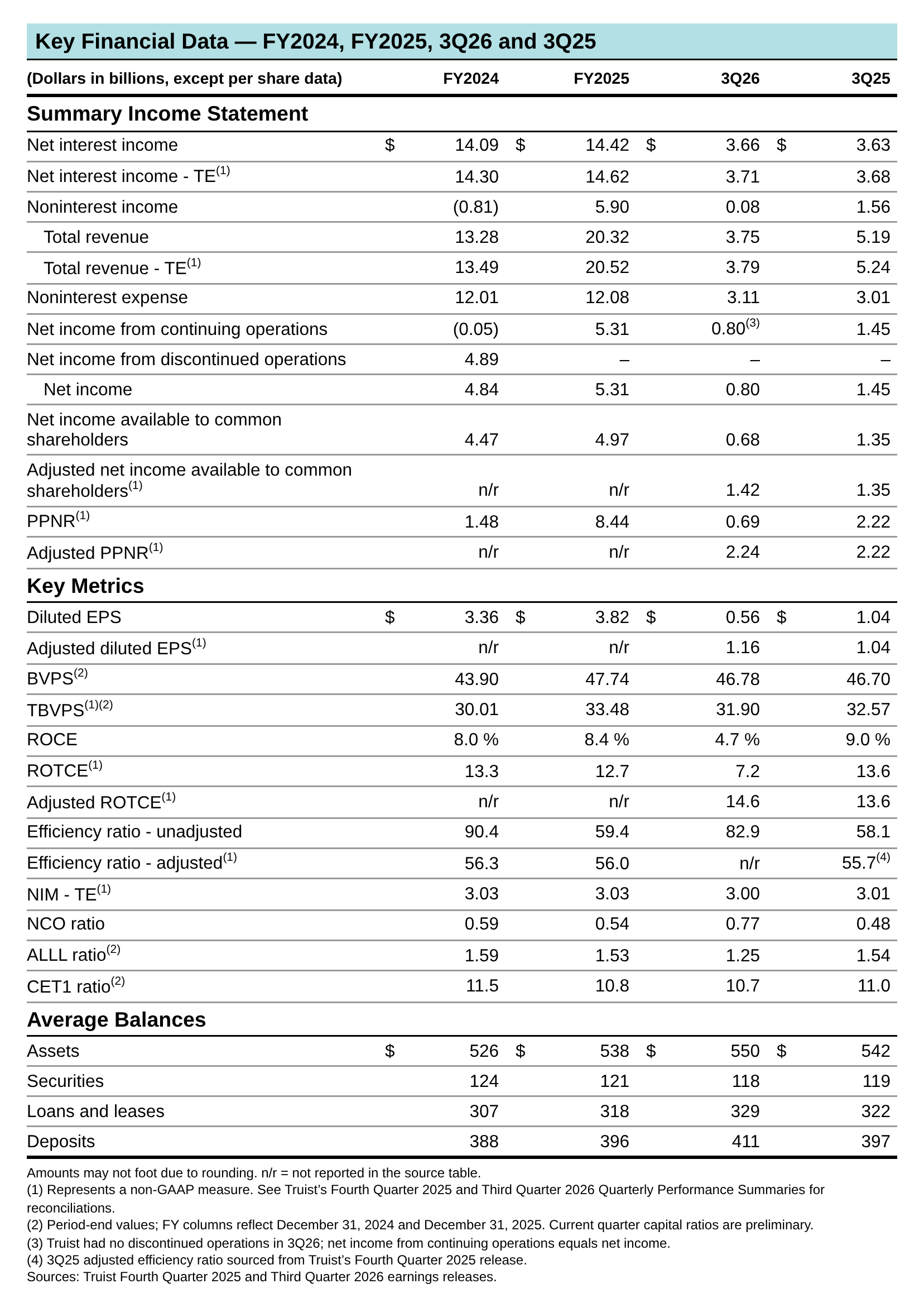
I’m looking at this on a 2-year horizon (into 2028):
Upside — Assuming they hit the 15% ROTCE target in 2027 and build a reasonable bridge to 16% by 2028. Tangible capital finished 3Q26 at $38bn, 2027 earnings should add $5.7bn and buybacks/dividends likely offset that amount while bringing share count down to ~1.12bn or so. A 16% ROTCE on $38bn = $6.1bn or $5.45 per share by 2028 with $34 per share TBV. At 2x TBV = $68 per share (39% upside), which works out to 12.5x earnings.
Downside — Tangible capital erodes as they reposition the securities portfolio and invest for growth, leaving little room for buybacks. Shares traded down to 1.2-1.3x TBV in early 2025 = $38 per share (-22% downside) on a lower TBV per share level of $32.
That’s ~1.8x upside/downside and perhaps could be better if there’s a sensible bridge to 17-18% ROTCE. Sell-side estimates have Truist earning $4.93 in 2027 and $5.40 in 2028, but 17-18% returns would likely push earnings closer to $6 per share. This could be a solid self-help earnings growth story in the making.
Summing it up…
Perhaps the biggest “risk” not yet discussed is the questionable Fiserv tenure from Mike Lyons. He was there only a short period (~18 months) and the stock performance was horrendous (-75%). Maybe that job was too far afield from his banking career?
Aside from that, TFC is cheap relative to peers and has an interesting management change aspect to it. That’s the likely catalyst to close the gap.
If successful, you can probably pencil out a 20%+ IRR over the next 2-3 years.
It’s not a screaming bargain, but it’s a reasonable story in large cap land.
Disclosure: no position.
Resources:
The point that TFC trades at 1.5x tangible book against peers near 1.9x frames the re-rating case clearly, and it makes execution under the new CEO the main variable to watch.