
Today’s post:
Upcoming spin-off of 2 disparate businesses
Several recent “clean up” catalysts now completed
Shares trading at 9.6x EBITDA after spin-off stranded costs
For new subscribers — these write-ups are meant to be a “jumping off point” for the idea generation process (i.e. a surface level review). Each write-up includes: (1) company background; (2) why the idea is interesting; and (3) fair value estimate.
Check out past write-ups here and my home base page here.
Recent write-ups include:
07/20/26 — Jockey-led holding company at HCI Group ($)
07/13/26 — Fubo + Hulu Live merger + management change
06/29/26 — Somnigroup’s vertical integration acquisition spree
06/23/26 — Guide to GoodCo / BadCo situations (a look at Tripadvisor) ($)
Quick Value
Resideo (REZI)
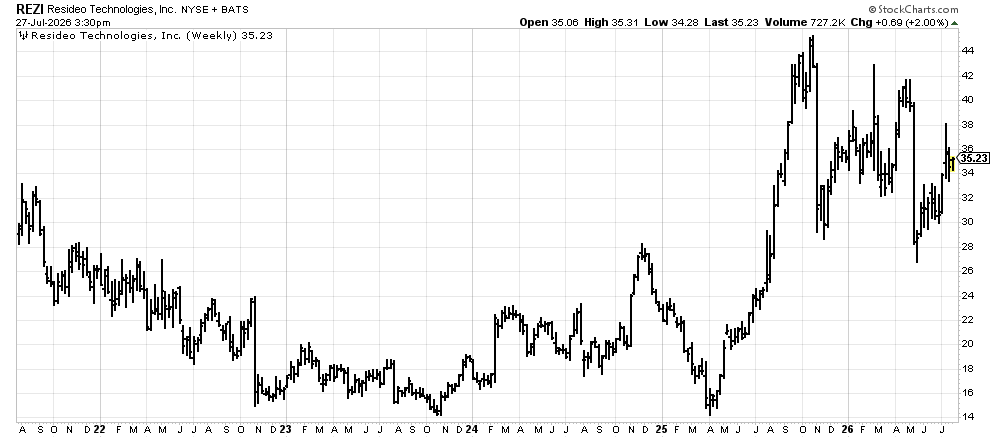
Ticker: REZI
Price: $35
Shares: 155m
Market cap: $5.4bn
Valuation: 9.6x EBITDA
Theme: Spin-off
When I wrote my “guide to spin-offs,” I mentioned lack of overlap / disparate businesses as a common reason for companies to pursue a spin:
Maybe there’s just honest-to-goodness lack of overlap in the business. This is perhaps the most fertile hunting ground for spin-offs (and the best reason for companies to do them in my opinion).
This feels like one of those moments.
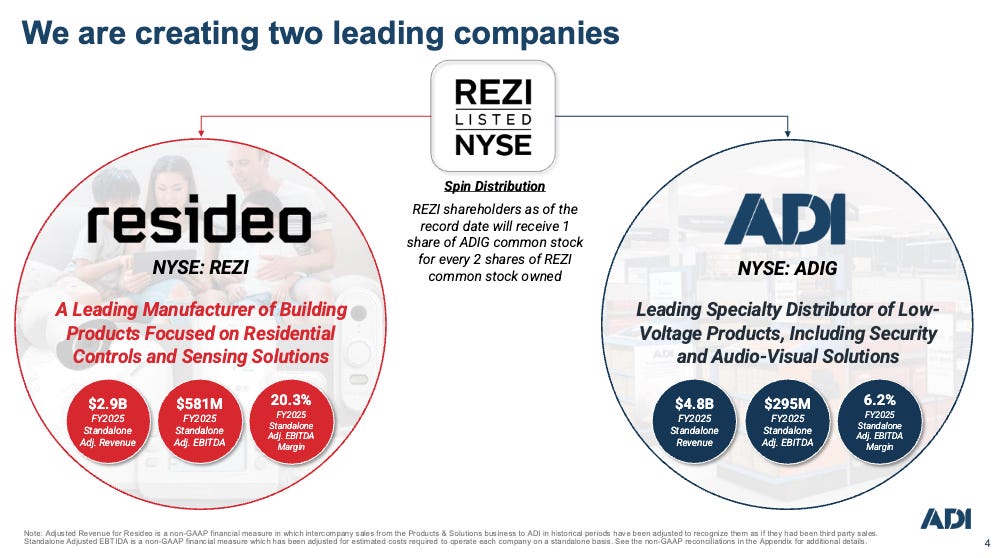
Resideo (REZI) is set to spin-off their wholesale distributor in just a few days.
Let’s take a closer look…
TL;DR:
Resideo is separating its high(er) margin manufacturing business from ADI Globa, its low(er) margin distribution business.
The spin follows a $1.59bn termination of a legacy Honeywell indemnification agreement, removing a huge cash flow overhang
I estimate RemainCo is worth $25–29 per share and SpinCo is worth another $13–17 per share (using pre-spin share count) = $38-46 per share combined.
Spin completion is just a few days away; as such, I’m waiting for initial trading.
Background
Resideo (REZI) was spun out of Honeywell in 2018 (Form 10 filing).
At the time, Honeywell packaged up their “residential comfort and security solutions” manufacturing business alongside a wholesale distributor of electrical and security products, and spun it off.
Shares underperformed the market since then (for reasons we’ll touch on later), and now REZI is separating the 2 businesses it was originally given.
There are 2 segments pre-spin.
Products and Solutions (RemainCo) — Manufacturer of fire alarms, thermostats, smoke and carbon monoxide detectors, water heater components, dehumidifiers, etc. Lower revenue but higher margins.
ADI Global Distribution (SpinCo) — Distributor of electrical, fire, and safety products used in commercial buildings and residential homes. More revenue at lower margins.
These are very different businesses so the spin-off rationale makes plenty of sense here.
At the time of the 2018 spin, Honeywell left Resideo with a few parting gifts:
Resideo could continue using the Honeywell brand name for certain products as part of a 40-year trademark agreement which includes a 1.5% royalty fee on those product sales. These royalties were $16-18m per year from 2023-2025, so they represent a meaningful portion of sales ($1bn+).
Similar to another Honeywell spin (Garrett Motion) Resideo was left with a 25-year “indemnification and reimbursement” arrangement. Under this agreement, Resideo pays Honeywell up to $140m per year for environmental liabilities incurred prior to the spin. Think of this as an “additional” $3.5bn debt at the time of the 2018 spin (25 years x $140m).
Pre-Spin Fundamentals
A quick look at pre-spin financials helps us understand the story a bit better…
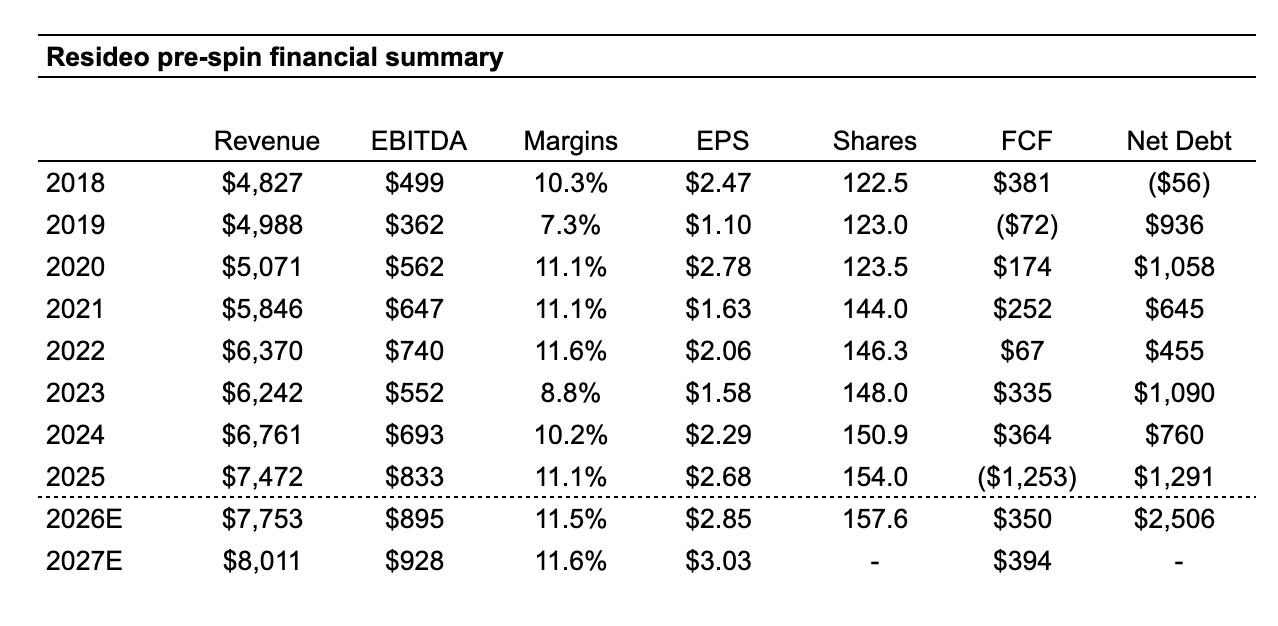
Some items to note here:
2019 — first year post-spin included some “botched” transition items which hurt results out of the gate (share price suffered too)
2020 — issued $279m equity at $15 per share to shore up the balance sheet
2021 — acquired First Alert from Newell Brands inside the manufacturing business portfolio for $593m (added ~$400m annual revenue)
2024 — acquired Snap One Holdings for $1.4bn inside the distribution business (added $1bn+ annual revenue)
2025 — terminated indemnification agreement with Honeywell for $1.59bn (this was the primary driver for negative FCF that year)
In total, from 2019-2025, REZI generated ~$1.96bn in FCF and raised $780m in common + preferred equity ($2.74bn sources of cash)… of that amount, they spent $1.59bn to terminate the indemnification agreement and ~$2.1bn on M&A.
As of today, there are ~155m fully diluted shares outstanding x $35 share price = ~$5.4bn market cap. Net debt (included preferred equity as debt) is $3.2bn for an $8.6bn enterprise value.
RemainCo (Resideo)
Background
Standalone Resideo manufactures a variety of products found in homes. They are the #1 player in thermostats and smoke detectors, producing 15m and 24m units annually.
There are 3 sales channels:
Distributors, including ADI, make up 60% of sales
Retailers like Lowe’s and Amazon are 17% of sales
OEMs of security products (ADT) and water heaters (AO Smith, etc.) are 23% of sales
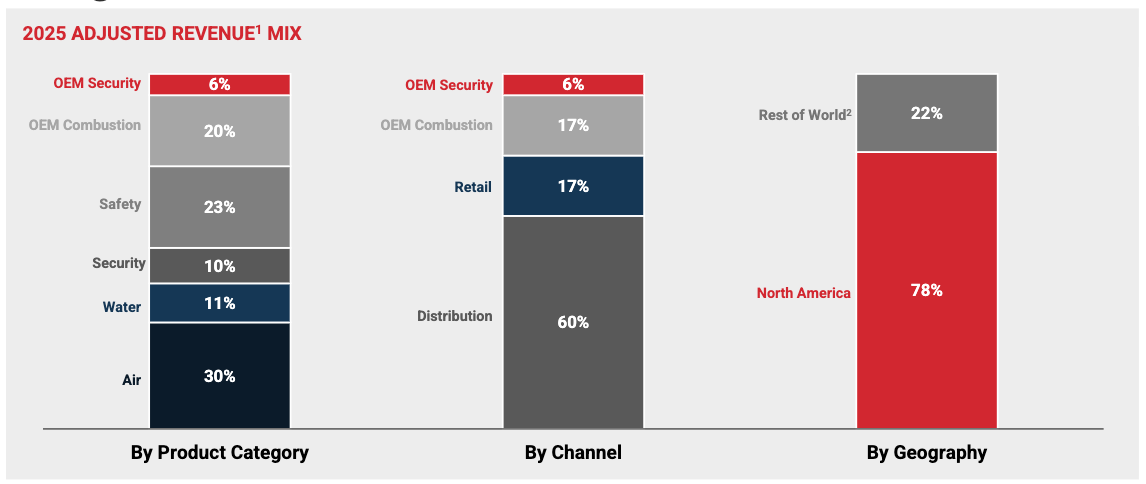
Homeowners are the end-users for Resideo products (they tout an installed base of 150m+ homes and businesses), but they are mainly sold through intermediary channels.
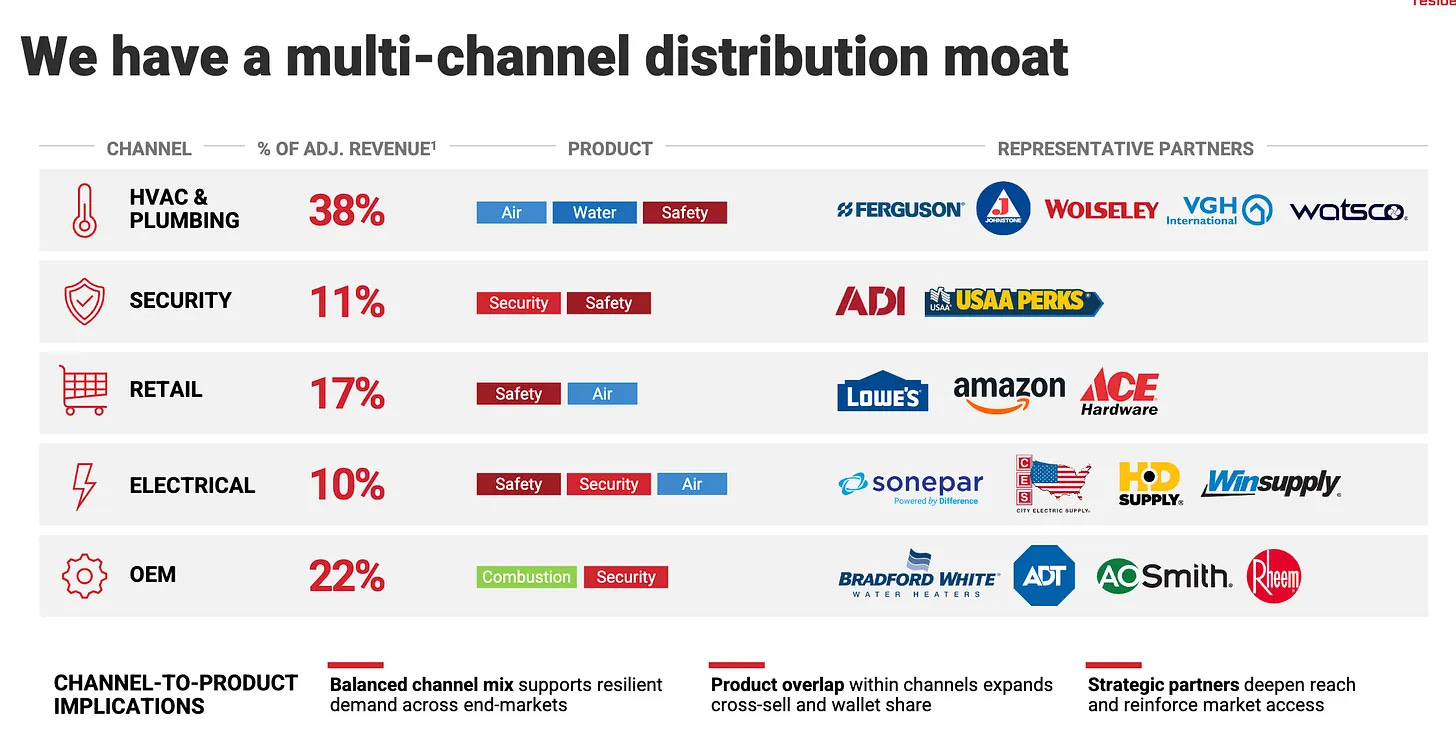
This is, to some extent, a bet on the housing market which has been weak lately. Sales are 80% repair & remodel and 20% new construction according to management.
What’s the financial picture?
On the surface, organic revenue growth looks low. Sales grew ~1.3% per year from 2017-2020, they acquired ~$400m revenue in 2021, and then sales were flat from 2022-1Q26.
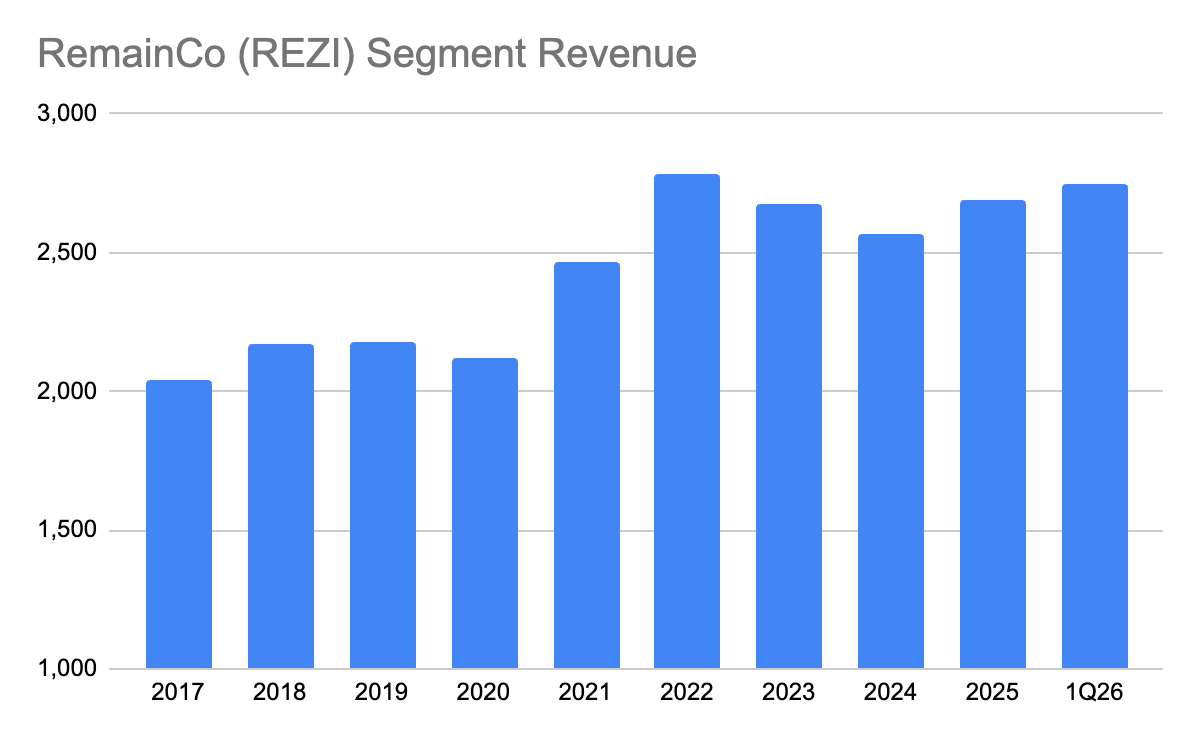
But beneath the surface, it reflects a declining relationship between Resideo and ADI… at the 2018 spin, intercompany sales were $337m which fell to $171m as of 1Q26 (page 77 of RemainCo investor presentation).
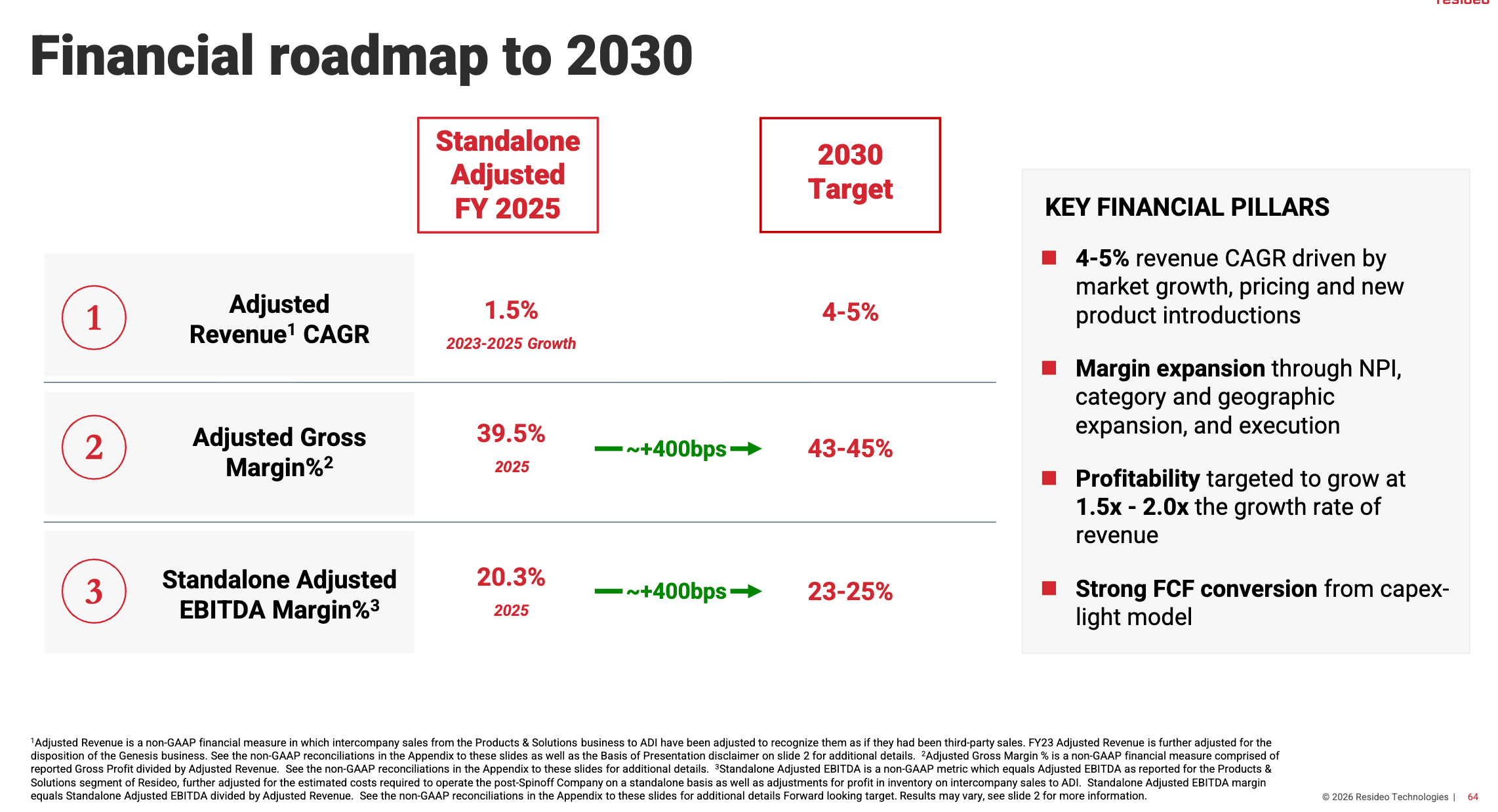
Management expects organic growth to accelerate to 4-5% per year from a combination of market growth (1-1.3%), pricing (1-1.3%), and product expansion / new customers (2-2.5%).
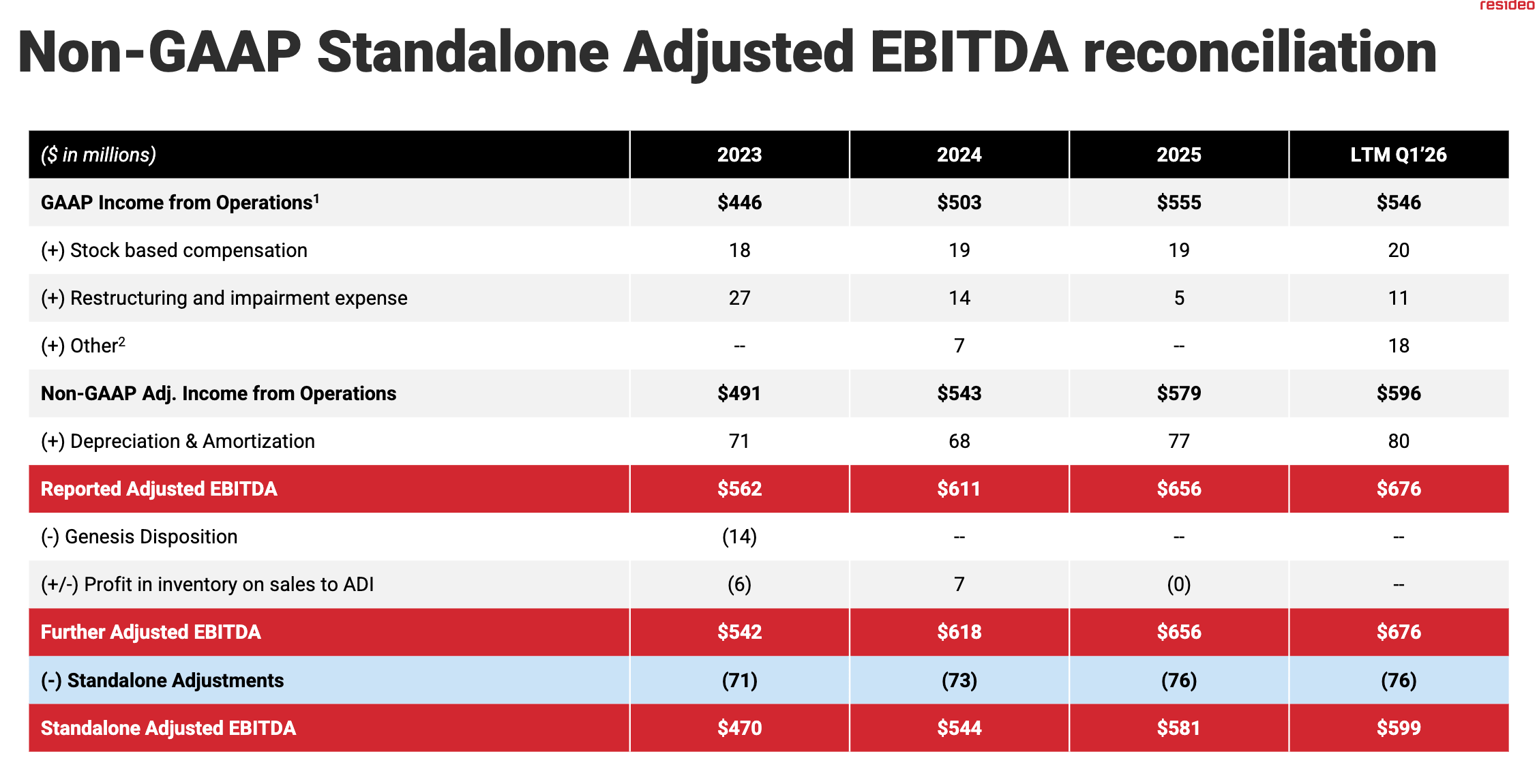
After burdening the company with standalone costs of ~$76m per year, trailing EBITDA is roughly $600m.
The “growth algorithm” includes 2030 financial targets of 4-5% revenue growth (up from ~0-2%) and 23-25% EBITDA margins (up from ~20%).
So what could RemainCo shares worth?
Pro-forma net debt is $2bn (3.3x leverage) before factoring in their share of preferred equity. Management anticipates being at or below 2x leverage within 24 months. Including preferred stock ($350m), net debt is more like $2.35bn.
Trailing revenue is $2.9bn with $600m EBITDA (both as of 1Q26).
If I take management’s financial targets and stretch them to 2028, I get $3-3.1bn sales (1-2% annual growth) and $630-680m EBITDA (21-22% margins).
Peers (JCI, FBIN, AOS, PNR, and WTS) have varying business models with some serving a heavier commercial mix (like Johnson Controls and Allegion), but they have similar margin profiles (18-22%). This group trades at 13-16x earnings on the low-end and ~11x EBITDA.
Assuming 10x EBITDA (to compensate for more leverage) = $6.3-6.8bn enterprise value. Less $2.35bn net debt and 155m shares outstanding = $25-29 per share.
This feels pretty conservative and ignores any cash generation over the next 2 years which could be well over $600m in total.
SpinCo (ADI Global)
Background
ADI Global is a distributor of “low voltage” products for commercial buildings (67% of sales) and residential homes (33% of sales).
They have a product catalog of 500k SKUs from 1,000+ suppliers and sell through a 100k+ professional contractor base. Sales channels include 200 branch locations and an e-commerce platform.
Product categories include: security (cameras, alarms, locks, etc.), audio visual (lighting, smart home, displays, switches), safety (detectors, alarms, etc.), and data communications.
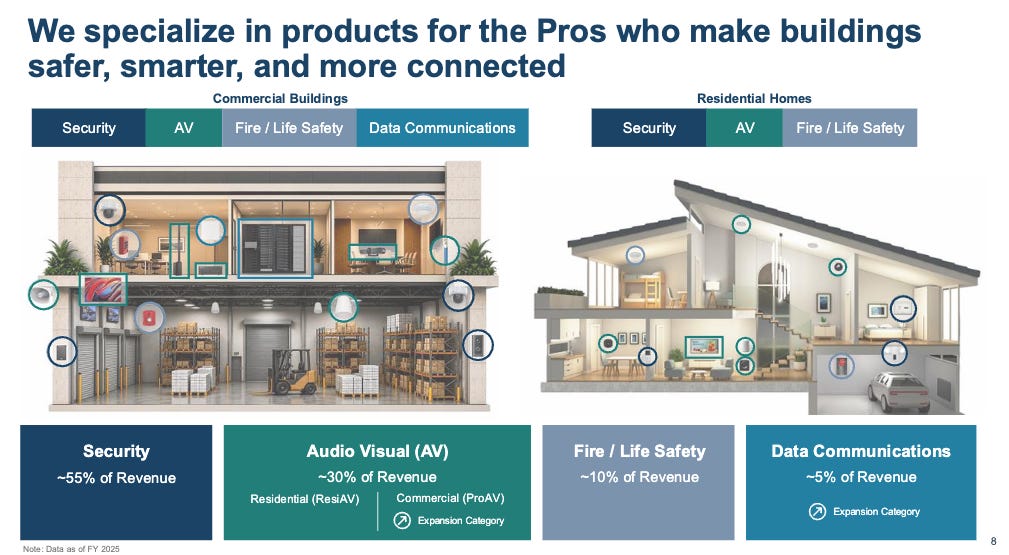
In 2024, ADI acquired Snap One Holdings (SNPO) for $1.4bn which added a large base of exclusive products (which carry much higher gross margins) and expanded the customer base from ~80k to ~100k.
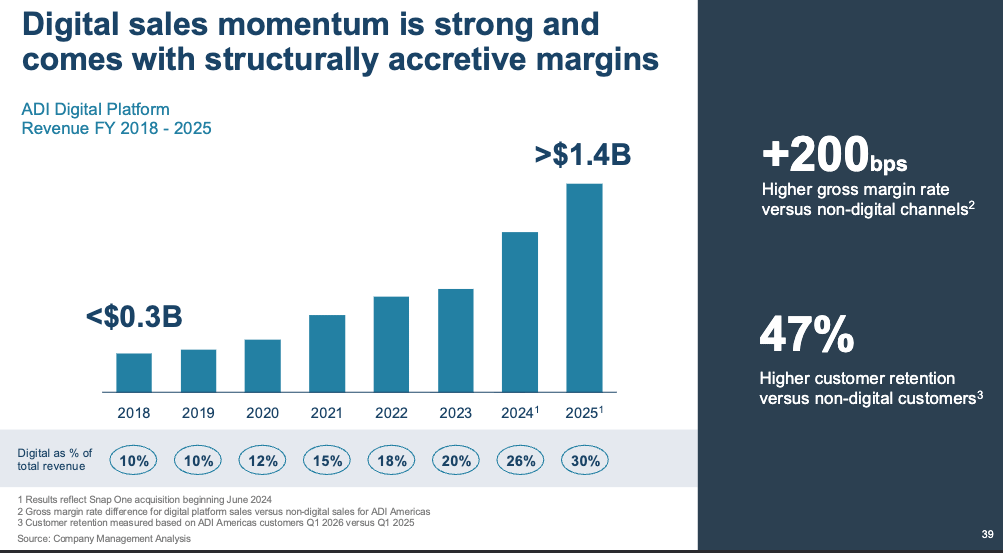
Digital sales channels are also a bright spot, growing from 10% of sales in 2018 to 30%+ in 2025. This channel also carries higher gross margins.
What’s the financial picture?
REZI shareholders will receive 1 share of ADIG for every 2 shares of REZI. That works out to ~77m shares outstanding post-spin.
The balance sheet will have $1bn gross debt, $150m cash, and ~$150m convertible preferred stock. Call this $1bn net debt or 3.4x leverage on $295m EBITDA.
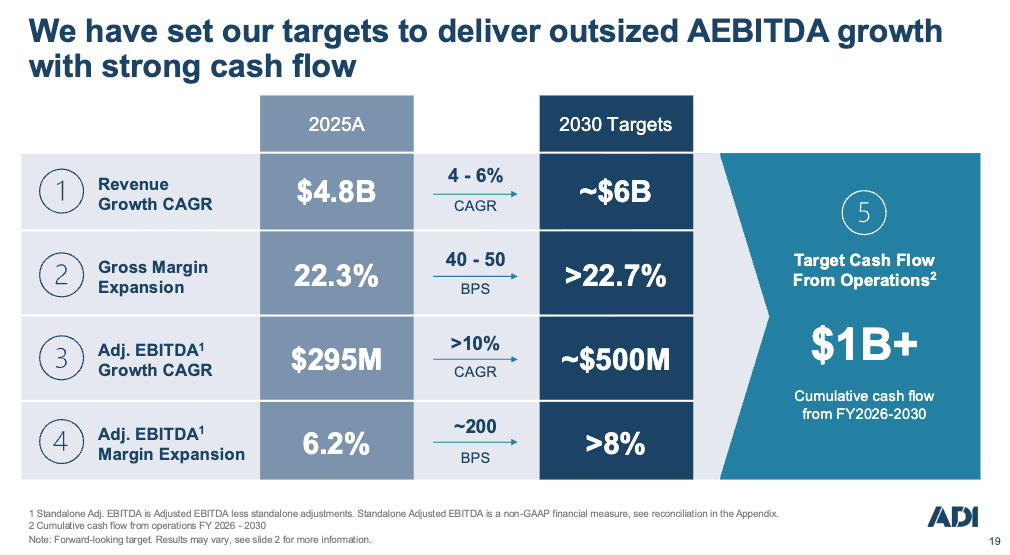
ADI is targeting 2030 sales of $6bn (4-6% annual growth), EBITDA of $500m, and $1bn in cumulative FCF.
So what could SpinCo shares worth?
Distributors like Wesco, Rexel, and DNOW have similar margins at 6-8% and trade at 9-11x EBITDA.
Taking a similar approach with projected sales and EBITDA growth, I get $5.2-5.3bn revenue (2.5-3.5% annual growth) and $325-370m EBITDA (6.3-7% margins) by 2028.
Assuming 9-10x EBITDA (again, compensating for higher leverage than peers) = $3-3.7bn enterprise value. Less $1bn net debt and 155m shares outstanding = $13-17 per share. (That’s $26-34 per share on the post-spin share count.)
Again, there’s no consideration for cash generation here. At a targeted $1bn cumulative FCF from 2026-2030, that’s ~$6.50 per (pre-spin) share over the next 5 years.
Summing it up…
On a combined basis, I get $38-46 per share vs. today’s $35 share price (~9-35% upside).
There are plenty of “clean-up” catalysts here: first the indemnification agreement was unwound, then up is the spin, perhaps the preferred stock comes after that?
Throw in some organic growth and deleveraging and this has an attractive multi-year setup…
Yes, I’ve glossed over some of the risks and potential downsides here…
There’s some reliance on a housing market recovery for both sides of the spin, but this feels like it should be more of a tailwind over the next few years. Google’s Nest smart thermostat product has taken a lot of share in that category, these are competitive product lines.
For now, I’m waiting to see how initial trading goes (since we’re just a few days away from completion). Stay tuned for updates.
Disclosure: no position in REZI.
Resources:
6 weeks later and it looks like the thesis still holds, only the upside is now ~26%-58% (in the short term). Longer term, should investor day projection hold, even more.
I think you hit on a lot of the points here. Unfortunately, it's not as interesting as I would like this to be. Good RemainCo, and I agree with your valuation there.
For SpinCo, there are probably really good efficiencies that can happen, especially around working capital. Which is like a primary driver of their value, but I don't know how much juice is really there anymore.
We'll see if remainco gets interesting. Not as juicy, but enjoyed the write-up.