
Today’s post:
Shares down 50% over the last 5 years and 65% off 2025 highs
Lapping a large (and levered) acquisition from mid-2025
Revenue still growing (20%+) but EPS growth slowing
Stock trades at ~8x earnings and ~7x EBITDA
For new subscribers — these write-ups are meant to be a “jumping off point” for the idea generation process (i.e. a surface level review). Each write-up includes: (1) company background; (2) why the idea is interesting; and (3) fair value estimate.
Check out past write-ups here and my home base page here.
Recent write-ups include:
08/04/26 — Inflection at beaten down MarketWise ($)
07/27/26 — Looking at the Resideo + ADI Global spin-off
07/20/26 — Jockey-led holding company at HCI Group ($)
07/13/26 — Fubo + Hulu Live merger + management change
Quick Value
Shift4 Payments Inc (FOUR)
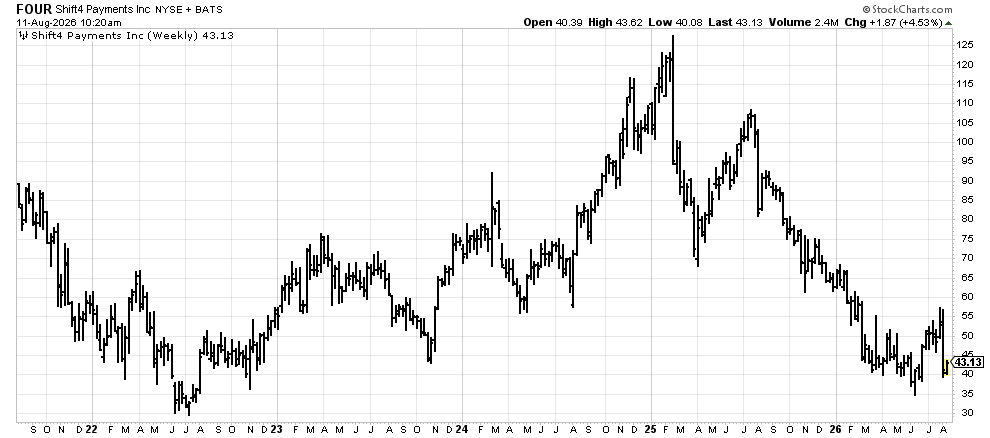
Ticker: FOUR
Price: $43
Shares: 90m
Market cap: $3.9bn
Valuation: 6.9x EBITDA / 8.2x earnings
Theme: Roll-up
This one has been sitting on my watchlist for a while now as the entire payment processing industry is getting clobbered over the past year…
Finally sat down to sort it out. Here are my notes…
TL;DR:
Shift4 (FOUR) is a roll-up in the payment processing industry. It’s a niche player focused on “complex card-present” customers like restaurants, hotels, stadiums, and entertainment venues.
Since coming public in 2020, they’ve spent ~$3.7bn on acquisitions and grew revenue from ~$760m to ~$5bn.
Peers are split into 2 buckets — slow-growing / levered peers trading at 6-7x EBITDA while faster-growing / unlevered peers trade at 10x or more. Shift4 is faster-growing but stuck in the 6-7x EBITDA bucket.
This one is sitting on my watchlist for now — management is still pushing acquisitions with high leverage and EPS growth is slowing/reversing (guide implies 2H 2026 EPS declines).
Background
Shift4 operates in a niche corner of the global payment processing industry.
Some history:
1999 — The company was founded by Jared Isaacman and originally operated as United Bank Card
2012 — Rebranded as Harbourtouch
2017 — Acquired Shift4 Corporation and rebranded under that name
2020 — Came public via traditional IPO at $23 raising $550m+ by yearend
2021-2025 — Spent $3.7bn on acquisitions, founder stepped down and replaced with new (internal) CEO as of mid-2025. Shares went from $65 to $59.
2026 — Digesting levered acquisition, other payments stocks declining, cleaned up founder shares / Up-C structure. Shares went from $59 to $43
It’s a roll-up story having completed dozens of acquisitions since it’s founding, most of which were rebranded under the Shift4 name. With a 2020 IPO, perhaps there was a bit of pandemic hype + unwind in here too.
A (very) brief primer on payment processing
When you go to the store and swipe your credit card, there’s a series of steps taking place behind the scenes which eventually send money from your account (consumer) into the store’s account (merchant).
Those “steps” involve a complex value chain ranging from: card issuers (banks), card networks (Visa, Mastercard, etc.), merchant acquirers and processors (GPN, FISV), payment gateways (Stripe, PYPL, XYZ), and hardware/software providers (NCR, DBD, TOST).
Traditionally, most of these steps operated as separate functions, but over the past decade+ they’ve collapsed with companies offering several functions as a single package (an “integrated” provider).
Example: a restaurant using Toast will pay upfront for Toast’s point-of-sale hardware, a monthly subscription for Toast’s software package, and they’ll be required to use Toast for payment processing.
These companies make money in a few ways: hardware as a one-time upfront cost, software on a recurring subscription-basis, and payment processing as a small fee on total transaction volume.
Consumer spending at ~$22 trillion annually is more than 70% of the U.S. economy, making this a large and growing market. Adyen estimates the global market for transaction volume at nearly $40 trillion annually.
It’s a concentrated industry with the top 10-15 players having 80-85% percent market share of U.S. transaction volume.
Since this industry is riding the wave of consumer spending (which is growing), you would think these stocks deserve to trade at big premiums with solid growth prospects.
Over the past 20 years or so, relatively new tech-based competitors have emerged and taken large market shares. Stripe, Adyen, Toast, and Shopify were all started between 2006-2011.
Stripe, Adyen, and Shopify represent a large portion of the growing e-commerce / online processing volume (referred to as “card not present”) and Toast dominates in the restaurant vertical.
Back to Shift4…
There are a few “mass market” payment processors (mostly FISV and GPN) with others taking a vertical-specific focus: Stripe/Adyen/PayPal (card not present), Toast (SMB restaurants), NCR Voyix (enterprise restaurants with white label processing), Square (basic SMB), etc.
Card-present business model — Shift4 is focused on complex “card-present” (i.e. physical venue) processing. They cater to restaurants, hotels, sports & entertainment venues, etc. with a stated objective of avoiding the more competitive basic SMB / singe-location merchants.
Revenue streams — The business operates as a single segment with 3 different revenue streams: (1) payments-based revenue from processing transactions; (2) subscription revenue from software; and (3) tax-free shopping (TFS) revenue which is a VAT tax refund tied to international shopping
Revenue mix — More than 82% of revenue comes from payment processing and there’s a large international mix (26% of Q2 2026 sales came from non-US currencies).
Think of Shift4 as targeting a specific (less competitive) corner of the payment processing industry.
Why it’s interesting…
Shift4 is a levered roll-up quickly approaching a point of critical mass (and perhaps already there).
It has the fundamental backdrop you’d expect from a roll-up…
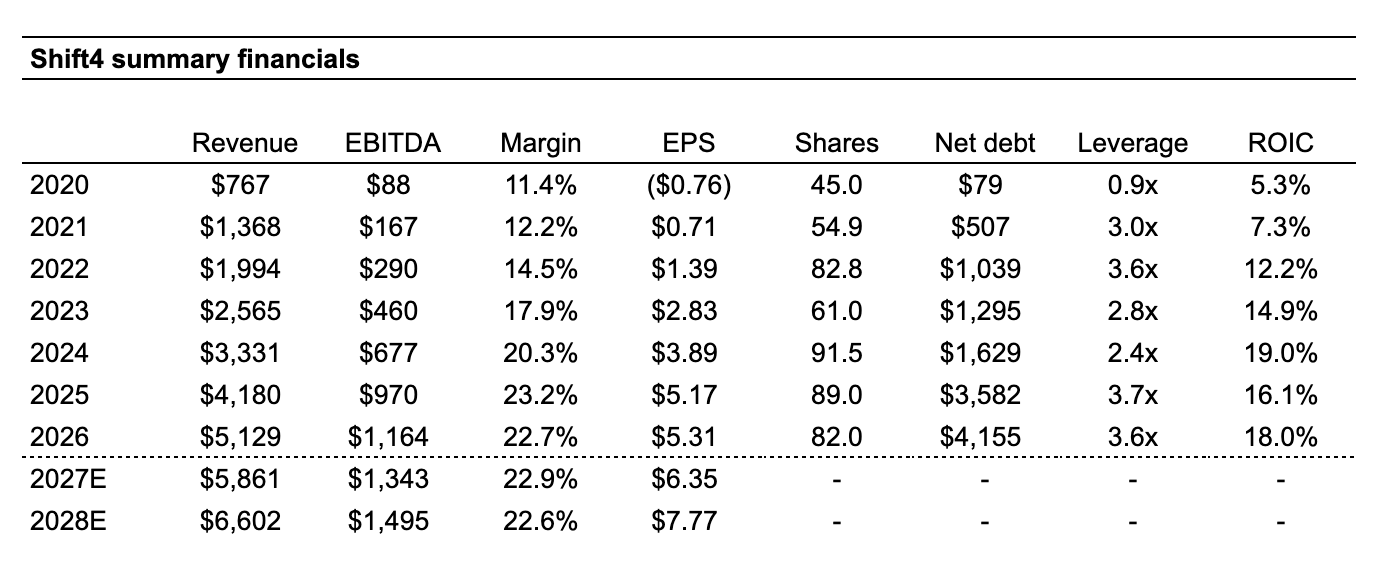
Revenue, EBITDA, and net earnings are all significantly higher today than at the time of the 2020 IPO.
Yet the stock (at $43) trades at ~8.2x estimated 2026 EPS.
So what’s the catch?
Three things catch my eye here:
First, the company recently made a large acquisition (Global Blue) which pushed net leverage from 2.4x to 3.6x.
Second, despite the revenue and earnings growth, there is some messiness here: outspending cash flow for years, a complex controlling shareholder structure (formerly an Up-C), FX is now meaningful, a fair amount of “add back” expenses to non-GAAP results, etc.
Third, the entire industry is in a major drawdown right now with competitor stock prices down 30-40% over the past year — some of this is macro and some stock-specific.
EPS isn’t keeping pace with the underlying revenue/EBITDA growth — they expect 2026 EPS of $5.25 at the midpoint vs. $5.17 in 2025 (~2% growth), this also implies declining EPS YoY in 2H 2026.
So where are the bright spots?
A few things jumped out to me which could make this a compelling long:
1) Niche business
First, this is a niche business when compared to the “mass market” merchant acquirers like GPN/Worldpay and Fiserv.
Like Toast or Shopify, it’s an integrated platform where customers commit to using Shift4 hardware, software, and payment processing bundled together. So it’s a very sticky recurring revenue base with direct customer relationships.
They also focus on complex multi-location situations, so they’re actively avoiding the more competitive single-location SMB space (think: a single coffee shop with a Square reader).
This slide outlining the “alternative options” for a sports/entertainment venue does a nice job highlighting the multiple payment touchpoints covered at a “complex” customer:
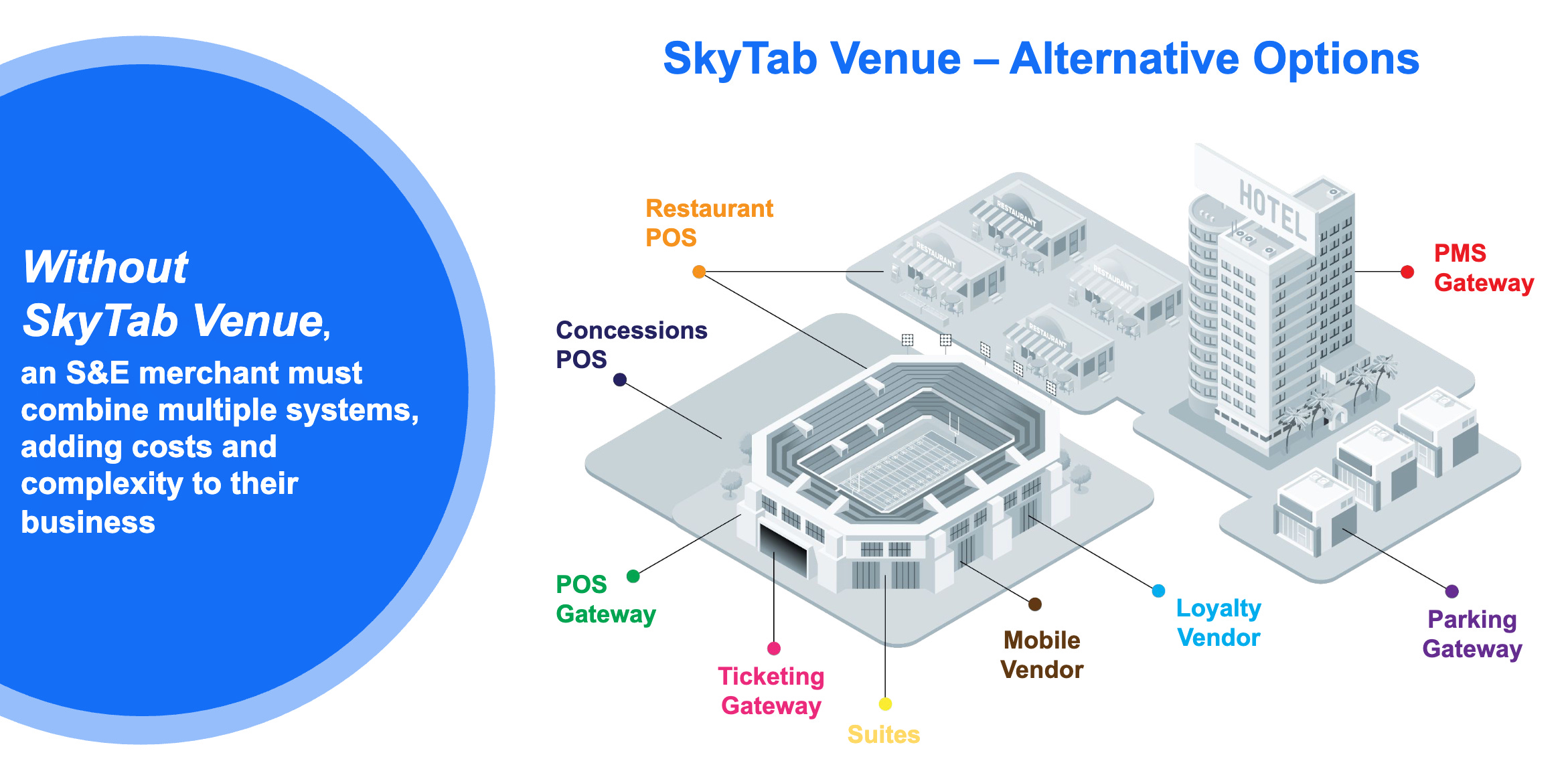
A 2025 investor day presentation is filled with nuggets describing the unique aspects of this business:
Customer acquisition via M&A:
For context, Toast spends right around $17,000 per location in sales and marketing alone, meaning that our acquisition-led growth strategy is over 5x more efficient than almost all of our SaaS and payment competitors that use PPC and traditional advertising channels instead of buying a sticky base of merchants using an ancillary product that you can cross-sell software and payments into.
Market leader in “complex card present” situations:
…we can do complex card present better than anyone else. And it’s way harder than card-not-present. I mean card-not-present, not taking anything away from Adyen, Stripe, for the others, but it’s a lot easier when you don’t have physical devices, encryption, which add PCI certification standards, which vary based on region and debit networks, it’s really hard. And we’re very good at this…
Quality of customer base:
…focus increasingly upmarket on the quality of businesses that we serve, whether that's larger restaurants or quite frankly, the smallest hotel is bigger than most of the restaurants that we serve, and then the small stadium is bigger than a lot of the hotels that we serve. So quality of customer actually helps to ensure that they're going to stick around for you, which isn't always the case if you're serving 100% SME restaurants.
Global Blue acquisition…
The mid-2025 acquisition of Global Blue adds an entirely new set of customers (luxury retailers), revenue streams, and international markets with very real cross-selling opportunities.
They are the #1 provider of that tax refund services across an incredible base of merchants that I’ll talk about in just a second. When I say number one, it’s like 80% market share and the #2 has 20 and is losing.
It’s early innings (they’re about to lap the first full year comparison in Q3 2026), but this acquisition should pay off long-term. Plus, Global Blue was already consistently growing >20% and traded at a premium valuation before Shift4 acquired them (GB 2025 20-F).
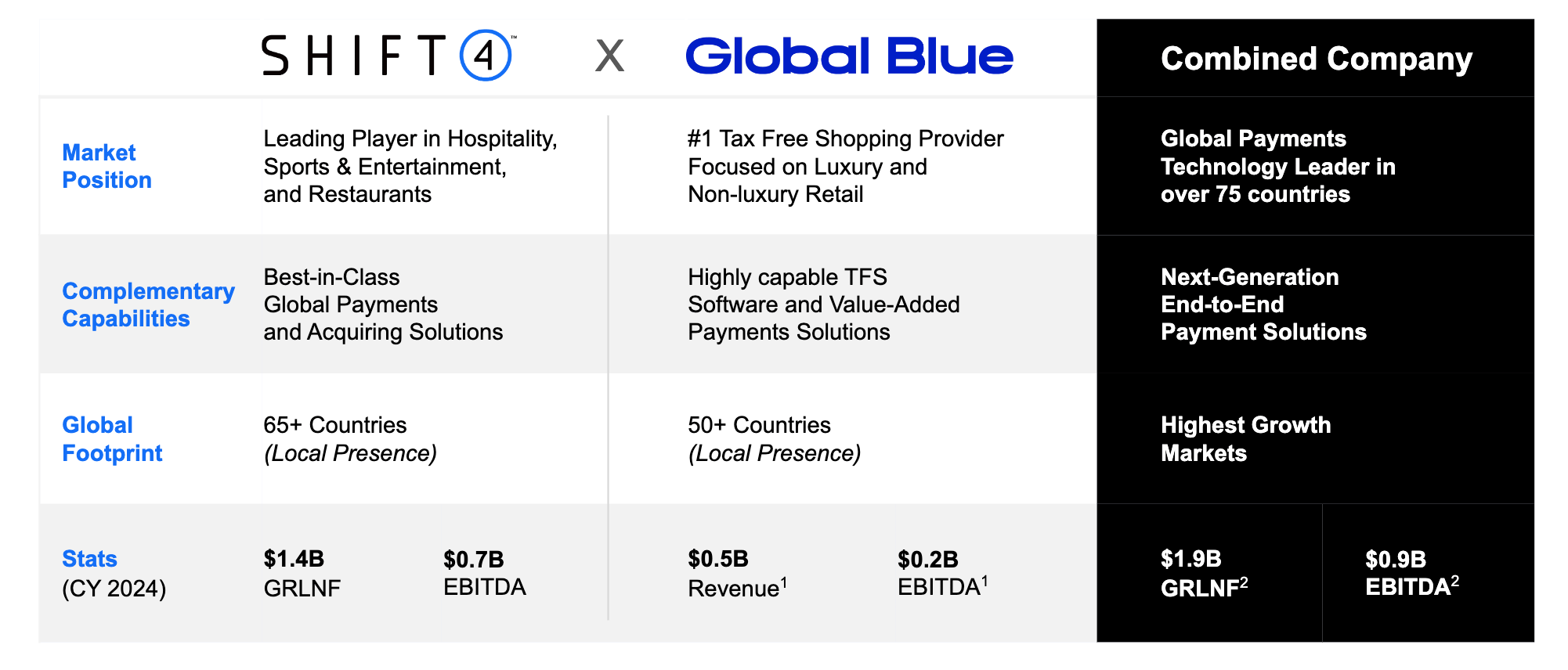
For context, this acquisition was roughly one-third of Shift4’s pre-acquisition revenue and EBITDA:
2) Financial profile
The acquisition strategy seems to be working, even in the face of leverage / complexity. ROIC improved substantially since going public as earlier M&A starts to pay off. (Note: my calculation includes stock-based comp and restructuring costs.)
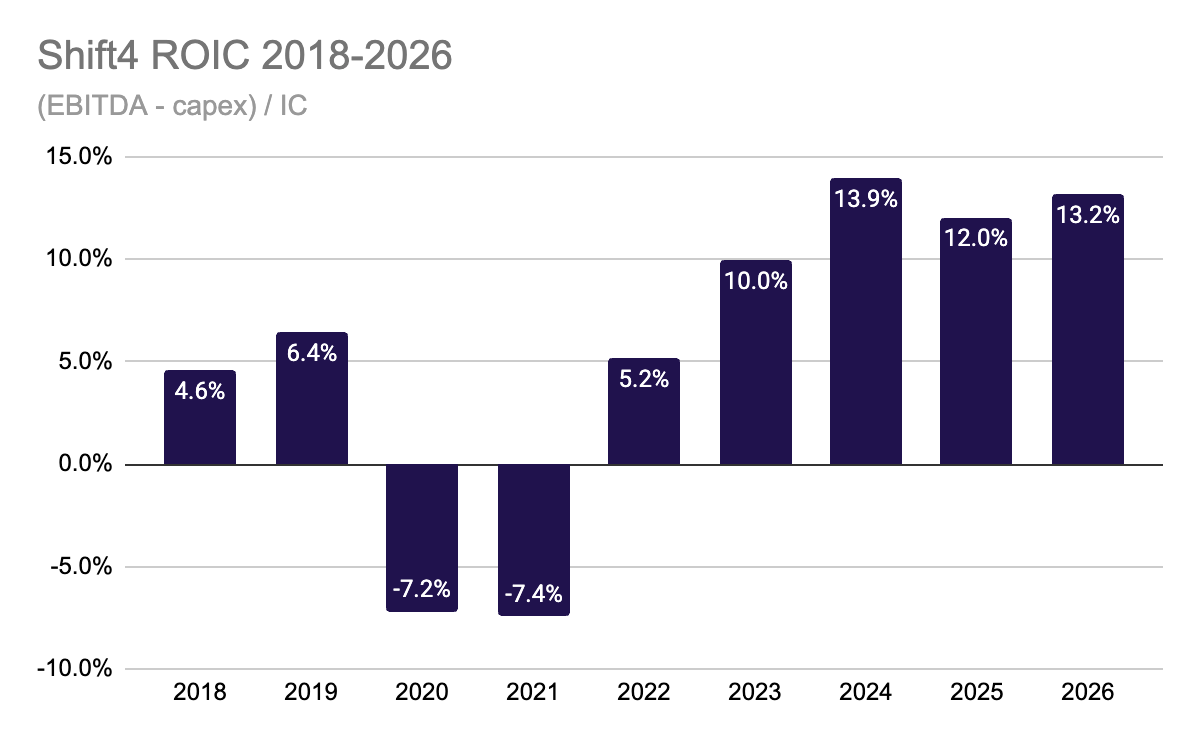
Under the surface here, management has been buying back lots of stock and they took measures to collapse the complicated Up-C structure with the controlling shareholder.
This works out to a ~10% buyback over the past 5 quarters and a single share class structure within 2 years.

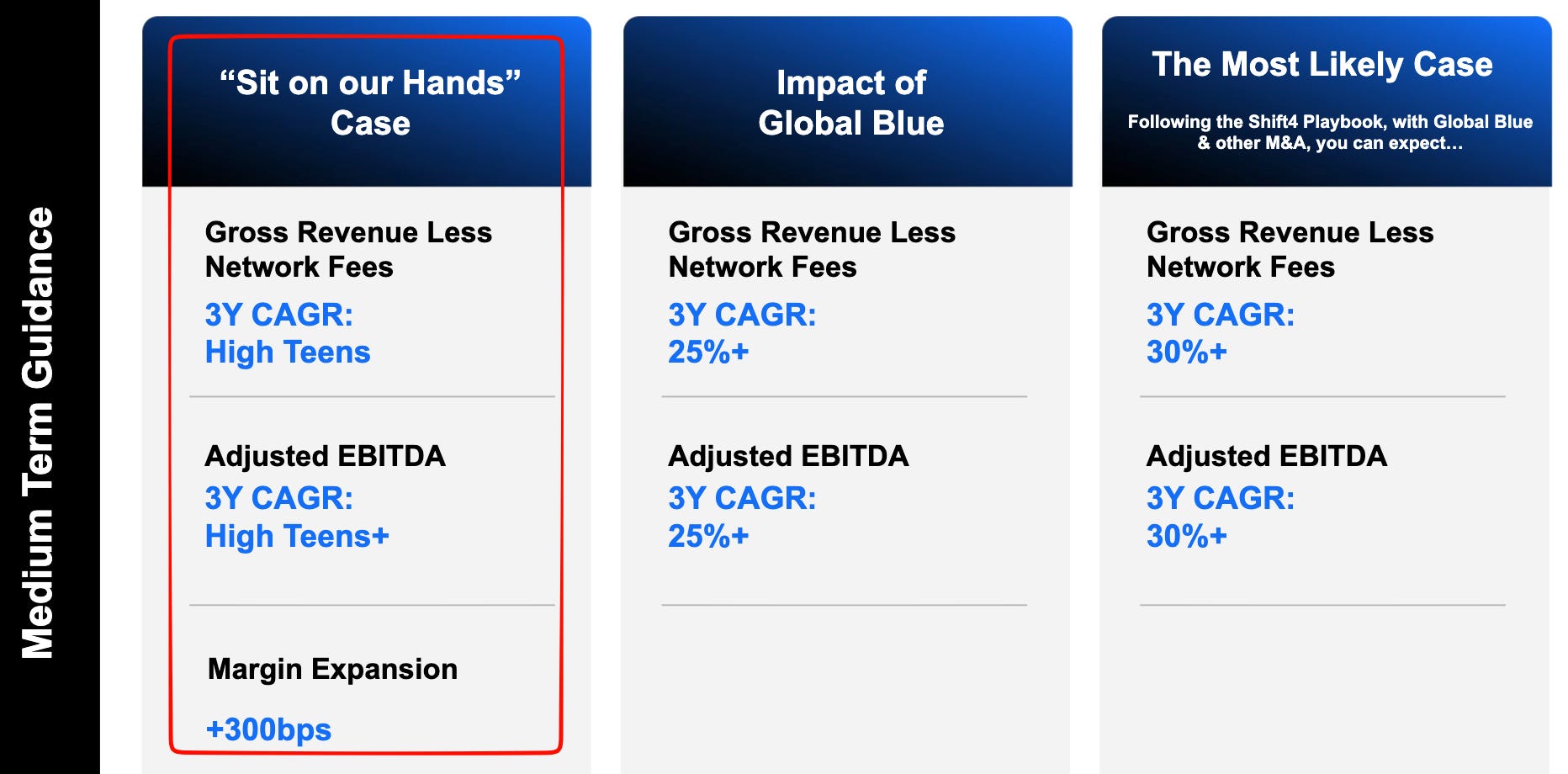
Then, there’s the medium-term targets:
Specifically, the “sit on our hands” and do nothing approach should lead to high-teens revenue and EBITDA growth from 2025-2028:
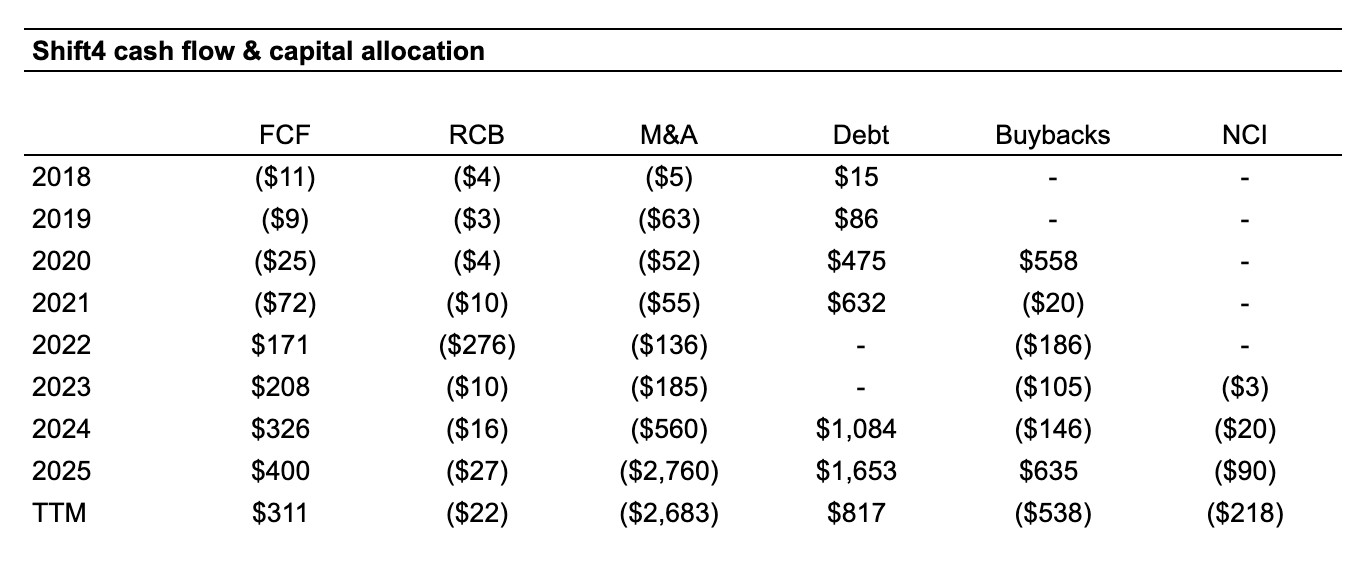
From a cash flow standpoint, they’ve made real progress in the last few years; but there are still several items eating into those cash flows (residual commission buyouts for distribution partners and noncontrolling interests).
3) Valuation
If we include the share count impact from the 2028 convertible preferred, there are ~90m shares outstanding x $43 = $3.9bn market cap. Add ~$4.2bn net debt (ex-preferred) for an $8.1bn enterprise value.
2026 mid-point guide calls for:
$2.5bn revenue less network fees (GRLNF) or 26.5% YoY growth (organic growth was 11% in both Q1 and Q2 2026)
$1.17bn EBITDA or ~20.5% growth
$470m adjusted free cash flow (they exclude acquisition/restructuring costs)
$5.25 EPS or 2% growth
So we have a stock trading at 8.2x earnings and 6.9x EBITDA with 3.6x leverage.
Note: this guidance was lowered during Q2 due to macro / Middle East travel impacts… the EPS guide was taken down from $5.50-5.70 to $5.15-5.35.
How does that compare to peers?
No 2 business models are entirely alike, but you’ll notice a cluster of stocks trading at 5-7x EBITDA and a cluster at 10x EBITDA or higher.
The first group are mostly legacy players with slower growth and high leverage; the second group are faster growing with better balance sheets:
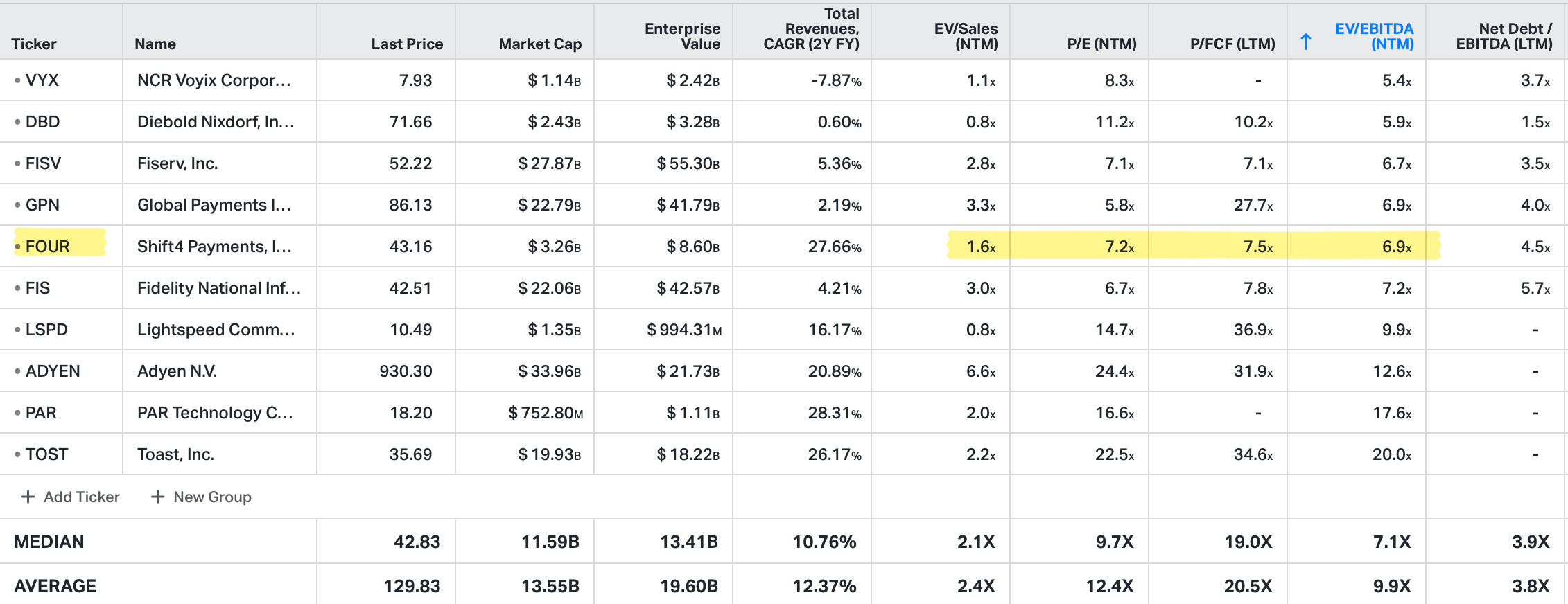
You’ll notice Shift4 is lumped in with the first group here which seems questionable compared to slower-growing mega caps like FISV, GPN, and FIS.
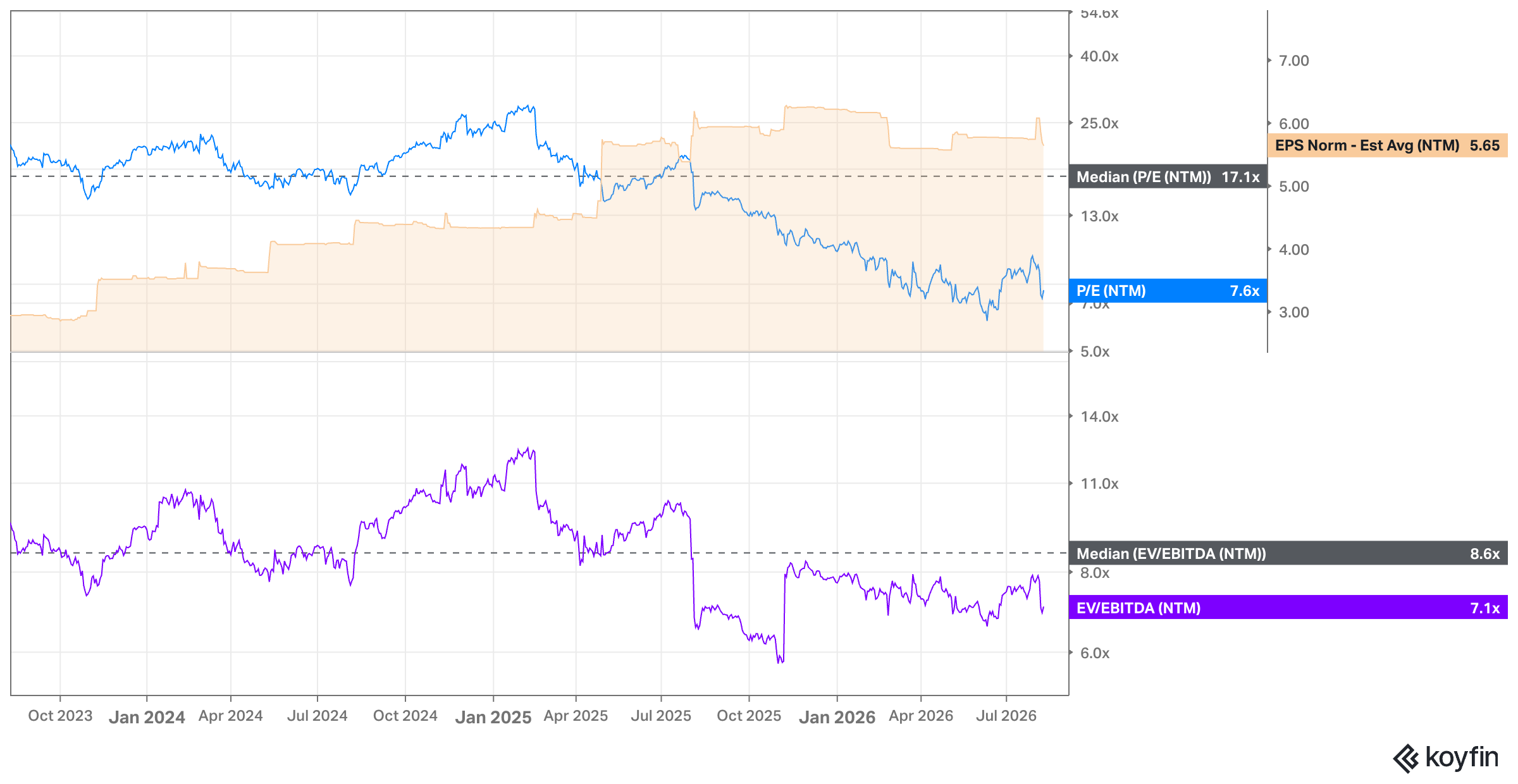
Over the past 3 years, Shift4 trades at a median multiple of 17x earnings and 8.6x EBITDA:
What could shares be worth?
Upside — Assuming they can return to consistent 20%+ EPS growth in FY2027 = $6.30 per share. At 12x earnings (a slight discount to unlevered peers LSPD/PAR) = $77 per share or 80% upside.
Downside — With EPS declining in second half of 2026 and another acquisition on the way, shares could drift toward low-end peers… at 6x $1.2bn EBITDA = $7.2bn EV or $3bn market cap. That works out to $33 per share or 23% downside.
This works out to a 3.5x upside/downside ratio which is sizable.
Summing it up…
There’s a lot going on here… and I have to assume that’s part of the equation for the current trading level.
Whether you believe leverage is too high or not; the market is clearly grouping peers into a levered bucket and an unlevered bucket with the latter group trading at higher multiples.
There’s no official leverage target per management and not even a commitment to bring this down overtime. In fact, they snuck another acquisition into the subsequent events section of the latest 10-Q, and it was a sizable deal at $316m too (~8% of market cap).
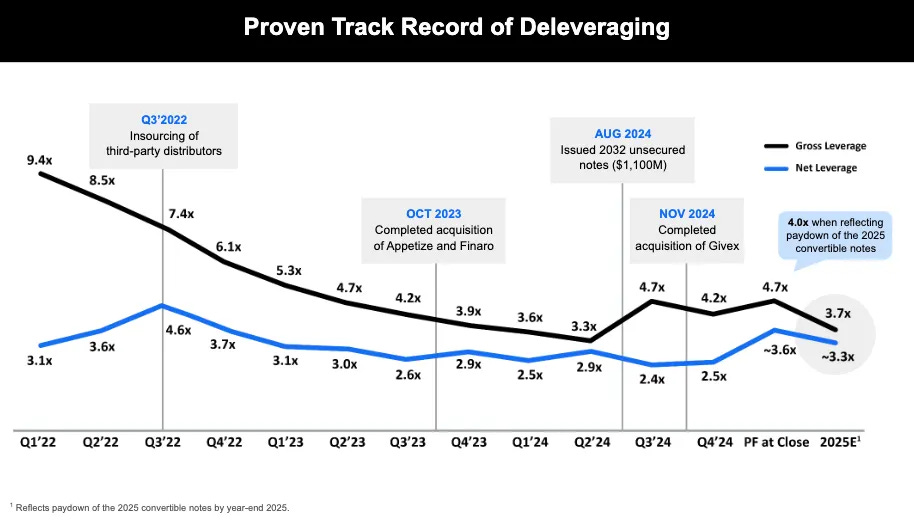
Also, I would expect earnings to be growing faster with revenue growth at more than 20%… Guidance implies earnings are going to decline YoY in the second half of 2026.
Maybe these things are what make it an attractive buy at these prices?
Perhaps the thing I’m struggling with most, and the reason I’m just going to watch this one for now, is what makes it work from here?
The overall picture is similar to Gen Digital (GEN) during the SaaS sell-off… It had mid 3x leverage and was trading at a single digit earnings multiple with solid revenue growth. A key difference was that earnings were (and remain) growing at 10-20% per year while things are slowing down at Shift4.
If I don’t have a catalyst, then I at least want earnings and FCF to be on the up-and-up…
Disclosure: no position in FOUR, but adding to my watchlist.
Resources:
Nice post. Agree with most of your thoughts in that the near-term setup may be rocky, and GB introduces some noise / complexity, but the core business is trending nicely, growing double digits organically, and it does not require heroic assumptions to reach a double, or close to it, from here.
Management actually did state a target leverage range of 'low 3s' by year end, which actually includes the acquisition in the 10Q, which should close H2. They just didn't put it in guidance due to the timing.
You read this letter?: https://www.emethvaluecapital.com/_files/ugd/b2ee4c_1316a576226d400f8b2892ead53fa664.pdf