
Today’s idea:
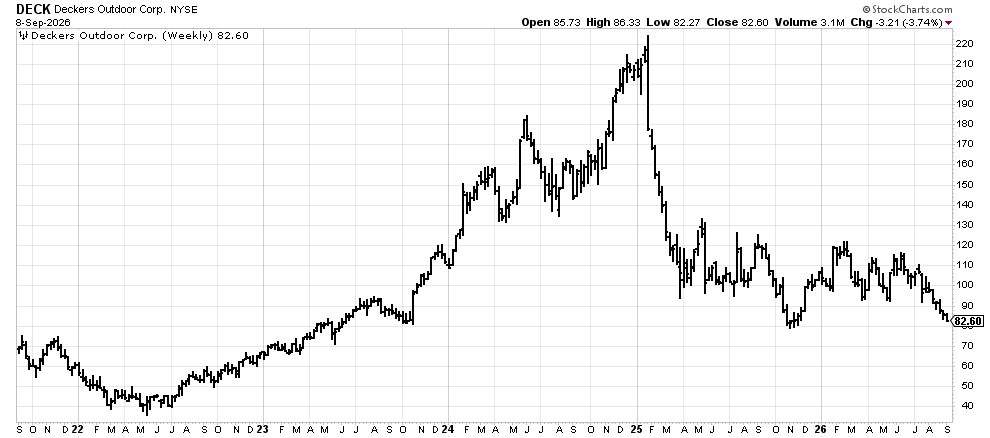
Shares are down ~60% since late 2024 / early 2025
The stock trades at ~11x EPS guidance with an unlevered balance sheet
Historic valuation + footwear comps + Skechers 2025 buyout price = 14-18x P/E
Growth is slowing in a key brand (HOKA), but international growth is early innings
For new subscribers — these write-ups are meant to be a “jumping off point” for the idea generation process (i.e. a surface level review). Each write-up includes: (1) company background; (2) why the idea is interesting; and (3) fair value estimate.
Check out past write-ups here and my home base page here.
Recent write-ups include:
09/01/26 — Microcap compounder at Rave Restaurant ($)
08/25/26 — Cal-Maine is a clean P/B mean reversion idea
08/18/26 — Stars aligning for a sale at Monro ($)
08/11/26 — Roll-up story at Shift4 Payments
08/04/26 — Inflection at beaten down MarketWise ($)
Quick Value
Deckers Outdoor Corp (DECK)
Ticker: DECK
Price: $83
Shares: 136m
Market cap: $11.3bn
Valuation: 11x earnings
Theme: Busted GARP
Several retailer stocks are looking beaten down this year. At this point, tariff impacts are well known and consumer spending has been resilient.
So why are some of these stocks down 30-50% or more?
Here are my notes on Deckers Outdoor (DECK) which is down 23% YTD to $83.
TL;DR:
Deckers operates 3 premium footwear brands (HOKA in running, UGG in casual, Teva in sandals) with an asset-light model, 20%+ operating margins, and a net cash balance sheet.
Shares look beaten down over the past 18 months as: (1) HOKA matures from a rapid growth phase; and (2) the stock re-rated from overvalued levels of 30x earnings.
Revenue continues to grow (though at a slower pace) and the stock now trades at 11x current earnings. DECK looks cheap versus its history and comparable footwear businesses. I’m calling it a “busted GARP” idea.
Background
Deckers Outdoor (DECK) owns and operates 3 footwear brands: HOKA in running shoes, UGG in comfort/lifestyle, and Teva in the sandals category.
It’s an asset-light “brand management” model where brand ownership, product development, marketing to consumers, etc. live with Deckers; but products are manufactured by third-parties.
Footwear is a $120bn retail value market in the US and $375-400bn internationally (depending on the source).
Notable footwear companies include:
Skechers — $9bn revenue (57% wholesale)
Deckers (DECK) — $5.5bn revenue (58% wholsale)
Crocs (CROX) — $4bn revenue (48% wholesale)
On Holding (ONON) — $3.7bn revenue (60% wholesale)
Steve Madden (SHOO) — $2.5bn revenue (66% wholesale)
Birkenstock (BIRK) — $2.3bn revenue (61% wholesale)
Wolverine World Wide (WWW) — $1.9bn revenue (74% wholesale)
These 7 competitors have total revenue around $29bn and I’m ignoring some larger players with a broader mix of footwear and apparel (like Nike, Adidas, and Puma).
Why it’s interesting…
In short — Deckers is a “busted GARP” name with slowing growth and an intense re-rating since late-2024 (shares are down ~60% since a late 2024 peak of $200). If expectations have adequately reset (and fundamentals hold up), then shares could be really attractive here.
First, a look at the fundamentals…
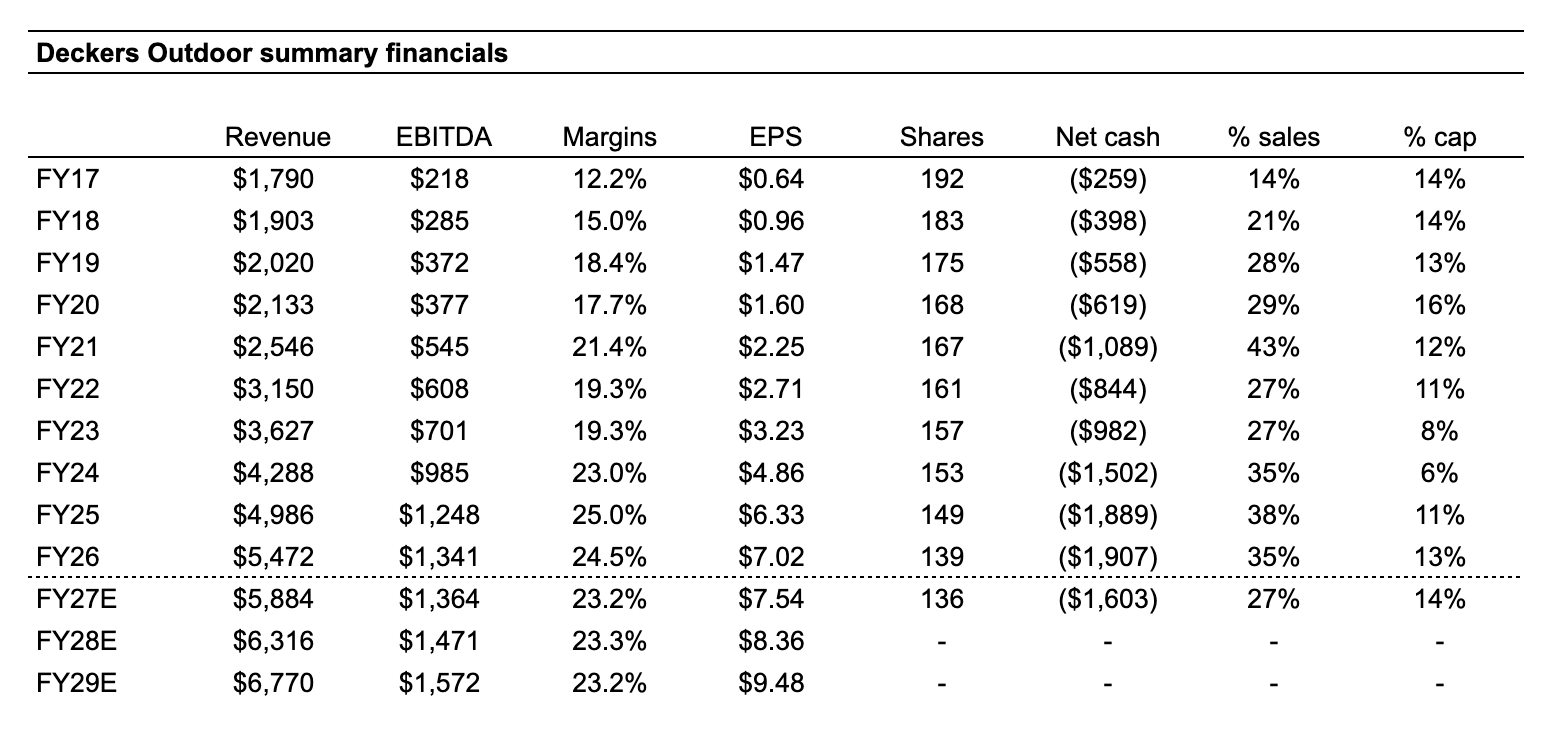
Fundamentally, DECK was/is one of the purest GARP stocks I’ve ever seen. Revenue and EPS grew 13% and 30% annually from FY17 to FY26 in what looks like straight-line growth:
A few takeaways:
High level results look clean, but there were periods of accelerating and decelerating growth along the way (though only 9 total quarters of YoY revenue decline in 20 years is very consistent!)
FY17 margins were a 20-year low and likely an anomaly — DECK had mid-teens margins for most of the 2010’s
Net cash position has grown in dollars, but it’s roughly the same amount relative to the size of the company today as it has been historically (20-30% of sales or 10-15% of market cap)
Capital allocation historically split between buybacks (~2/3rds of capital) and accumulating cash on the balance sheet (1/3rd of capital) — from FY17 to FY26, FCF totaled $5.2bn, of which $3.4bn was spent on buybacks and $1.65bn was added to net cash
Share count declined nearly 30% since FY17 from 192m to 136m today — management has a good track record of ramping buybacks when shares are cheap and pulling back when they get expensive
So why are shares down 60% since the beginning of 2025?
A few items are contributing to the decline:
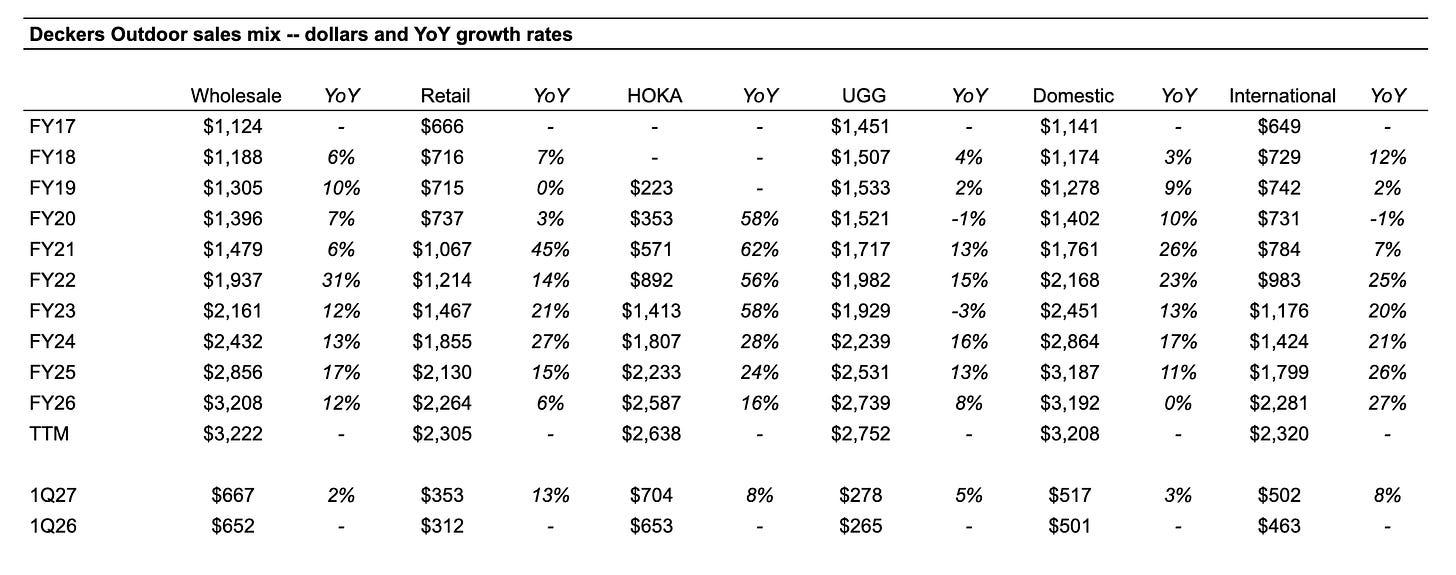
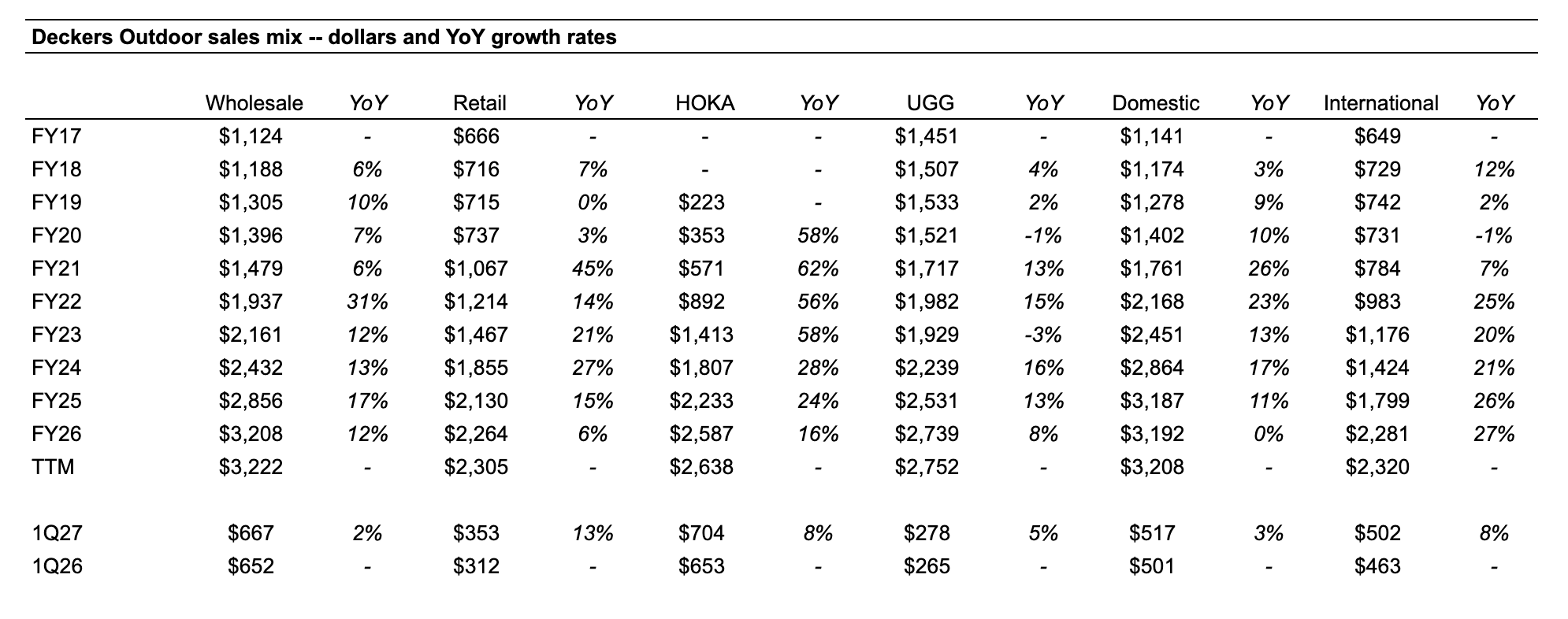
Slowing growth — I assume this is the largest factor to the current weakness. HOKA was growing 20%+ and it’s now growing 10% (or maybe less). Why? Likely a mix of brand maturity, competition, product launch timing, etc.
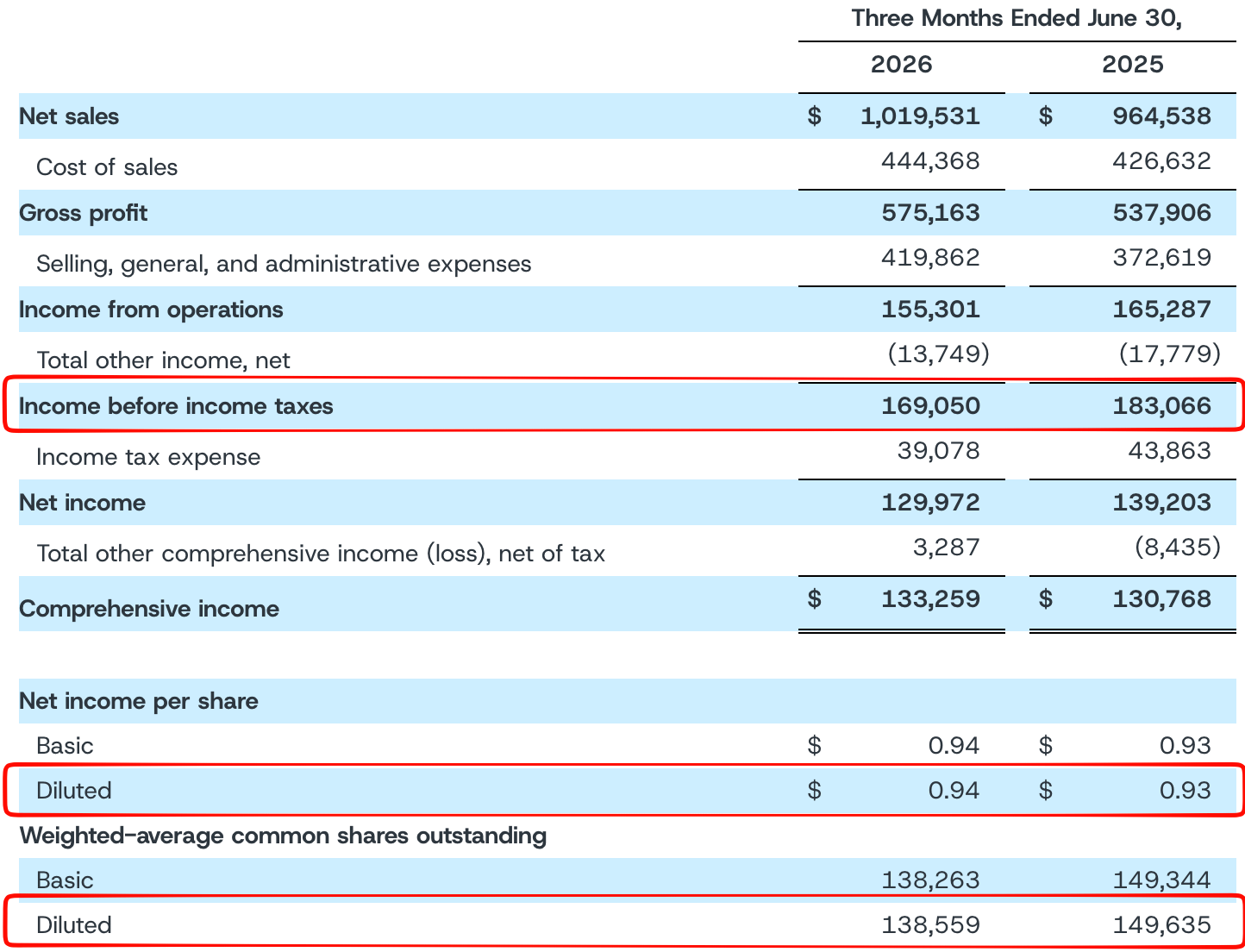
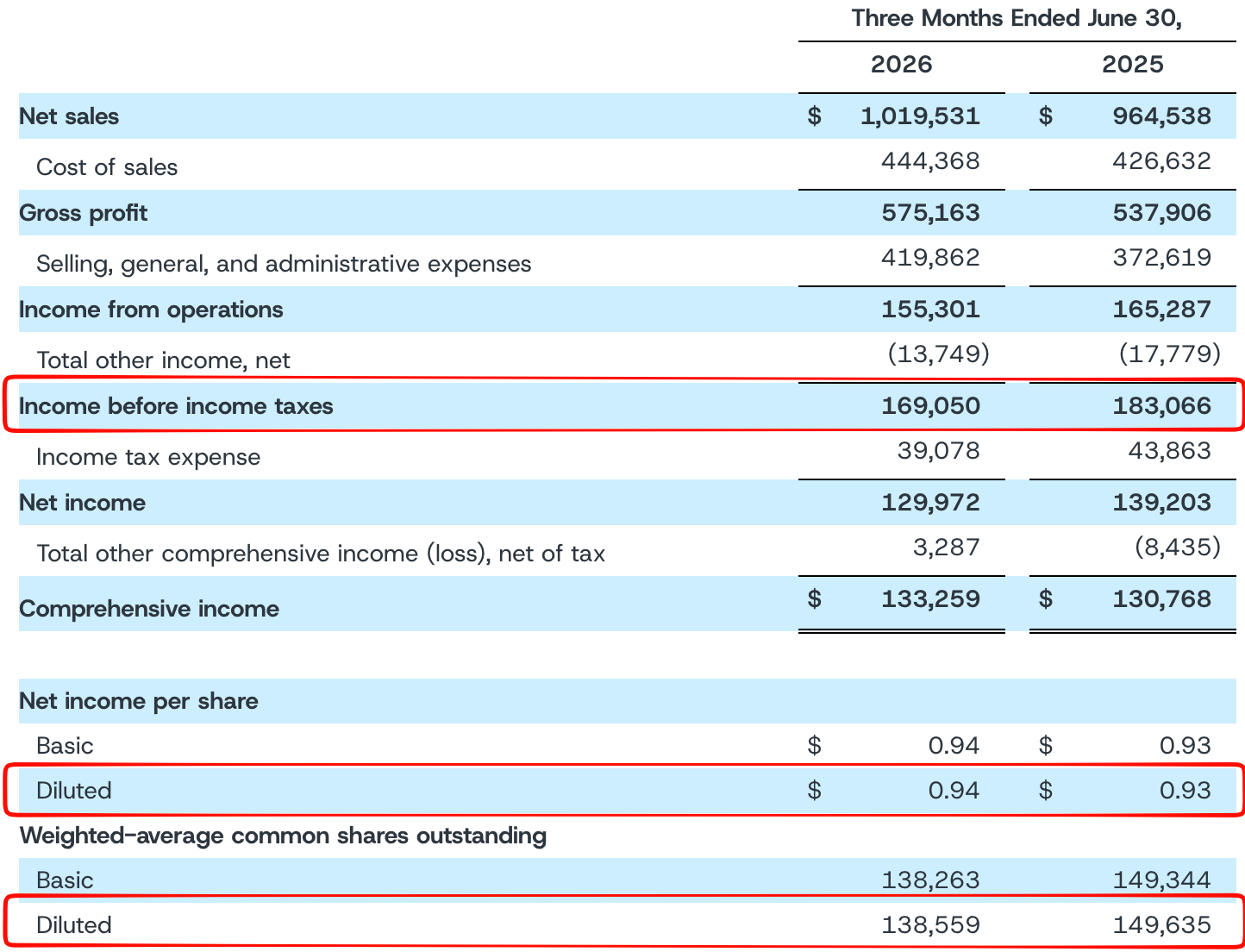
Sales mix ($ and % growth) Earnings decline — Technically, EPS is still growing modestly, but that growth is coming entirely from buybacks. Pre-tax income fell by ~8% in Q1 FY27 from higher SG&A costs.
Q1 FY27 earnings decline Tariffs — Initially, tariffs were guided at 10% and then increased to 12.5% in Q1 FY27. Also, there was zero tariff impact in the P&L as of Q1 last year, so the YoY comparison is hurting right now (though they’re signaling the biggest hit is behind them).
Starting valuation — Shares of DECK were arguably overvalued for much of 2023-2024 as shares traded north of 30x earnings while HOKA was growing +50%. This starting valuation is probably compounding the pain as expectations reset.
The big question becomes — are these factors temporary or not?
I don’t have any unique insights that brand revenue will start to inflect soon, but I do know that revenue growth has slowed/stalled at times in company history (most of 2012-2018):
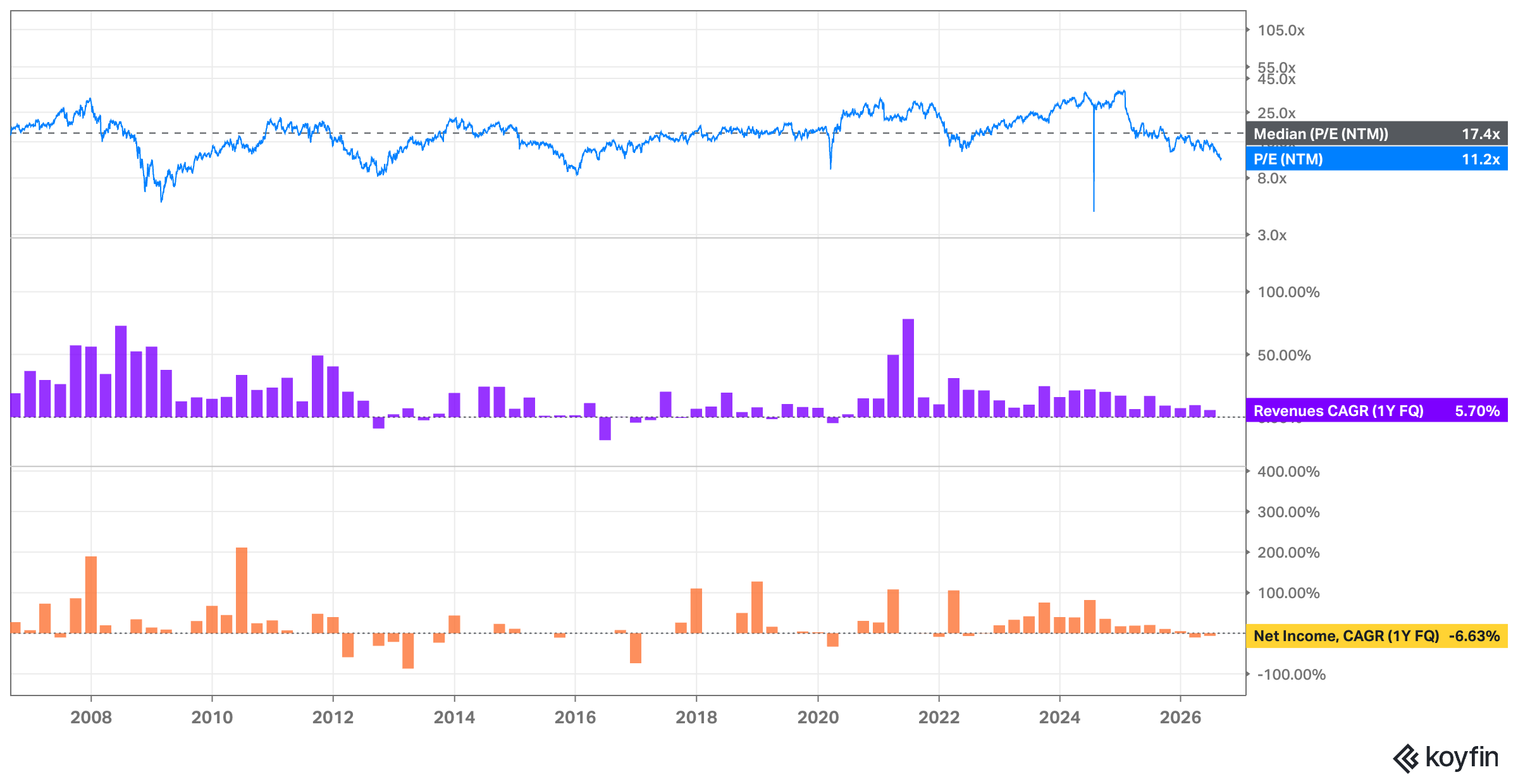
During those periods, shares would trade down to the lower band of historic valuation multiples until revenue or earnings growth rebounded. (Sort of looks like a mean reversion idea under this lens.)
Interestingly, while HOKA brand sales may be maturing/slowing, it looks like international markets are growing nicely and probably still early innings (5 years of 20%+ revenue growth).
As for the declining pre-tax earnings, those look a bit more intentional.
Here is some CFO commentary on the rising SG&A costs:
…investments in this fiscal year are focused on fortifying the foundation of our business and supporting the continued growth of our brands, positioning us to begin delivering operating expense leverage in fiscal year 2028 and beyond
Sounds like overhead expenses should level off going into next year.
So what’s the outlook from here?
Guidance for FY27 (ends 3/31/27) calls for:
Revenue growth of 7-8% ($5.89bn mid-point vs. $5.47bn in FY26)
HOKA = low-double-digit growth
UGG = mid-single-digit growth
EPS growth of 5-7% ($7.35-7.50 vs. $7.02 in FY26)
Share count for EPS assumes 80% of FCF used on buybacks
Looking at FY28 and beyond. Estimates call for revenue growth of ~7% (basically at the low end of FY27 guidance).
Here’s some math on potential FY28 earnings…
If we extrapolate Q1 FY27 growth of 6% (below consensus) into FY28, that’s $6.25bn revenue
Assume flat gross margins (56.5%) = $3.53bn gross profit
Hold SG&A essentially flat ($2.1bn) = $1.43bn operating profit
Taxed at 23% = $1.1bn net income
Let’s say buybacks total $2bn (~90% of net income) from today through FY28 at a price of $90-100 = 21m shares repurchased over 7 quarters for an ending share count of 115m.
That $1.1bn net earnings = $9.50 EPS by yearend FY28 or 8.7x P/E at today’s $83 per share.
Hmm…
Alright, so what are shares worth?
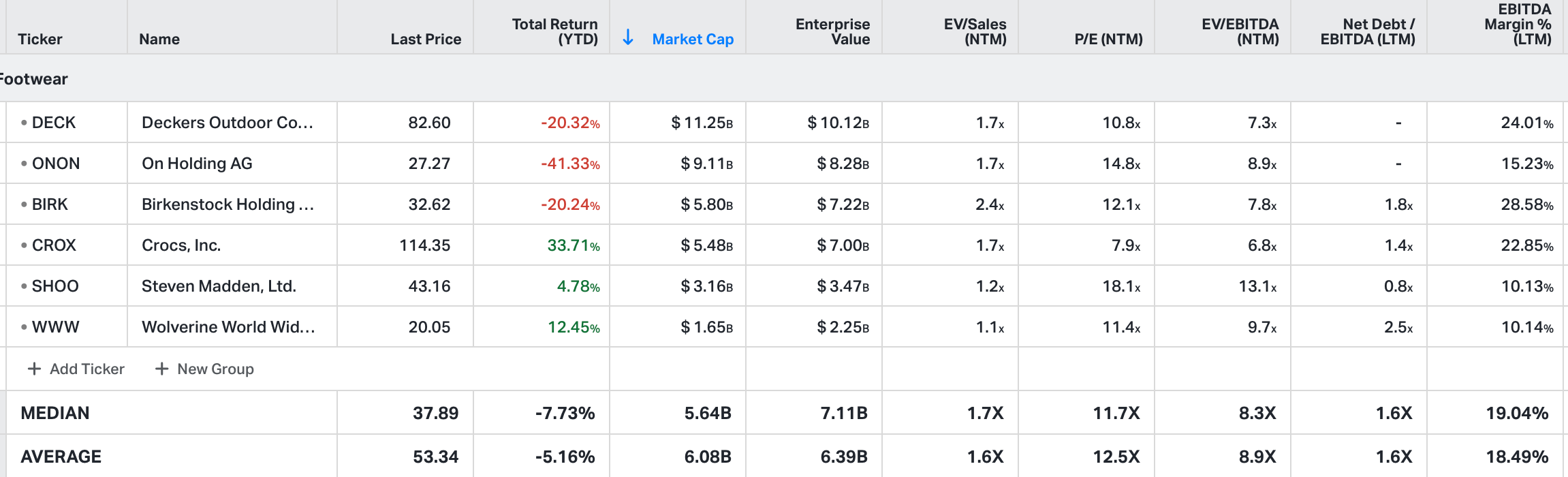
Retailers in general are getting killed in 2026 (LULU, NKE, ONON, and DKS are all down 30-50% YTD as of this writing).
The better retailers (clean balance sheet, margins at mid-teens or better, and growing revenue) trade at 10-15x earnings. So DECK looks undervalued on a relative basis.
Historically (over 20 years), DECK trades between 14-18x earnings with a median multiple around 17x earnings.
Perhaps the best comparison is Skechers which was taken private by 3G Capital in September 2025 at ~$9.6bn (around 15x earnings).
Skechers is a clean comparison for Deckers — They operated a single brand across various footwear styles, had consistent mid-single-digit sales growth, a net cash balance sheet, similar wholesale/DTC mix, and most importantly, Skechers finished its public life as an “international growth” story (international footwear markets are very large and seen as a long growth runway).
International sales went from 46% in 2016 to 62% at the time they were acquired in 2025 (a 16% CAGR over 9 years).
Deckers currently gets 42% of sales from international markets (where Skechers was in 2016), but those regions are growing 10-20%+ with plenty of room to expand further.
As an added reference, here were the comparable multiples from the Skechers 2025 merger proxy:
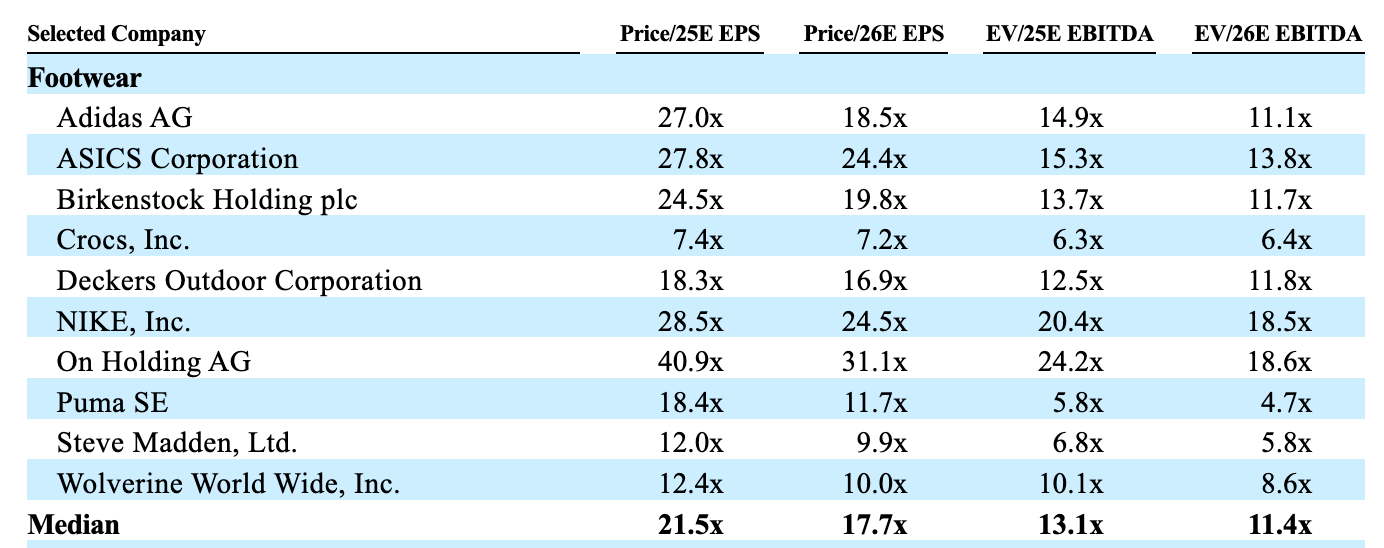
To summarize — Most of these valuation references point to the same 14-18x earnings range.
Here are my rough valuation estimates:
Upside — Even a slower level of 5-6% revenue growth is quite good (that’s what Skechers was putting up). At 16x $7.50 FY27 EPS = $120 per share or 45% upside.
If my FY28 estimates materialize ($9.50 EPS), then at 15x = $143 per share or 72% upside.
Downside — DECK’s lowest earnings multiple in 20 years was 4.5x and 2 standard deviations below median is 7x earnings (about where CROX trades today). Let’s say revenue misses while opex investments continue and EPS misses at $7. At 7x = $49 per share or 40% downside.
That’s a ~1.2-1.8x upside/downside ratio.
I’m probably being overly punitive in this downside scenario, but things can get irrational when there are fears a consumer brand is going out of favor.
Summing it up…
Given the Skechers buyout last year and recent trading multiples, maybe DECK is a takeout candidate here?
With shares trading at ~11x earnings + an unlevered balance sheet, management could continue plowing all FCF into buybacks to engineer 10%+ annual EPS growth for years (likely more if operating leverage kicks in). And that’s without a “return to growth” for HOKA.
For now, I’m keeping this one on my watchlist.
I like the idea and feel there’s a good chance investors will look back in a few years and call this timeframe a “no brainer.” I’d like to review a few other retailers (DKS is on my list) to get a sense for what others are seeing.
Disclosure: no position in DECK
Resources: