
Today’s idea:
Investor day presentations held, spin-off scheduled for Oct 1 trading
Vylor (spin) GoodCo with 30% EBITDA margin target & solid growth
New Corteva crop protection business akin to specialty chemicals
Could be compelling if SpinCo trades at a (deserved) premium
For new subscribers — these write-ups are meant to be a “jumping off point” for the idea generation process (i.e. a surface level review). Each write-up includes: (1) company background; (2) why the idea is interesting; and (3) fair value estimate.
Check out past write-ups here and my home base page here.
Recent write-ups include:
09/15/26 — Guide to investing in M&A situations ($)
09/09/26 — Deckers Outdoor busted GARP story
09/01/26 — Microcap compounder at Rave Restaurant ($)
08/25/26 — Cal-Maine is a clean P/B mean reversion idea
08/18/26 — Stars aligning for a sale at Monro ($)
Quick Value
Corteva (CTVA) & Vylor (VYLR)
Ticker: CTVA
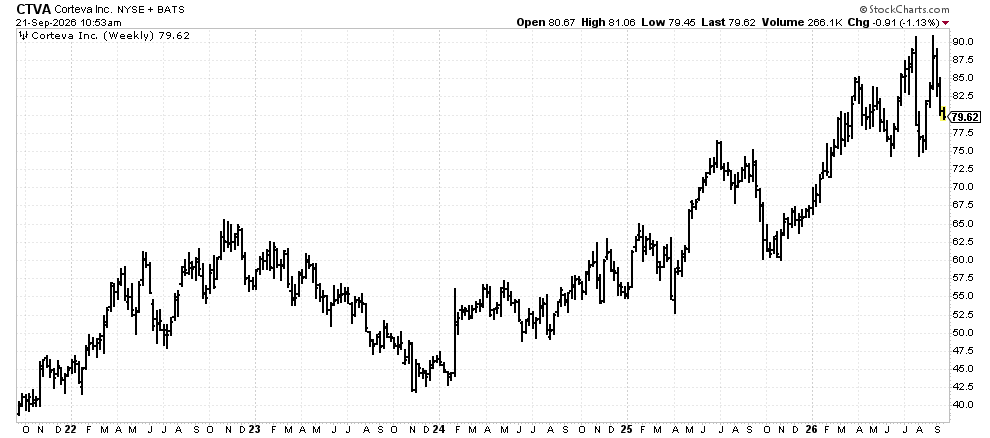
Price: $80
Shares: 668m
Market cap: $54bn
Valuation: 13x 2026 pre-split EBITDA
Theme: spin-off
There are a few imminent spin-offs coming over the next few weeks and Corteva / Vylor just held their respective investor day presentations and multi-year outlooks.

I’ll preface this one by saying Corteva is quite a bit more expensive than my “usual suspect” at 13-14x EBITDA, but there’s a tiny bit of GoodCo/BadCo in here which could make it interesting.
Here are my notes and valuation estimates for each piece…
TL;DR:
Corteva will split its higher-quality Seed business (Vylor) from the Crop Protection business (New Corteva) on October 1, 2026.
My SOTP is roughly $78–91/share today which is limited upside to today’s $80 share price.
The interesting setup comes after the split: if investors give Vylor a premium valuation, RemainCo could be left trading at a discount.
If Vylor trades at 15-16x EBITDA = implied $13-17 RemainCo price or 6.5-8.5x 2026 EBITDA, which is much more interesting.
Background
DuPont acquired the Pioneer seed brand in 1999 and operated it until 2017 when they merged with Dow to become “DowDuPont.”
DowDuPont combined their various divisions into 3 businesses, and then split them up into separate public companies with the agriscience business becoming Corteva in 2019.
Here’s what Corteva looked like at the time of the 2019 spin compared to peers:
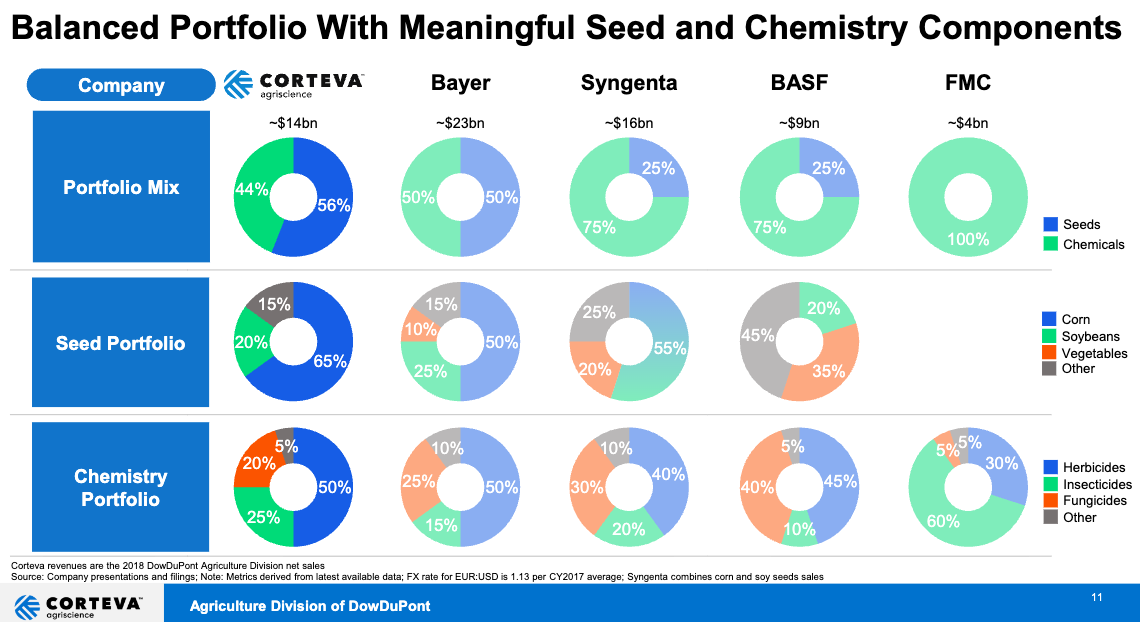
After the spin, Corteva grew revenue from $14bn to $18bn (~4% CAGR) and EPS from $1.50 to $3.70 (2026 mid-point guide). Most of the earnings growth came from a long tail of DowDuPont merger synergies. Since the spin, shares are up 2.8x. Not bad.
Management is ready for the next chapter, and on October 1, 2026, Corteva will complete a spin-off of their seed business Vylor (VYLR), leaving Corteva RemainCo with the crop protection business.
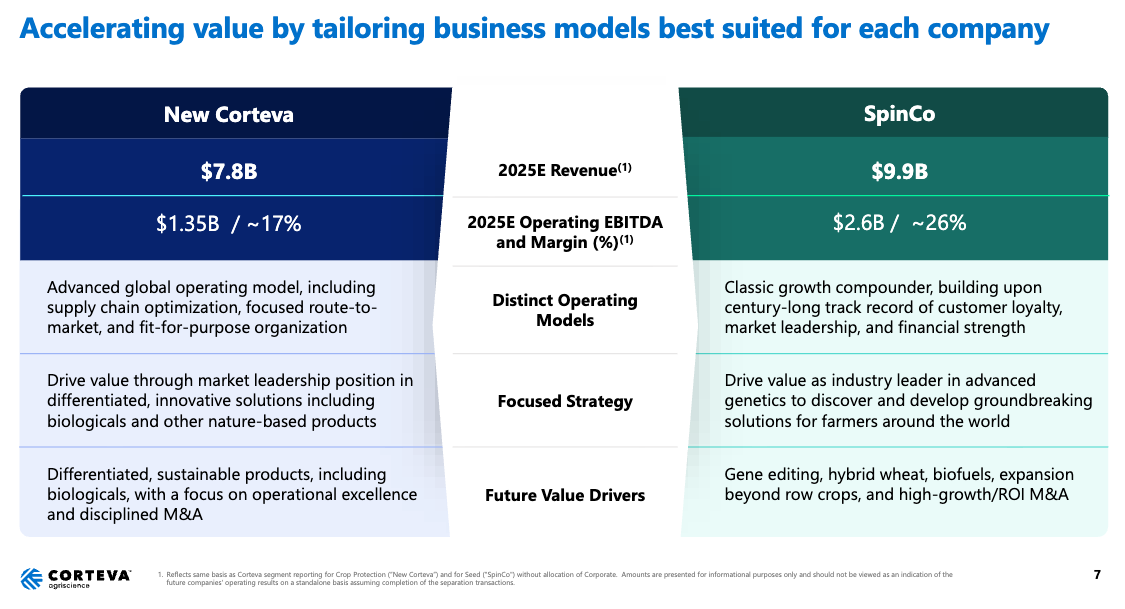
On the surface, you’ll have:
Seed (Vylor / SpinCo) — Develops seeds for maximizing farmer crop yields. They own the #1 corn and soybean brand (Pioneer). This business is seen as the “GoodCo” with an economic model resembling a high-margin royalty or licensing business.
Crop Protection (Corteva / RemainCo) — Basically a specialty chemical business with products to protect crops against weeds, insects, diseases, etc. Margins and cash flow are good, but the business behaves somewhat like a pharmaceutical with a need to develop new products and combat generic competition.
Pre-Spin Fundamentals
On a pre-spin basis, Corteva has 668m shares outstanding x $80 = $54bn market cap. Net debt is $2.5bn as of June 2026, but cash generation is highly seasonal at the seed business.
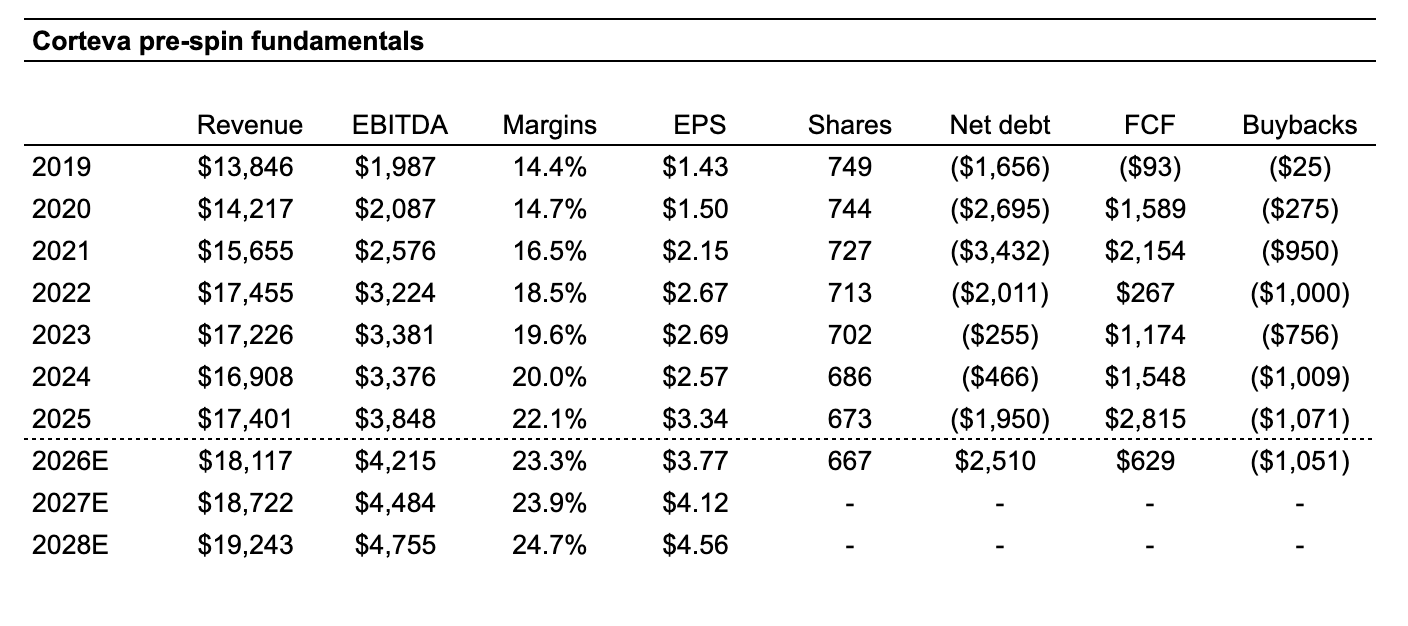
Some takeaways:
Margin expansion was a significant driver for earnings and EPS growth
Balance sheet historically runs a net cash position at yearend with peak net debt coming in Q2/Q3 each year
Capital allocation strongly favors buybacks with share count down 11% since the 2019 spin (~1.7% reduction per year)
There is some “beneath the surface” activity we’ll see in a moment
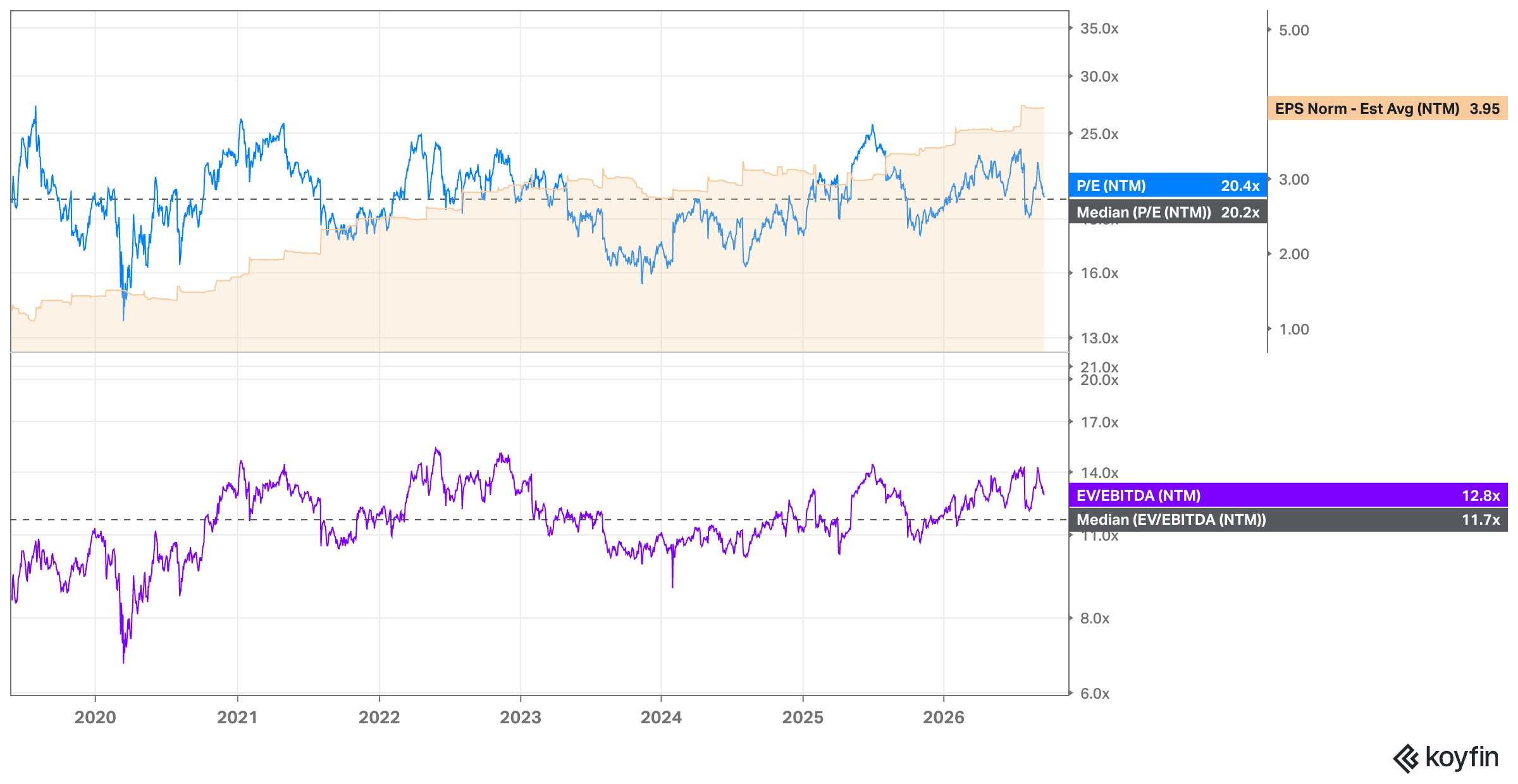
Pre-spin, the median valuation is 20x earnings and ~12x EBITDA:
RemainCo (Corteva)
I. Background
Crop protection is a $70bn industry and acts as maintenance spend for farmers to protect their crops from weeds and pests which reduce their yields.
It’s a highly concentrated industry with the top 4 players (Bayer/Monsanto, Corteva, Syngenta, BASF) at 50%+ of the total market.
Think of crop protection as specialty chemical products developed through R&D and sold mainly through distributors or retailers. It’s a nice re-occurring revenue stream business model.
The challenge with this business model (and why it’s likely to trade at a discount to SpinCo) is the pharma-like nature of the industry where competitors are constantly developing and launching new products while older products face generic competition.
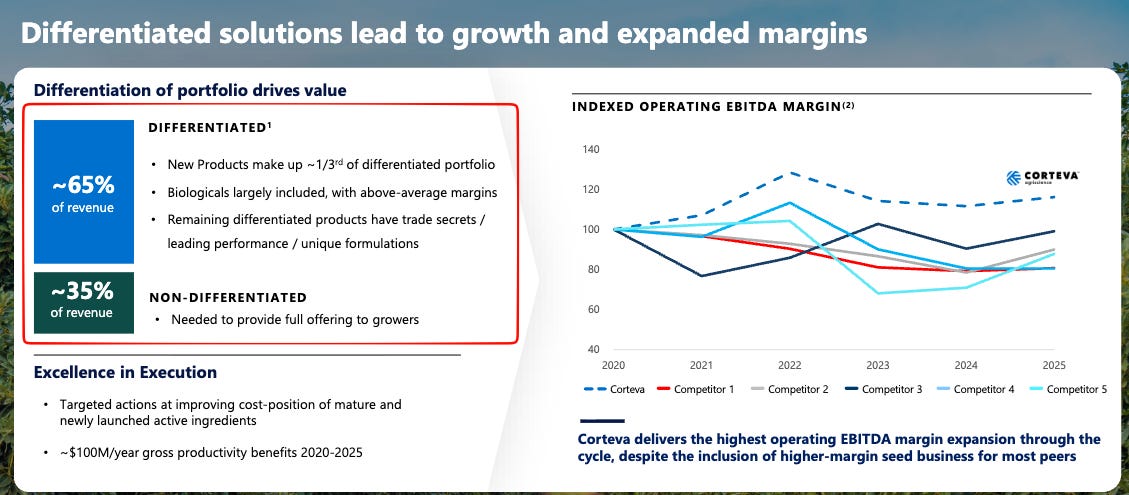
Corteva refers to this as differentiated versus non-differentiated product sales. Currently, they get 65% of revenue from differentiated sources and 35% from non-differentiated sources. Management has made this a priority over the past few years to walk away from non-differentiated revenue streams.
II. Outlook
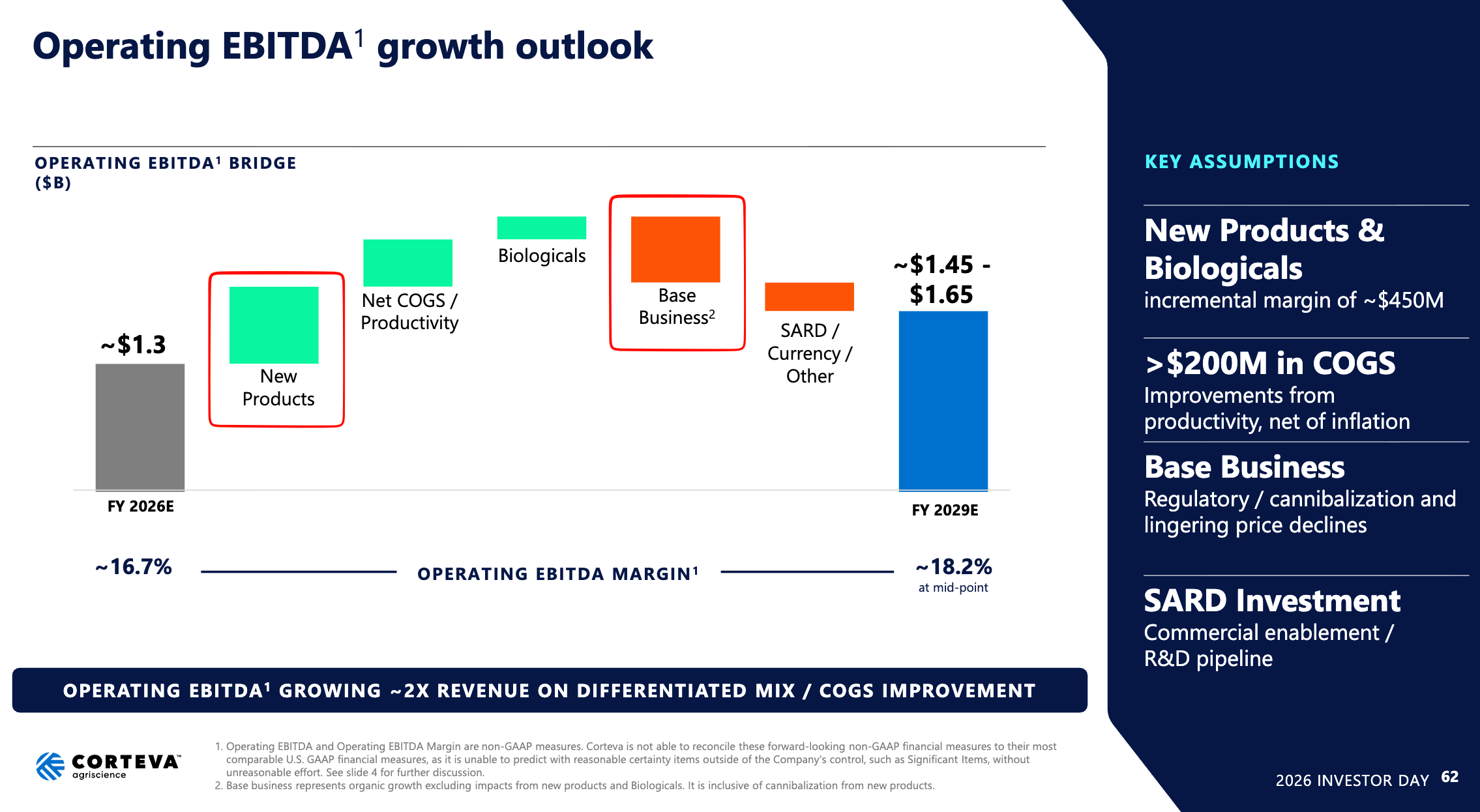
First, a look at crop protection segment financials and the 2026 & 2029 outlook:
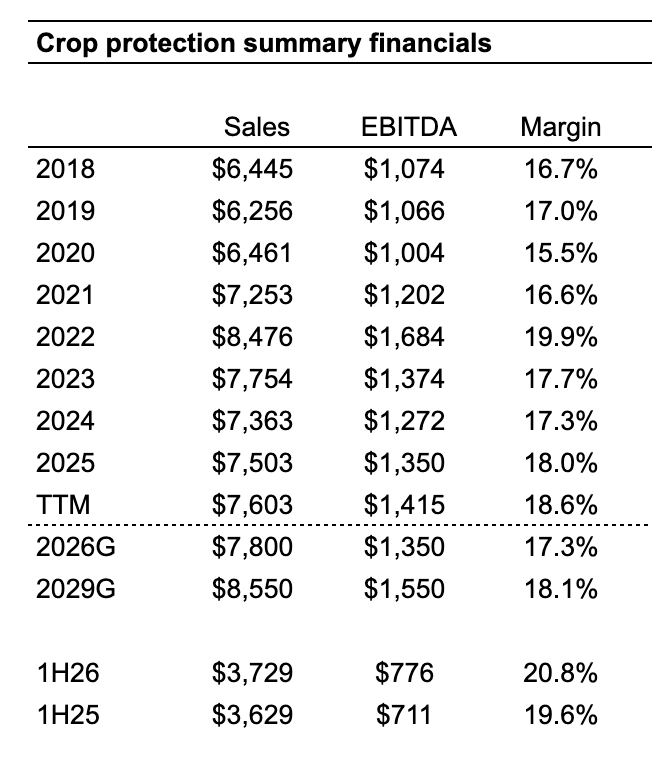
From 2027-2029, the “value creation algorithm“ includes:
3% revenue CAGR from $7.8bn in 2026 to $8.4-8.7bn by 2029
6% EBITDA CAGR (2x revenue CAGR) = $1.45-1.65bn by 2029
High-teens EBITDA margins (150bps improvement at mid-point)
$2.4bn cumulative operating cash flow from 2027-2029 ($1.2-1.4bn cumulative FCF)
How will they get there?
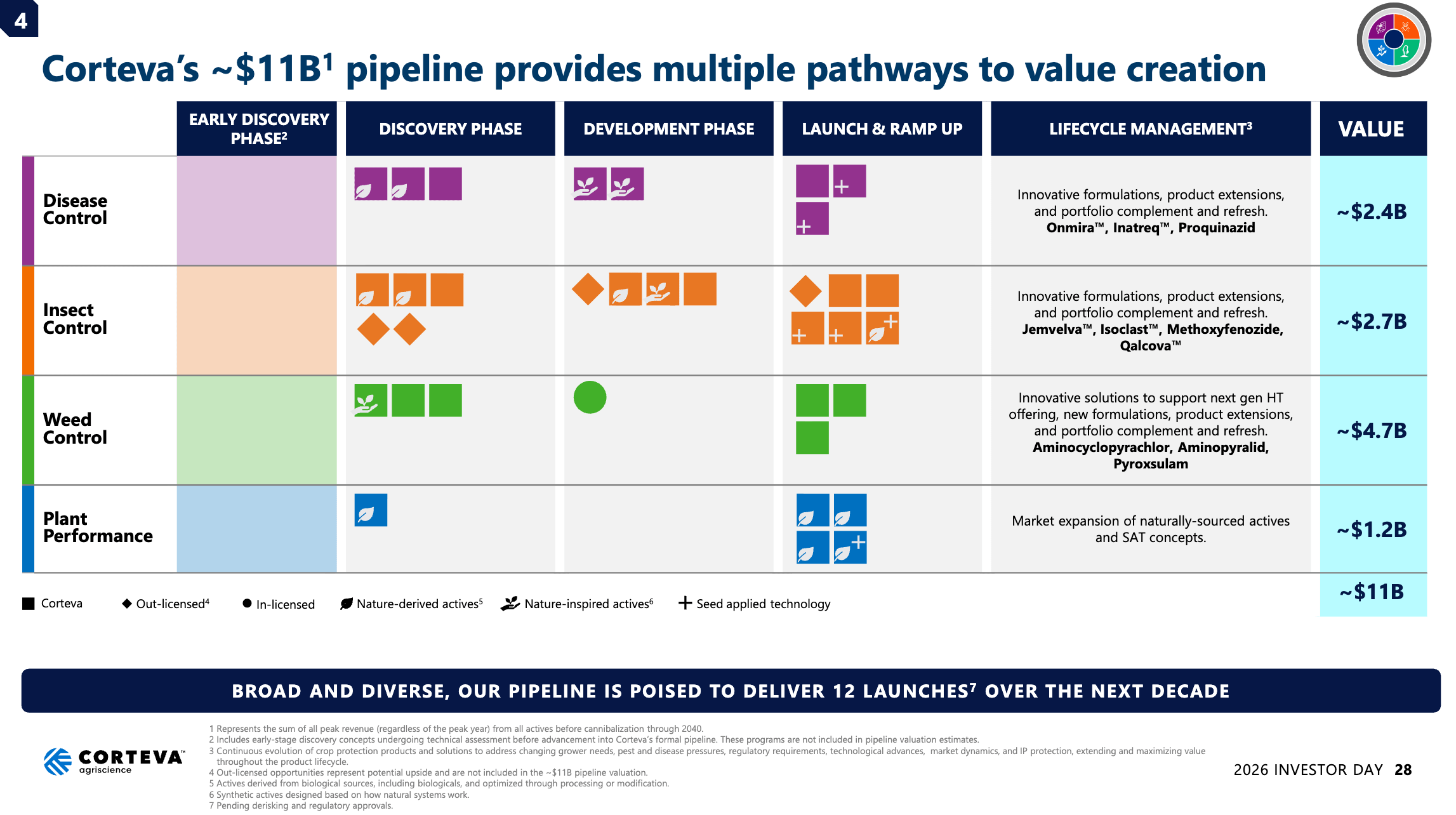
At the September 2026 investor day, Corteva outlined a product pipeline with $11bn of peak revenue over the next decade. These launches will be the key contributor to their targeted 3% revenue CAGR over the next few years.
From the 2026-2029 EBITDA bridge, you can see the base business erosion consumes most of new product launch profits, so there’s risk that new products fall short of expectations. (Granted, this management team is generally hitting their targets since the 2019 spinoff.)
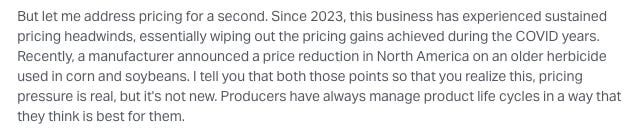
Last, management commentary around pricing is a tad concerning: “sustained pricing headwinds” since 2023, wiped out all pricing gains achieved during COVID years, competitors are further reducing prices.
This is a stock trading at 13-14x EBITDA pre-split. Generic drug makers like Viatris (formerly Mylan) and Teva were also trading at 10-14x EBITDA from 2014-2017 right before a lengthy period of “sustained pricing headwinds” which sent those stocks to 4-5x earnings!
III. Valuation
There are no pure play seed or crop protection businesses anymore; as the industry consolidated, they’ve all merged or combined into agriculture or chemical conglomerates.
Most specialty chemical companies with high-teens margins or better trade at 10-14x EBITDA and pre-spin Corteva was trading at a median 11.7x EBITDA.
At 10x and 11.7x 2026 EBITDA of $1.3bn = $13-15bn EV. Management guided to a $500m net cash position by yearend 2026 (slide 63) and I’ll assume no change in share count (668m) = $20-24 per share for RemainCo.
Long-term, let’s say they achieve their mid-point EBITDA guide at $1.55bn and get the share count down to 620m via buybacks. Assuming no change in net debt, I get $30 per share by 2029.
SpinCo (Vylor)
I. Background
Traditional row crop seeds are a $60bn industry.
Again, this is a highly concentrated industry with the same top 4 players at 50%+ of the market. It’s likely more concentrated than that headline as well depending on the crop + geography combo (Corteva and Monsanto are basically a duopoly in corn).
Seeds are a higher margin and stickier business model because these products are the key driver to increased crop yields for farmers with very high switching costs. And since farmers can’t magically create new land, they need to find ways to increase the output of what they’re planting.
II. Outlook
Here’s a look at seed segment financials and the 2026 & 2029 outlook:
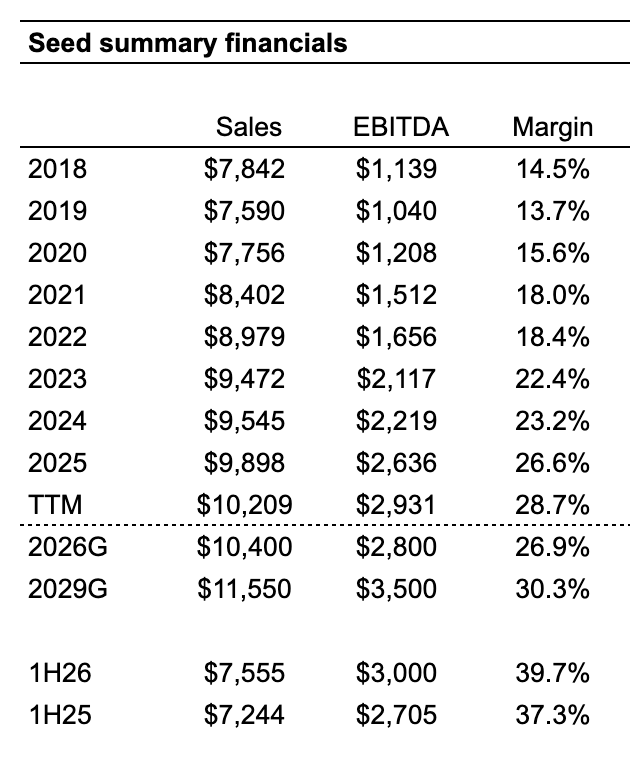
From 2027-2029, the “value creation algorithm“ at SpinCo includes:
Sales growth of 3-4% annually to $11.2-11.9bn by 2029
EBITDA growth of 7-8% annually to $3.3-3.7bn by 2029
Cumulative FCF of $5.5-6.5bn (targeting 60% FCF/EBITDA conversion)
Intend to return at least $1bn per year via buybacks ($3bn minimum)
R&D at 10% of sales
Perhaps the most compelling piece of SpinCo is the margin expansion story. From mid-20% EBITDA margins in 2025 to 30%+ by 2029 (and likely higher into the 2030’s).
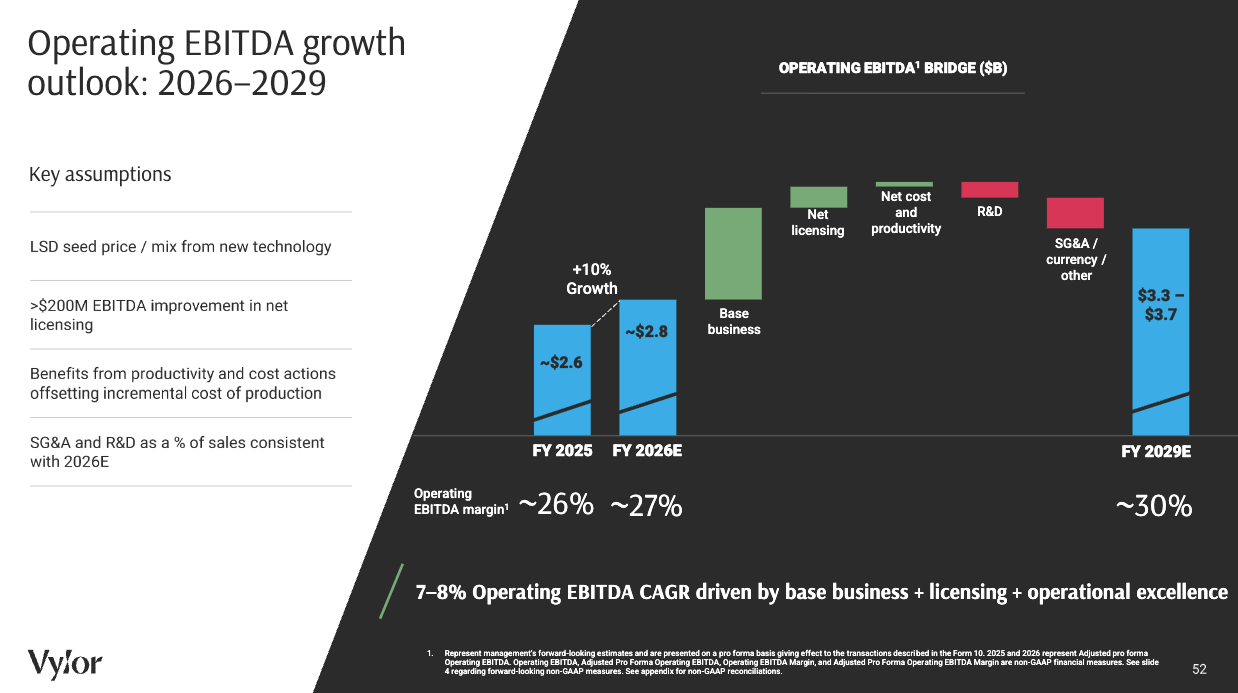
Most of this margin expansion comes from the company’s licensing situation. Vylor was historically paying licensing fees of $700m per year for in-licensed seed traits. That spend will flip to out-licensing to other independent seed companies into the 2030’s:
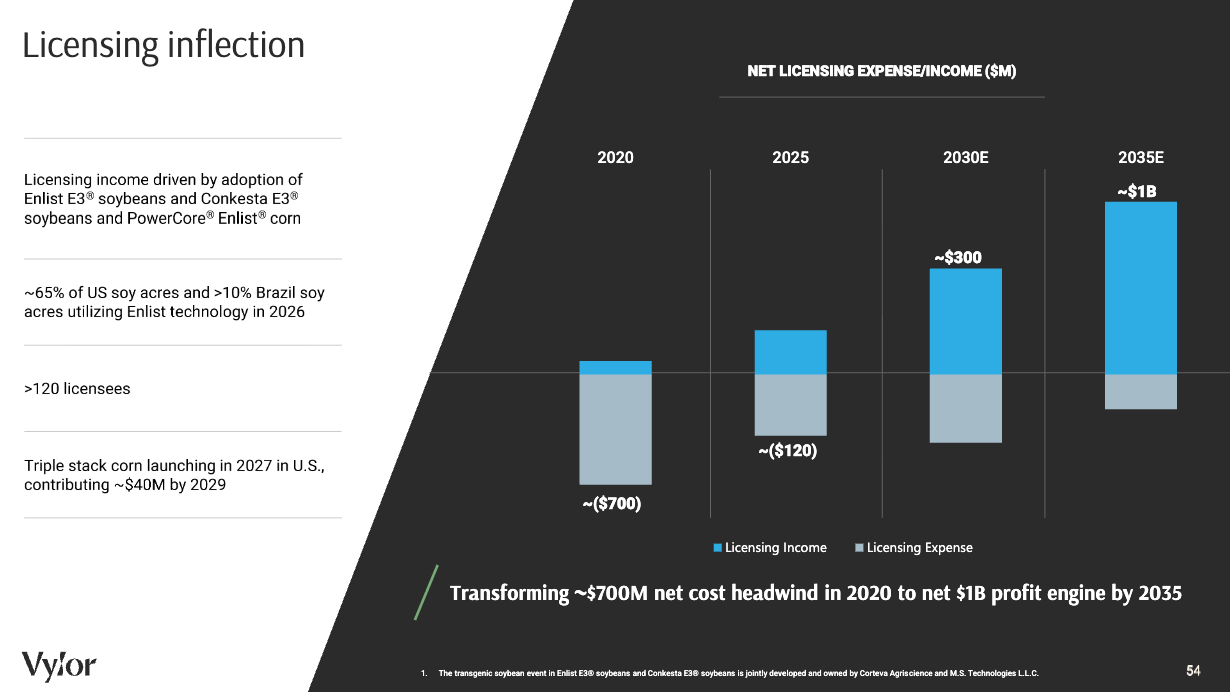
These are relatively small numbers ($1bn net licensing income vs. $11bn total revenue), but it’s very high-margin recurring revenue.
III. Valuation
Both Monsanto and Syngenta were acquired around 16x EBITDA in 2017-2018.
If you lump Vylor into the same bucket of “trophy asset” and call it 14-16x EBITDA at $2.8bn 2026 EBITDA = $39-45bn enterprise value. Because of their highly seasonal cash generation, Vylor likely finishes the year close to zero net debt. Call it $58-67 per share based on 2026 guidance.
Long-term, at $3.3-3.7bn EBITDA and a similar 14-16x multiple = $46-59bn EV. Assume no change in debt and they’ve repurchased $5bn worth of stock (I’ll use 600m shares instead of 668m) = $77-98 per share by 2029.
Summing it up…
If I add these pieces together, I get:
RemainCo value — $20-24 per share ($30 long-term)
SpinCo value — $58-67 per share ($77-98 long-term)
That works out to $78-91 per share vs. $80 today which isn’t compelling; though $107-128 by 2029 works out to a 10-17% IRR.
Where this potentially gets interesting is if SpinCo (GoodCo) comes out at a premium valuation leaving RemainCo at a cheap entry point.
Let’s say SpinCo trades at $63 per share and I get RemainCo for $17. Based on the $1.3bn EBITDA guide, that means I’m getting shares at 8.4x EBITDA which is fairly cheap for a specialty chemical business.
Shareholders will get 1 share of VYLR for every share of CTVA they own with when-issued trading starting on Sep 25, 2026 and regular way trading starting on Oct 1, 2026.
Let’s see how things play out…
Disclosure: no position in CTVA or VYLR
Resources: